


HLA-DQA1 expression is associated with prognosis and predictable with radiomics in breast cancer
- PMID: 37434241
- PMCID: PMC10337141
- DOI: 10.1186/s13014-023-02314-4
HLA-DQA1 expression is associated with prognosis and predictable with radiomics in breast cancer
Abstract
Background: High HLA-DQA1 expression is associated with a better prognosis in many cancers. However, the association between HLA-DQA1 expression and prognosis of breast cancer and the noninvasive assessment of HLA-DQA1 expression are still unclear. This study aimed to reveal the association and investigate the potential of radiomics to predict HLA-DQA1 expression in breast cancer.
Methods: In this retrospective study, transcriptome sequencing data, medical imaging data, clinical and follow-up data were downloaded from the TCIA ( https://www.cancerimagingarchive.net/ ) and TCGA ( https://portal.gdc.cancer.gov/ ) databases. The clinical characteristic differences between the high HLA-DQA1 expression group (HHD group) and the low HLA-DQA1 expression group were explored. Gene set enrichment analysis, Kaplan‒Meier survival analysis and Cox regression were performed. Then, 107 dynamic contrast-enhanced magnetic resonance imaging features were extracted, including size, shape and texture. Using recursive feature elimination and gradient boosting machine, a radiomics model was established to predict HLA-DQA1 expression. Receiver operating characteristic (ROC) curves, precision-recall curves, calibration curves, and decision curves were used for model evaluation.
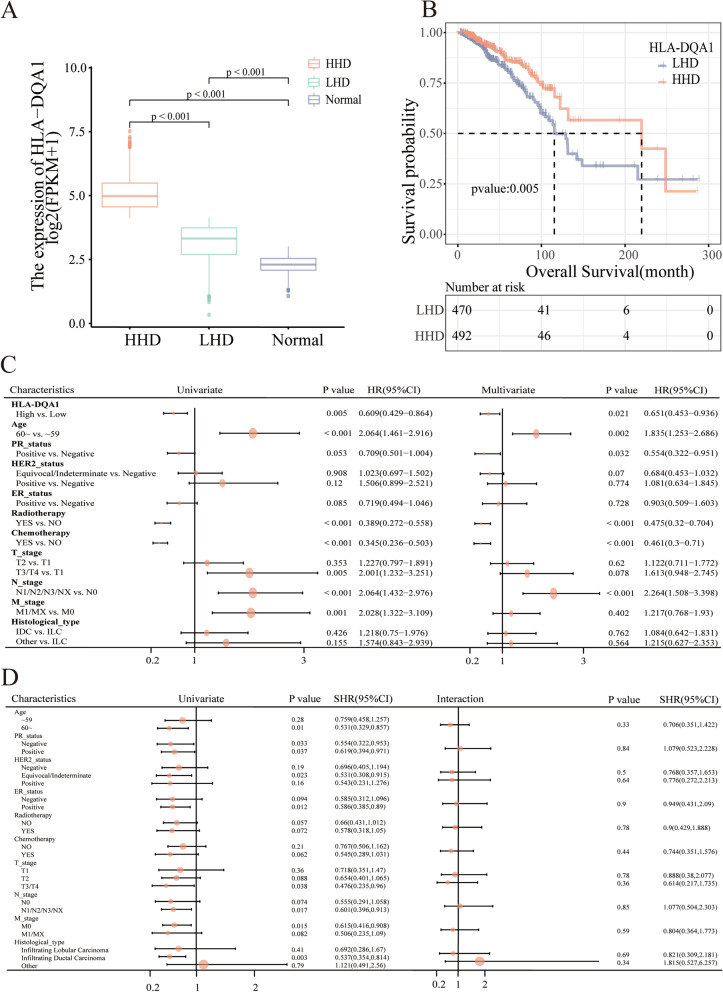
Results: The HHD group had better survival outcomes. The differentially expressed genes in the HHD group were significantly enriched in oxidative phosphorylation (OXPHOS) and estrogen response early and late signalling pathways. The radiomic score (RS) output from the model was associated with HLA-DQA1 expression. The area under the ROC curves (95% CI), accuracy, sensitivity, specificity, positive predictive value, and negative predictive value of the radiomic model were 0.866 (0.775-0.956), 0.825, 0.939, 0.7, 0.775, and 0.913 in the training set and 0.780 (0.629-0.931), 0.659, 0.81, 0.5, 0.63, and 0.714 in the validation set, respectively, showing a good prediction effect.
Conclusions: High HLA-DQA1 expression is associated with a better prognosis in breast cancer. Quantitative radiomics as a noninvasive imaging biomarker has potential value for predicting HLA-DQA1 expression.
Keywords: Biomarker; Breast cancer; Human leukocyte antigen; Prognosis; Radiomics.
© 2023. The Author(s).
Conflict of interest statement
Not applicable. Institutional Review Board approval was not required because the data analyzed in this retrospective study were obtained from The Cancer Genome Atlas (TCGA,
The authors declare that they have no competing interests.
Figures


References
-
- Jung SY, Papp JC, Sobel EM, Pellegrini M, Yu H, Zhang Z-F. Pro-inflammatory cytokine polymorphisms and interactions with dietary alcohol and estrogen, risk factors for invasive breast cancer using a post genome-wide analysis for gene-gene and gene-lifestyle interaction. Sci Rep. 2021;11(1):1058. doi: 10.1038/s41598-020-80197-1. - DOI - PMC - PubMed
MeSH terms
Substances
Grants and funding
LinkOut - more resources
Full Text Sources
Medical
Research Materials
