


The evolution in pituitary tumour classification: a clinical perspective
- PMID: 37434652
- PMCID: PMC10305559
- DOI: 10.1530/EO-22-0079
The evolution in pituitary tumour classification: a clinical perspective
Abstract
Objective: Pituitary tumours comprise a pathologically and clinically diverse group of neoplasms. Classification frameworks have changed dramatically in the past two decades, reflecting improving understanding of tumour biology. This narrative review examines the evolution of pituitary tumour classification, from a clinical perspective.
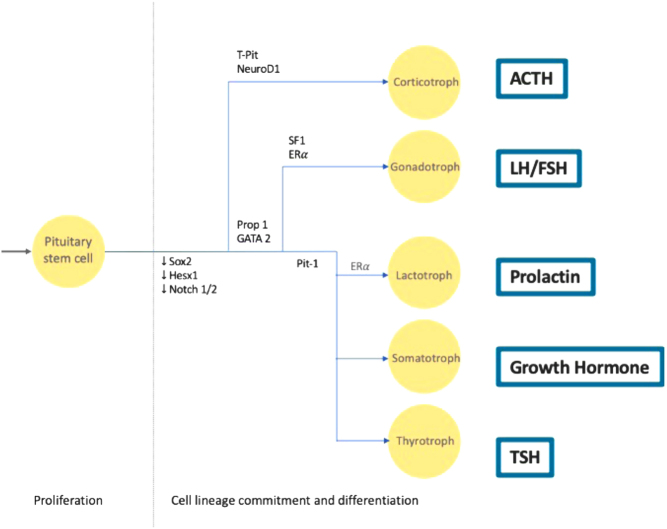
Results: In 2004, pituitary tumours were classified as 'typical' or 'atypical', based on the presence of markers of proliferation, Ki67, mitotic count and p53. In 2017, the new WHO marked a major paradigm shift, with a new focus on lineage-based classification, determined by transcription factor and hormonal immunohistochemistry. The terms 'typical' and 'atypical' were omitted, though the importance of proliferative markers Ki67 and mitotic count was acknowledged. The recent WHO 2022 classification incorporates further refinements, specifically recognising some less common types that may represent less well-differentiated tumours. Whilst 'high risk' tumour types have been identified, further work is still required to improve prognostication.
Conclusions: Recent WHO classifications have marked significant progress in the diagnostic evaluation of pituitary tumours, though shortcomings and challenges remain for both clinicians and pathologists in managing these tumours.
Keywords: immunohistochemistry; neuroendocrine tumours; pituitary; transcription factors.
© the author(s).
Conflict of interest statement
The authors declare that there is no conflict of interest that could be perceived as prejudicing the impartiality of this study.
Figures
References
-
- Almeida JP, Stephens CC, Eschbacher JM, Felicella MM, Yuen KCJ, White WL, Mooney MA, Bernat AL, Mete O, Zadeh G, et al.2019Clinical, pathologic, and imaging characteristics of pituitary null cell adenomas as defined according to the 2017 World Health Organization criteria: a case series from two pituitary centers. Pituitary 22514–519. (10.1007/s11102-019-00981-9) - DOI - PubMed
Publication types
LinkOut - more resources
Full Text Sources
Research Materials
Miscellaneous