. 2023 Jul;169(7):001351.
doi: 10.1099/mic.0.001351.

Sweet and sour synergy: exploring the antibacterial and antibiofilm activity of acetic acid and vinegar combined with medical-grade honeys

Affiliations

Sweet and sour synergy: exploring the antibacterial and antibiofilm activity of acetic acid and vinegar combined with medical-grade honeys

Freya Harrison et al. Microbiology (Reading). 2023 Jul.

Abstract

Oxymel, a combination of honey and vinegar, has been used as a remedy for wounds and infections in historical and traditional medical settings. While honey is now clinically used to treat infected wounds, this use of a complex, raw natural product (NP) mixture is unusual in modern western medicine. Research into the antimicrobial activity of NPs more usually focuses on finding a single active compound. The acetic acid in vinegar is known to have antibacterial activity at low concentrations and is in clinical use to treat burn wound infections. Here, we investigated the potential for synergistic activity of different compounds present in a complex ingredient used in historical medicine (vinegar) and in an ingredient mixture (oxymel). We conducted a systematic review to investigate published evidence for antimicrobial effects of vinegars against human pathogenic bacteria and fungi. No published studies have explicitly compared the activity of vinegar with that of a comparable concentration of acetic acid. We then characterized selected vinegars by HPLC and assessed the antibacterial and antibiofilm activity of the vinegars and acetic acid, alone and in combination with medical-grade honeys, against Pseudomonas aeruginosa and Staphylococcus aureus. We found that some vinegars have antibacterial activity that exceeds that predicted by their acetic acid content alone, but that this depends on the bacterial species being investigated and the growth conditions (media type, planktonic vs. biofilm). Pomegranate vinegars may be particularly interesting candidates for further study. We also conclude that there is potential for acetic acid, and some vinegars, to show synergistic antibiofilm activity with manuka honey.

Keywords: antimicrobials; biofilm; natural products; synergy.


Conflict of interest statement

The authors declare that there are no conflicts of interest.

Figures
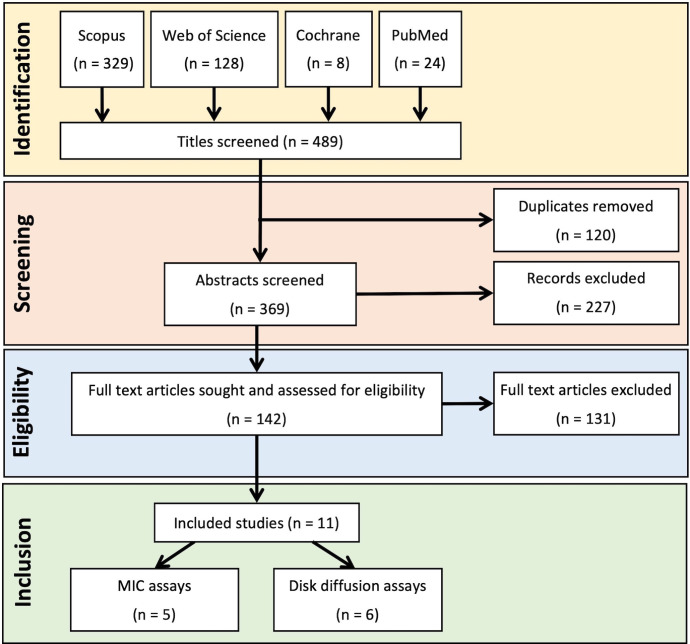
Fig. 1.
Fig. 1.
PRISMA diagram showing steps in the systematic review of research articles testing the antimicrobial activity of vinegar. See reference [65] for Preferred Reporting Items for Systematic reviews and Meta-Analyses (PRISMA) guidelines.
Fig. 2.
Fig. 2.
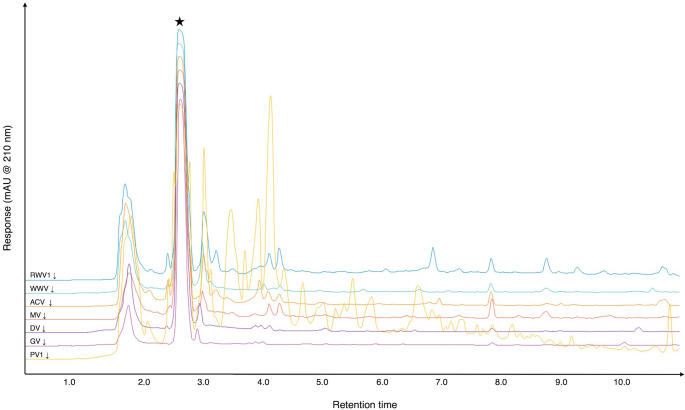
Reversed-phase HPLC chromatograms of diluted vinegar samples at 210 nm. Representative chromatograms from triplicate aliquots of selected vinegars; see Table 1 for further details of vinegars tested and Figs S1–S3 for individual chromatograms of aliquots read at 210, 260 and 280 nm. The peak corresponding to acetic acid is marked with a star (see Fig. S4). Retention times are in minutes.
Fig. 3.
Fig. 3.
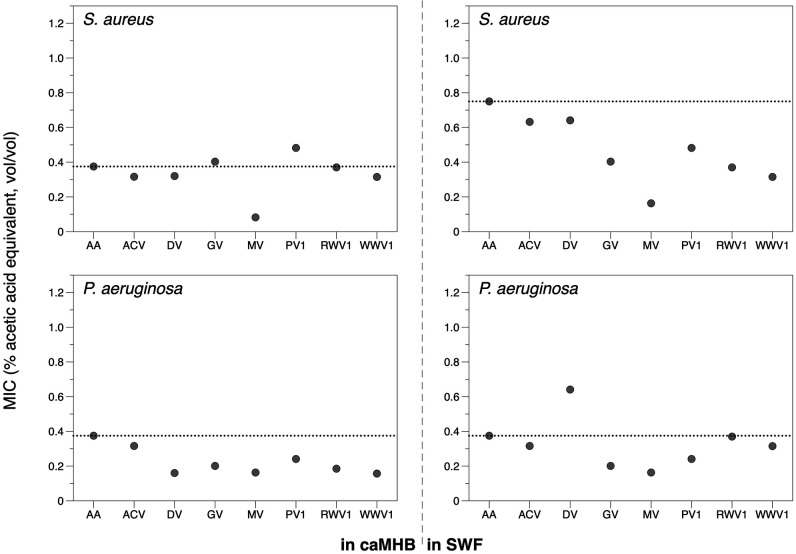
MICs of selected vinegars and acetic acid. MIC tests were conducted against P. aeruginosa PA14 and S. aureus Newman using a broth microdilution method according to EUCAST guidelines. The assay was repeated in cation-adjusted Muller–Hinton broth (caMHB, left) and synthetic wound fluid (SWF, right).
Fig. 4.
Fig. 4.
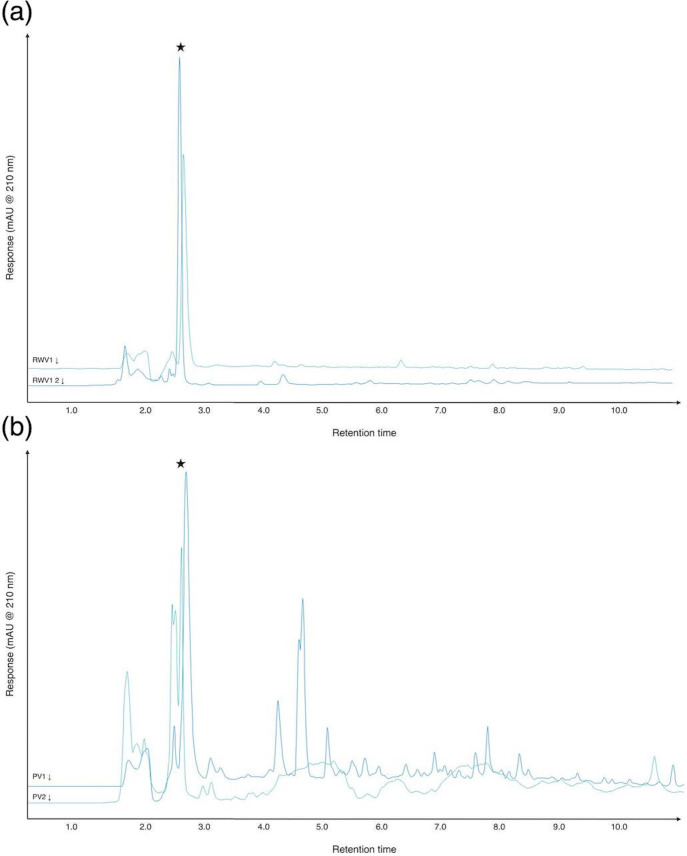
Chromatograms of example aliquots of different red wine and pomegranate vinegars. Representative chromatograms from triplicate aliquots of (a) RWV1 and RWV2, and (b) PV1 and PV2; diluted samples at 210 nm. See Figs S5–S7 for individual chromatograms of aliquots read at 210, 260 and 280 nm. Retention times are in minutes.
Fig. 5.
Fig. 5.
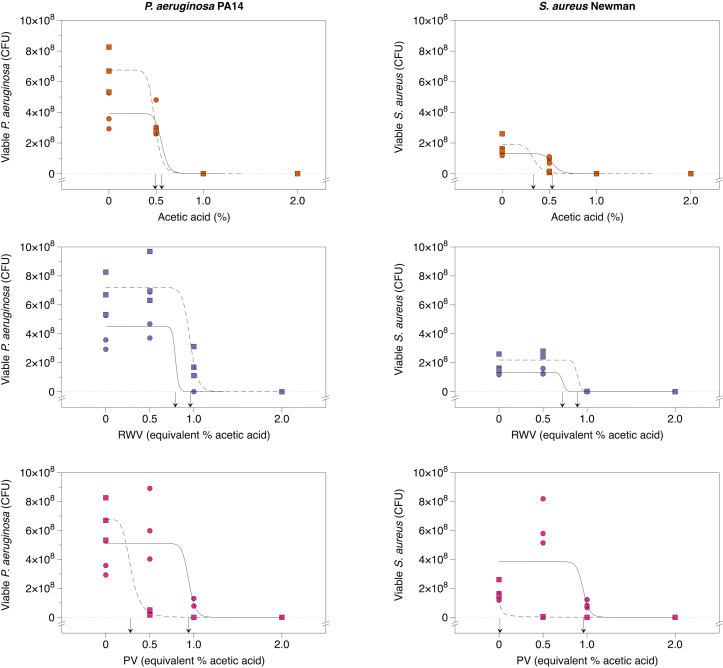
Dose–response of mature biofilms to acetic acid, red wine vinegars and pomegranate vinegars. Triplicate synthetic wounds containing mature biofilms of either P. aeruginosa PA14 or S. aureus Newman were topically treated with water, acetic acid at 0.5, 1 or 2 %, or RWV1, RWV2, PV1 or PV2 at concentrations containing 0.5, 1 or 2 % acetic acid. After 24 h of treatment, wounds were enzymatically digested to release bacteria, serially diluted and plated out to count colonies. Colony-forming units (c.f.u.) are used to estimate the number of viable bacterial cells in the biofilms. The R package drc [61] was used to fit dose–response curves for each treatment and the EC50 for each treatment is indicated by an arrow on the x-axis. The EC50 is the concentration predicted to cause a half-maximal kill. Circles and solid lines are used for RWV1 and PV1 data; squares and dashed lines are used for RWV2 and PV2 data. The acetic acid experiment was repeated and data for the two replica experiments are shown with circles+solid lines and squares+dashed lines. These data are provided on a log-transformed y-axis in Fig. S8; raw data and R code are provided in Document S1.
Fig. 6.
Fig. 6.
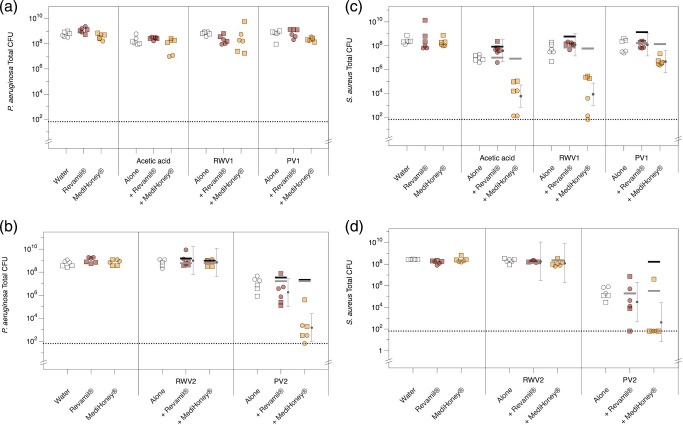
Effect of treating biofilms with acetic acid or vinegar, alone and in combination with medical-grade honey. Triplicate synthetic wounds containing mature biofilms of either P. aeruginosa PA14 or S. aureus Newman were topically treated with water, 0.5 % acetic acid or RWV1, RWV2, PV1 or PV2 at concentrations containing 0.5 % acetic acid, MediHoney 80 % gel at 30 % (w/v), Revamil 100 % gel at 30 % (w/v) or combinations of each acid treatment plus each honey treatment. The experiment was repeated with a further set of triplicate wounds from a fresh starter culture. Circles and squares denote the replica experiments. After 24 h of treatment, wounds were enzymatically digested to release bacteria, serially diluted and plated out to count colonies. Colony-forming units (c.f.u.) are used to estimate the number of viable bacterial cells in the biofilms. (a) ANOVA revealed no significant interaction between acid treatment and honey treatment (acid F 3,48=8.35, P<0.001; honey F 2,48=8.18, P<0.001; acid×honey F 6,48=1.46, P=0.213). (b) ANOVA revealed a significant interaction between acid treatment and honey treatment (acid F 2,35=180, P<0.001; honey F 2,35=21.3, P<0.001; acid×honey F 4,35=20.8, P<0.001). Planned contrasts using t-tests of each treatment versus the water-treated control showed that only PV2, PV2+Revamil and PV2+Medihoney caused any reduction in c.f.u. compared with the control (P<0.001). (c) ANOVA revealed a significant interaction between acid treatment and honey treatment (acid F 3,48=83.5, P<0.001; honey F 2,48=179, P<0.001; acid×honey F 6,48=28.2, P<0.001). Planned contrasts using t-tests of each treatment versus the water-treated control showed that acetic acid, acetic acid+either honey, PV+MediHoney, RWV and RWV+MediHoney caused reductions in c.f.u. compared with the control (P≤0.003). (d) ANOVA revealed a significant interaction between acid treatment and honey treatment (acid F 2,36=121, P<0.001; honey F 2,36=5.22, P=0.010; acid×honey F 4,36=4.18, P=0.007). Planned contrasts using t-tests of each treatment versus the water-treated control showed that only PV2, PV2+Revamil and PV2+MediHoney caused reductions in c.f.u. compared with the control (P<0.001). For the data shown in (b)–(d), the predicted c.f.u. in combination treatments under the assumption of no additive effects of acetic acid/vinegar and honey were calculated as described in the main text and plotted as horizontal bars. The fitted means and associated 95 % confidence intervals for the observed c.f.u. in combination treatments were calculated using the R package lsmeans and added to the plots as small black circles and associated error bars. The predicted mean c.f.u. for combination treatments under Response Additivity and Bliss Independence are shown as thick horizontal black and grey bars, respectively. Where the 95 % confidence intervals around observed means do not overlap with these predicted values, the observed c.f.u. is significantly different from that predicted under the respective null model. Raw data and associated R code are provided in Document S1; data were log-transformed prior to analysis to meet the assumptions of ANOVA and the R package car [62] was used to conduct the ANOVA on the data in (b) because a missing value led to non-orthogonality.

References

    1. Kuropatnicki AK, Kłósek M, Kucharzewski M. Honey as medicine: historical perspectives. J Apic Res. 2018;57:113–118. doi: 10.1080/00218839.2017.1411182. - DOI
    1. Eteraf-Oskouei T, Najafi M. Traditional and modern uses of natural honey in human diseases: a review. Iran J Basic Med Sci. 2013;16:731–742. - PMC - PubMed
    1. Mazza S, Murooka Y. In: Vinegars of the World. Solieri L, Giudici P, editors. Milano: Springer Milan; 2009. Vinegars through the ages; pp. 17–39. - DOI
    1. Krug I. In: Wounds and Wound Repair in Medieval Culture. Krug I, Tracy L, DeVries K, editors. Brill; 2015. The wounded soldier: honey and late medieval military medicine; pp. 194–214. - DOI
    1. Zargaran A, Zarshenas MM, Mehdizadeh A, Mohagheghzadeh A. Oxymel in medieval Persia. Pharm Hist. 2012;42:11–13. - PubMed

Publication types

LinkOut - more resources