


Glyoxal in hyperglycaemic ischemic stroke - a cohort study
- PMID: 37438755
- PMCID: PMC10339542
- DOI: 10.1186/s12933-023-01892-7
Glyoxal in hyperglycaemic ischemic stroke - a cohort study
Abstract
Background: Hyperglycaemia is frequent in acute ischemic stroke and denotes a bad prognosis, even in the absence of pre-existing diabetes. However, in clinical trials treatment of elevated glucose levels with insulin did not improve stroke outcome, suggesting that collateral effects rather than hyperglycaemia itself aggravate ischemic brain damage. As reactive glucose metabolites, glyoxal and methylglyoxal are candidates for mediating the deleterious effects of hyperglycaemia in acute stroke.
Methods: In 135 patients with acute stroke, we used liquid chromatography coupled to tandem mass spectrometry (LC-MS/MS) to measure glyoxal, methylglyoxal and several of their glycated amino acid derivatives in serum. Results were verified in a second cohort of 61 stroke patients. The association of serum concentrations with standard stroke outcome scales (NIHSS, mRS) was tested.
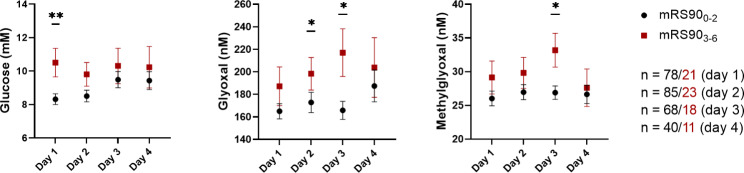
Results: Glucose, glyoxal, methylglyoxal, and the glyoxal-derived glycated amino acid Nδ-(5-hydro-4-imidazolon-2-yl)ornithine (G-H1) were positively correlated with a bad stroke outcome at 3 months as measured by mRS90, at least in one of the two cohorts. However, the glycated amino acids Nε-carboxyethyllysine (CEL) and in one cohort pyrraline showed an inverse correlation with stroke outcome probably reflecting lower food intake in severe stroke. Patients with a poor outcome had higher serum concentrations of glyoxal and methylglyoxal.
Conclusions: The glucose-derived α-dicarbonyl glyoxal and glycated amino acids arising from a reaction with glyoxal are associated with a poor outcome in ischemic stroke. Thus, lowering α-dicarbonyls or counteracting their action could be a therapeutic strategy for hyperglycaemic stroke.
Keywords: Advanced glycation end-products; Glucose; Ischemic brain damage; Undernutrition.
© 2023. The Author(s).
Conflict of interest statement
The authors declare the following conflict of interest: GR received speaker’s honoraria and reimbursement for congress traveling and accommodation from Boehringer-Ingelheim, Bristol-Myers Squibb, Daiichi Sankyo and AstraZeneca. MS received speaker’s honoraria from AstraZeneca.
Figures


References
-
- Rinkel LA, Nguyen TTM, Guglielmi V, Groot AE, Posthuma L, Roos YBWEM, Majoie CBLM, Lycklama À, Nijeholt GJ, Emmer BJ, Van Der Worp HB, et al. High admission glucose is Associated with Poor Outcome after Endovascular Treatment for ischemic stroke. Stroke. 2020;51(11):3215–23. doi: 10.1161/STROKEAHA.120.029944. - DOI - PubMed
-
- Perez-Vega C, Domingo RA, Tripathi S, Ramos-Fresnedo A, Kashyap S, Quinones-Hinojosa A, Lin MP, Fox WC, Tawk RG. Influence of glucose levels on clinical outcome after mechanical thrombectomy for large-vessel occlusion: a systematic review and meta-analysis. J neurointerventional Surg 2022, 14(1). - PubMed
Publication types
MeSH terms
Substances
LinkOut - more resources
Full Text Sources
Medical
Research Materials
