


Systematic review of the values and preferences regarding the use of injectable pre-exposure prophylaxis to prevent HIV acquisition
- PMID: 37439057
- PMCID: PMC10805120
- DOI: 10.1002/jia2.26107
Systematic review of the values and preferences regarding the use of injectable pre-exposure prophylaxis to prevent HIV acquisition
Abstract
Introduction: Pre-exposure prophylaxis (PrEP) is an important HIV prevention option. Two randomized trials have provided efficacy evidence for long-acting injectable cabotegravir (CAB-LA) as PrEP. In considering CAB-LA as an additional PrEP modality for people at substantial risk of HIV, it is important to understand community response to injectable PrEP. We conducted a systematic review of values, preferences and perceptions of acceptability for injectable PrEP to inform global guidance.
Methods: We searched nine databases and conference websites for peer-reviewed and grey literature (January 2010-September 2021). There were no restrictions on location. A two-stage review process assessed references against eligibility criteria. Data from included studies were organized by constructs from the Theoretical Framework of Acceptability.
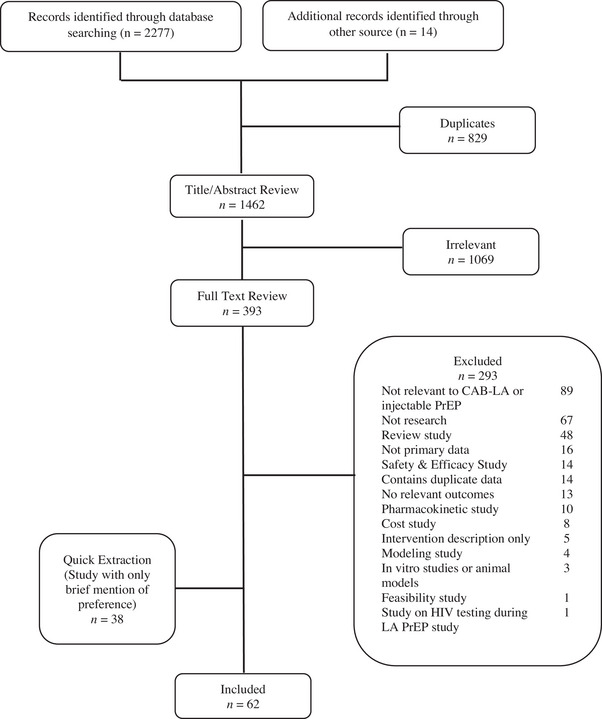
Results: We included 62 unique references. Most studies were observational, cross-sectional and qualitative. Over half of the studies were conducted in North America. Men who have sex with men were the most researched group. Most studies (57/62) examined injectable PrEP, including hypothetical injectables (55/57) or placebo products (2/57). Six studies examined CAB-LA specifically. There was overall interest in and often a preference for injectable PrEP, though there was variation within and across groups and regions. Many stakeholders indicated that injectable PrEP could help address adherence challenges associated with daily or on-demand dosing for oral PrEP and may be a better lifestyle fit for individuals seeking privacy, discretion and infrequent dosing. End-users reported concerns, including fear of needles, injection site pain and body location, logistical challenges and waning or incomplete protection.
Discussion: Despite an overall preference for injectable PrEP, heterogeneity across groups and regions highlights the importance of enabling end-users to choose a PrEP modality that supports effective use. Like other products, preference for injectable PrEP may change over time and end-users may switch between prevention options. There will be a greater understanding of enacted preference as more end-users are offered anti-retroviral (ARV)-containing injectables. Future research should focus on equitable implementation, including real-time decision-making and how trained healthcare providers can support choice.
Conclusions: Given overall acceptability, injectable PrEP should be included as part of a menu of prevention options, allowing end-users to select the modality that suits their preferences, needs and lifestyle.
Keywords: PrEP; acceptability; injectable PrEP; long-acting injectable cabotegravir; pre-exposure prophylaxis; values and preferences.
© 2023 World Health Organization; licensed by International AIDS Society. Journal of the International AIDS Society published by John Wiley & Sons Ltd on behalf of International AIDS Society.
Conflict of interest statement
The authors declare no competing interests.
References
-
- World Health Organization . HIV data and statistics. World Health Organization; 2020.
-
- World Health Organization . Guideline on when to start antiretroviral therapy and on pre‐exposure prophylaxis for HIV. Switzerland: World Health Organization; 2015. - PubMed
-
- HIV/AIDS JUNPo . Danger: UNAIDS Global AIDS Update 2022. 2022.
-
- Castel AD, Magnus M, Greenberg AE. Pre‐exposure prophylaxis for human immunodeficiency virus: the past, present, and future. Infect Dis Clin North Am. 2014;28(4):563–83. - PubMed
Publication types
MeSH terms
Grants and funding
LinkOut - more resources
Full Text Sources
Medical
Miscellaneous
