Central executive training for ADHD: Impact on organizational skills at home and school. A randomized controlled trial
- PMID: 37439737
- PMCID: PMC10615842
- DOI: 10.1037/neu0000918
Central executive training for ADHD: Impact on organizational skills at home and school. A randomized controlled trial
Abstract
Objective: The current randomized controlled trial (RCT) was the first to examine the benefits of central executive training (CET, which trains the working components of working memory [WM]) for reducing organizational skills difficulties relative to a carefully matched neurocognitive training intervention (inhibitory control training [ICT]).
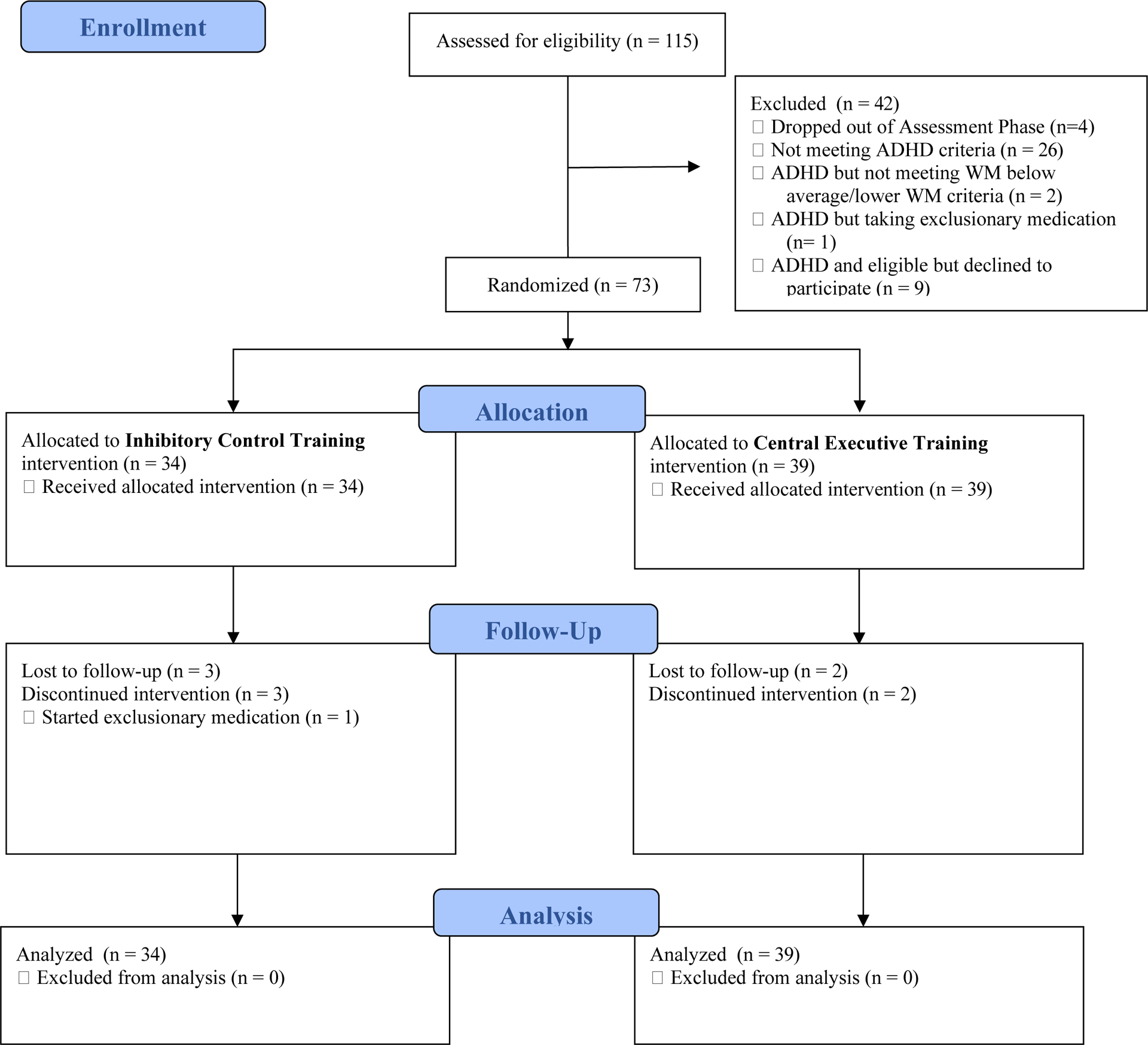
Method: A carefully phenotyped sample of 73 children with attention-deficit/hyperactivity-impulsivity disorder (ADHD; ages 8-13, M = 10.15, SD = 1.43; 20 girls; 73% White/Non-Hispanic) participated in a preregistered RCT of CET versus ICT (both 10-week treatments). Parent-rated task planning, organized actions, and memory/materials management data were collected at pretreatment, posttreatment, and 2-4 month follow-up; teacher ratings were obtained at pretreatment and 1-2 month follow-up.
Results: CET was superior to ICT for improving organizational skills based on teacher report (Treatment × Time interaction: d = 0.61, p = .01, BF₁₀ = 31.61). The CET group also improved significantly based on parent report, but this improvement was equivalent in both groups (main effect of time: d = 0.48, p < .001, BF₁₀ = 3.13 × 10⁷; Treatment × Time interaction: d = 0.29, p = .25, BF₀₁ = 3.73). Post hocs/preregistered planned contrasts indicated that CET produced significant and clinically meaningful (number needed to treat = 3-8) pre/post gains on all three parent (d = 0.50 -0.62) and all three teacher (d = 0.46 -0.95) subscales, with gains that were maintained at 1-2 month (teacher report) and 2-4 month follow-up (parent report) for five of six outcomes.
Conclusions: Results provide strong initial evidence that CET produces robust and lasting downstream improvements in school-based organizational skills for children with ADHD based on teacher report. These findings are generally consistent with model-driven predictions that ADHD-related organizational problems are secondary outcomes caused, at least in part, by underdeveloped working memory abilities. (PsycInfo Database Record (c) 2023 APA, all rights reserved).
Conflict of interest statement
Conflict of Interest:
The principal investigator Michael Kofler/Florida State University (FSU) was awarded U.S. Patent 11,210,967 for the neurocognitive interventions described in the present study. Central Executive Training was recently licensed to Sky Therapeutics, where Michael Kofler is in negotiations to serve as consultant. There are no other financial or other conflicts to report.
Figures
References
-
- Abikoff H, Gallagher R Children’s organizational skills scale. NY: Multi-Health; 2009.
-
- Achenbach TM (1991). Manual for the Teacher’s Report Form and 1991 profile. U. Vermont.
-
- Alderson RM, Rapport MD, & Kofler MJ (2007). Attention-deficit/hyperactivity disorder and behavioral inhibition: a meta-analytic review of the stop-signal paradigm. Journal of abnormal child psychology, 35(5), 745–758. - PubMed
-
- American Psychiatric Association. (2013). Diagnostic and Statistical Manual of Mental Disorders (DSM-5®). American Psychiatric Pub.
Publication types
MeSH terms
Grants and funding
LinkOut - more resources
Full Text Sources
Medical