


Change in the faunal composition of mosquitoes (Diptera: Culicidae) along a heterogeneous landscape gradient in the Brazilian Amazon
- PMID: 37440515
- PMCID: PMC10343073
- DOI: 10.1371/journal.pone.0288646
Change in the faunal composition of mosquitoes (Diptera: Culicidae) along a heterogeneous landscape gradient in the Brazilian Amazon
Abstract
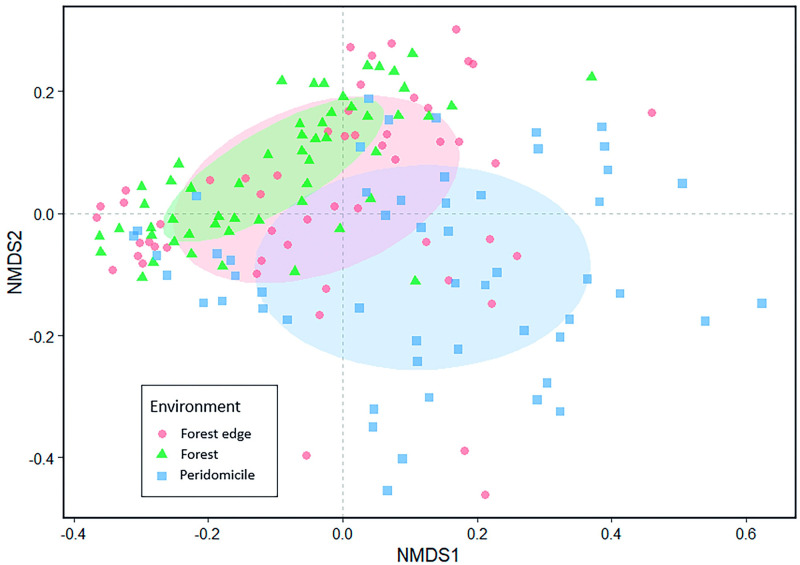
This study aimed to evaluate the influence of different anthropic landscape profiles on the diversity and distribution of mosquito species in a rural settlement of the Brazilian Amazon. Eight field collections were conducted at 18 sampling points interspersed throughout 2020-2021. Plastic containers, bamboo internodes, and tires were used as traps to capture immature mosquitoes in three distinct habitats: forest, forest edge, and peridomicile. A total of 15,547 individuals, distributed in 26 species of culicids, were collected. The most abundant species were Culex urichii (8,376 specimens), Culex (Melanoconion) (2,473 specimens), and Aedes albopictus (1,252 specimens). Forest habitat showed the highest abundance, and forest edge showed the highest species richness. Different types of environments influenced both the abundance and richness of mosquitoes. The species composition was also significantly different between the analyzed sites, mainly between forest and peridomicile environments. The change in species dominance could largely explain this change in mosquito community composition. Haemagogus janthinomys, an important sylvatic arbovirus vector, was found in peridomicile habitats and Ae. albopictus, a vector associated with human environments, was found in forest habitats, thus providing evidence of species spillover. Our results indicated that landscape changes affect mosquito communities, influencing their richness and abundance. These changes may have implications for future arboviral outbreaks in this rural settlement due to the possible establishment of sylvatic vector species in anthropic environments.
Copyright: © 2023 Almeida et al. This is an open access article distributed under the terms of the Creative Commons Attribution License, which permits unrestricted use, distribution, and reproduction in any medium, provided the original author and source are credited.
Conflict of interest statement
The authors have declared that no competing interests exist.
Figures


References
-
- Arcos AN, da S Ferreira FA, da Cunha HB, Tadei WP. Characterization of artificial larval habitats of Anopheles darlingi (Diptera: Culicidae) in the Brazilian Central Amazon. Revista Brasileira de Entomologia. 2018;62: 267–274. doi: 10.1016/j.rbe.2018.07.006 - DOI
-
- Duque PL, Liria J, Enríquez S, Burgaleta E, Salazar J, Arrivillaga-Henríquez J, et al.. High mosquito diversity in an Amazonian village of Ecuador, surrounded by a Biological Reserve, using a rapid assessment method. Journal of Entomological and Acarological Research. 2019;51. doi: 10.4081/jear.2019.7775 - DOI
-
- Harbach R. Culicidae Classification | Mosquito Taxonomic Inventory. 2022 [cited 3 Sep 2022]. https://mosquito-taxonomic-inventory.myspecies.info/simpletaxonomy/term/...
MeSH terms
LinkOut - more resources
Full Text Sources
Medical
