


Pre and postharvest characteristics of Dahlia pinnata var. pinnata, cav. As affected by SiO2 and CaCO3 nanoparticles under two different planting dates
- PMID: 37441372
- PMCID: PMC10333474
- DOI: 10.1016/j.heliyon.2023.e17292
Pre and postharvest characteristics of Dahlia pinnata var. pinnata, cav. As affected by SiO2 and CaCO3 nanoparticles under two different planting dates
Abstract
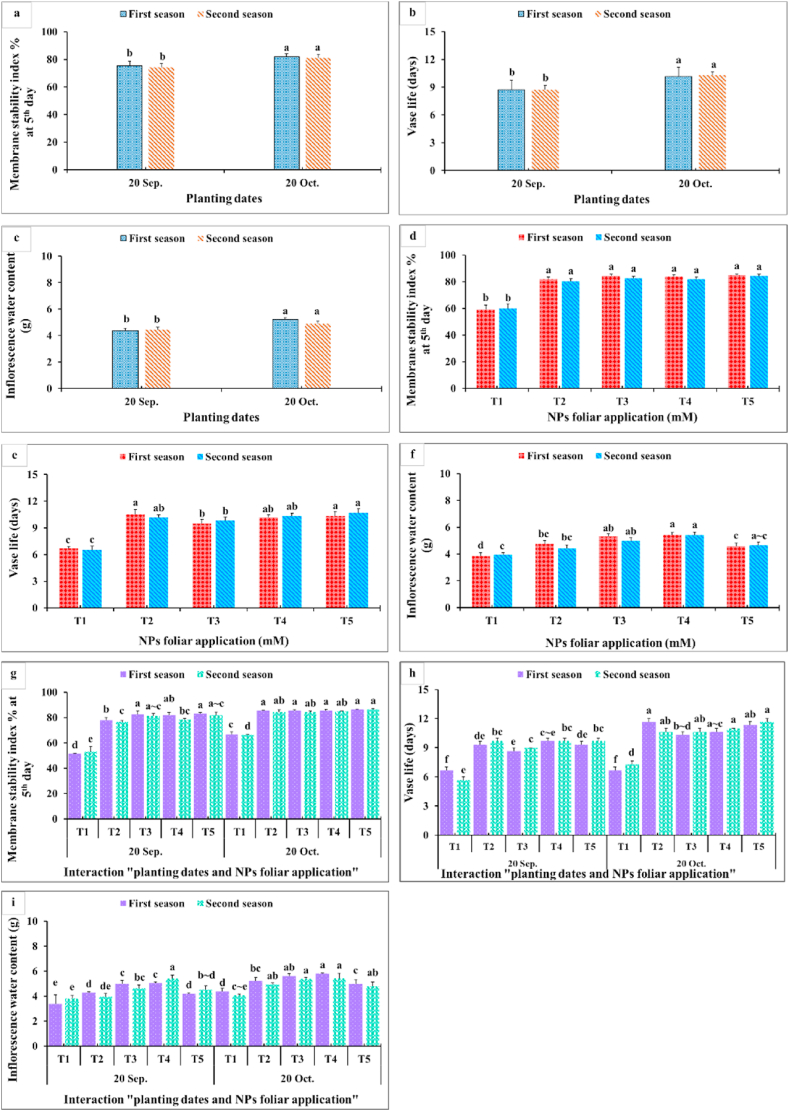
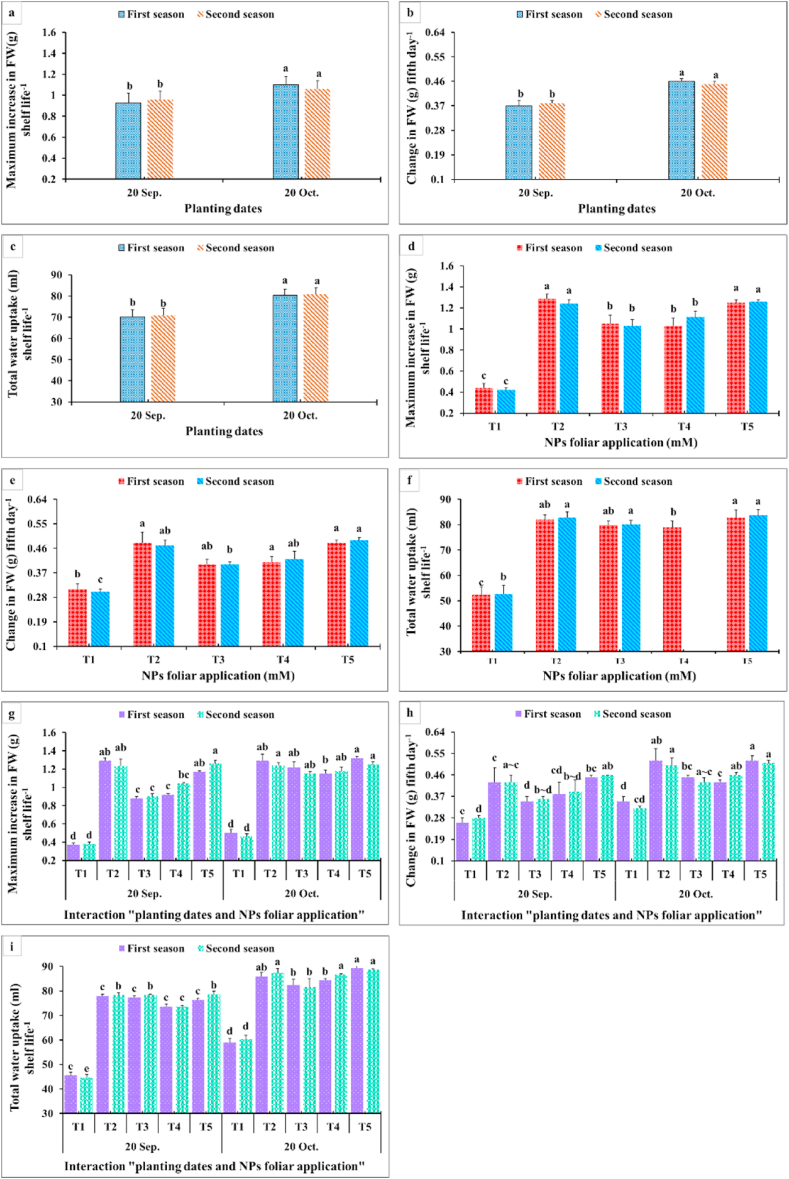
Agriculture faces many challenges because of climate changes. The nutrients present in nano-sized form improve plant productivity, especially when used at the appropriate planting time. Field experiments were conducted as a factorial experiment for evaluating two planting dates (20th September and 20th October), foliar application with nanoparticles (NPs) including silica nanoparticles (SiO2-NPs) at 1.5 and 3 mM, calcium carbonate nanoparticles (CaCO3-NPs) at 5 and 10 mM and distilled water (control) on pre- and post-harvest characteristics of Dahlia pinnata var. pinnata Cav. The results indicate that the interactions during the late planting time (20th October) and exogenous applications of SiO2-NPs at 1.5 mM or CaCO3-NPs at 10 mM have improved plant growth including plant height, stem diameter, fresh and dry weights of plant, leaf area, inflorescence diameter, inflorescence stalk length, branches number, tuber numbers, inflorescences number on the plant, and the vase life. At the same time, insignificant differences appeared in the interaction during the planting dates and SiO2 or CaCO3 -NPs concentrations on inflorescence stalk diameter, total soluble solids, membrane stability index, maximum increase in fresh weight (FW), and Si and Ca contents. In addition, all exogenous applications of NPs at the late planting time promoted the plant growth characteristics like lignin %, cellulose %, inflorescence water content, change in FW, and total water uptake. Moreover, the controls through the two planting dates recorded the maximum change in water uptake and water loss values. In short, it can be recommended to use SiO2-NPs at 1.5 mM or CaCO3-NPs at 10 mM as a foliar application at the late planting time (20th October) for obtaining the optimum quantitative and qualitative parameters of D. pinnata.
© 2023 The Authors.
Conflict of interest statement
The authors declare that they have no known competing financial interests or personal relationships that could have appeared to influence the work reported in this paper.
Figures



References
-
- Kamenetsky R., Okubo H. CRC Press; Boca Raton, FL, USA: 2012. Ornamental Geophytes: from Basic Science to Sustainable Production. 978-1-4398-4924-8.
-
- Ohno S., Hosokawa M., Hoshino A., Kitamura Y., Morita Y., Park K.I., Nakashima A., Deguchi A., Tatsuzawa F., Doi M., et al. A BHLH transcription factor, DvIVS, is involved in regulation of anthocyanin synthesis in dahlia (Dahlia variabilis) J. Exp. Bot. 2011;62:5105–5116. doi: 10.1093/jxb/err216. - DOI - PMC - PubMed
-
- Santana Legorreta S., Villanueva-Carvajal A., Morales-Rosales E.J., Laguna-Cerda A., Domínguez-López A. Extracción y evaluación de Inulina a partir de Dalias silvestres mexicanas. Dahlia coccinea Cav. 2016;52:63–70.
-
- Elsadek A. Improvement yield and quality of dahlia flowers by exogenous application of gibberellic acid and salicylic acid under sandy soil conditions. J. Plant Prod. 2018;9:289–297. doi: 10.21608/jpp.2018.35498. - DOI
-
- Khan F.U., Jhon A.Q., Khan F.A., Mir M.M. Effect of planting time on flowering and bulb production of tulip under polyhouse conditions in kashmir. Indian J. Hortic. 2008;65:79–82.
LinkOut - more resources
Full Text Sources
Research Materials
