


doi: 10.1016/j.ekir.2023.04.002.
eCollection 2023 Jul.
Randall-Type Monoclonal IgE Kappa Light-Heavy Chain Deposition Disease
Affiliations
- PMID: 37441467
- PMCID: PMC10334351
- DOI: 10.1016/j.ekir.2023.04.002
Item in Clipboard
Randall-Type Monoclonal IgE Kappa Light-Heavy Chain Deposition Disease
Kidney Int Rep.
.
No abstract available
Keywords: IgE; LHCDD; MIDD.
Figures
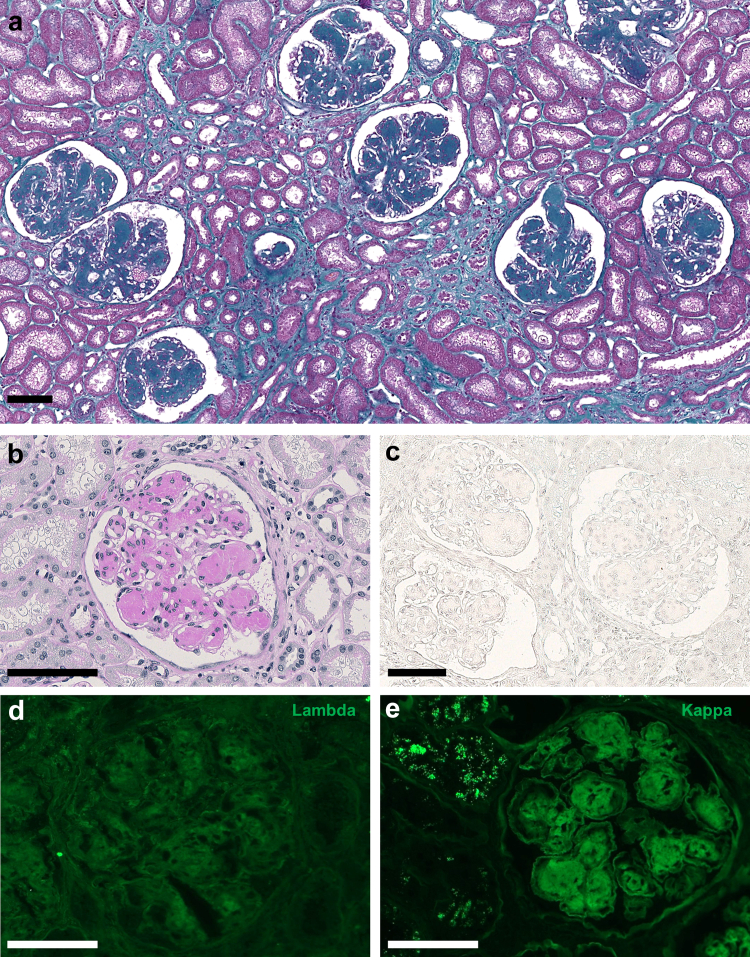
(a) Kidney biopsy with Masson Trichrome staining showing global and diffuse nodular mesangial deposits. (b) Kidney biopsy with Periodic Acid Schiff (PAS) staining, showing PAS-positive nodular mesangial deposits and glomerular basement membrane thickening (c) Kidney biopsy with Congo red staining showing Congo red-negative mesangial deposits. (d) and (e) Immunofluorescence analyses of the kidney biopsy using anti-kappa and anti-lambda antibodies showing mild monotypic kappa light chain staining on glomerular deposits. Scale bars 100 μm.
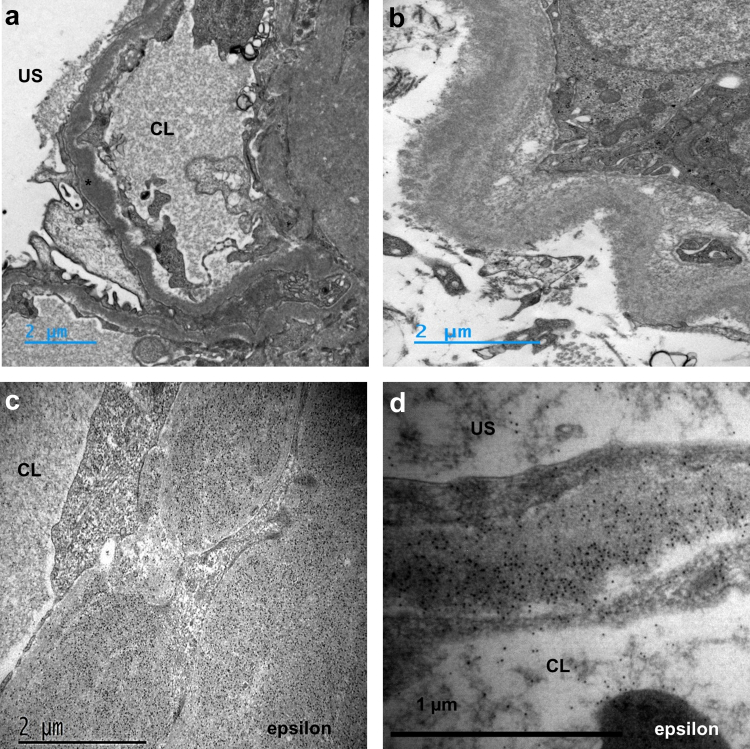
(a) and (b) Electron microscopy analysis of the kidney biopsy showing homogeneous microgranular osmiophilic deposits (∗) located in the mesangium, the glomerular basement membranes (a) and in the tubular basement membranes (b). (c) and (d) Immunogold studies with anti-epsilon antibody showing a significant concentration of gold beads on glomerular deposits in (c) mesangium and (d) in glomerular basement membranes. CL: capillary lumen US: urinary space.
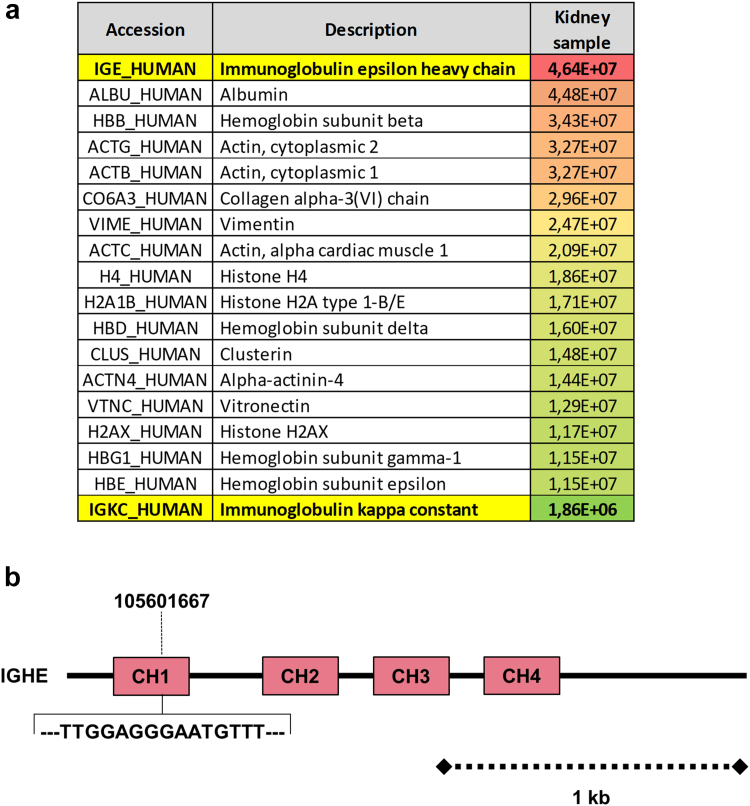
(a) Mass spectrometry analysis results showing Ig epsilon heavy chain as the dominant component of glomerular deposits associated with kappa light chain. (b) Schematic representations of the patient’s immunoglobulin heavy constant epsilon gene structure with 5 codons deletion (15 base pairs) in the exon 1 (chr14, 105601667, CH1).
References
LinkOut - more resources
Full Text Sources
