


IFABP levels predict visceral malperfusion in the first hours after open thoracoabdominal aortic repair
- PMID: 37441698
- PMCID: PMC10333487
- DOI: 10.3389/fcvm.2023.1200967
IFABP levels predict visceral malperfusion in the first hours after open thoracoabdominal aortic repair
Abstract
Introduction: Intestinal ischemia after open thoracoabdominal aortic repairs, is a rare but devastating complication, associated with high mortality. Notoriously challenging to diagnose, visceral malperfusion necessitates immediate surgical attention. Intestinal fatty acid-binding protein (IFABP) has been proposed as a biomarker for the diagnosis of intestinal wall damage. In this prospectively conducted, observational study we evaluated the diagnostic capacity of IFABP levels in patients' serum and their correlation with visceral malperfusion.
Methods: 23 patients undergoing open thoracoabdominal aortic repairs were included in this study and 8 of them were diagnosed postoperatively with visceral malperfusion-defined as a partial or complete thrombotic occlusion of the superior mesenteric artery and/or the coeliac trunk. IFABP levels and laboratory parameters often associated with intestinal ischemia (leucocytes, CRP, PCT and lactate) were measured at baseline, directly postoperatively, and at 12, 24 and 48 h after surgery. Postoperative visceral malperfusion-as revealed in CT angiography-was assessed and the predictive ability of IFABP levels to detect visceral malperfusion was evaluated with receiver-operator curve analysis.
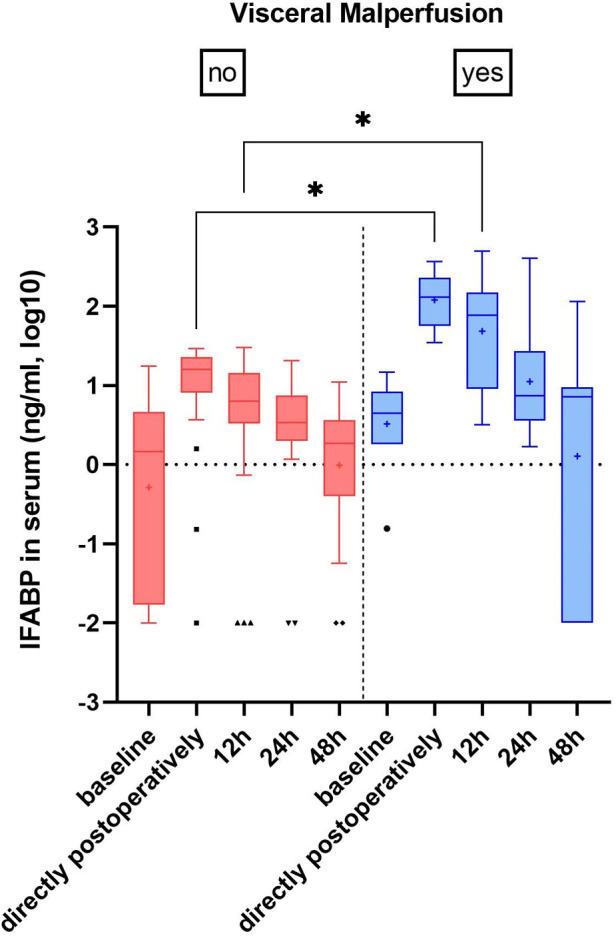
Results: Patients with visceral malperfusion had a relevant risk for a fatal outcome (p = .001). IFABP levels were significantly elevated directly postoperatively and at 12 h after surgery in cases of visceral malperfusion. High IFABP concentrations in serum detected visceral malperfusion accurately during the first 12 h after surgery, with the maximum diagnostic ability achieved immediately after surgery (AUC 1, Sensitivity 100%, Specificity 100%, p < .001).
Conclusion: We conclude, that IFABP measurements during the first postoperative hours after open thoracoabdominal aortic surgery can be a valuable tool for reliable and timely detection of visceral malperfusion.
Keywords: aortic aneurysm; intestinal ischemia; open aortic repair; postoperative management; thoracoabdominal aorta; visceral malperfusion.
© 2023 Doukas, Bassett, Krabbe, Frankort, Jacobs, Elfeky and Gombert.
Conflict of interest statement
The authors declare that the research was conducted in the absence of any commercial or financial relationships that could be construed as a potential conflict of interest.
References
-
- Vermeulen Windsant IC, Hellenthal FA, Derikx JP, Prins MH, Buurman WA, Jacobs MJ, et al. Circulating intestinal fatty acid-binding protein as an early marker of intestinal necrosis after aortic surgery: a prospective observational cohort study. Ann Surg. (2012) 255(4):796–803. 10.1097/SLA.0b013e31824b1e16 - DOI - PubMed
LinkOut - more resources
Full Text Sources
Research Materials
Miscellaneous
