


Pulmonary function and exercise capacity six months after hospital discharge of patients with severe COVID-19
- PMID: 37442195
- PMCID: PMC10403708
- DOI: 10.1016/j.bjid.2023.102789
Pulmonary function and exercise capacity six months after hospital discharge of patients with severe COVID-19
Abstract
Introduction: The long-term consequences of COVID-19, especially pulmonary impairment, are frequent but not well understood. The knowledge about sequels or long COVID-19 are necessary, considering the high prevalence and need for specific public strategies.
Method: The study was conducted to evaluate symptoms (standardized questionnaire), pulmonary function (spirometry), and exercise capacity (6-minute-walk-test) at 30 (D30), 90 (D90), and 180 (D180) days after hospital discharge of patients surviving to severe COVID-19. We excluded in this follow up patients with comorbidities before COVID infection.
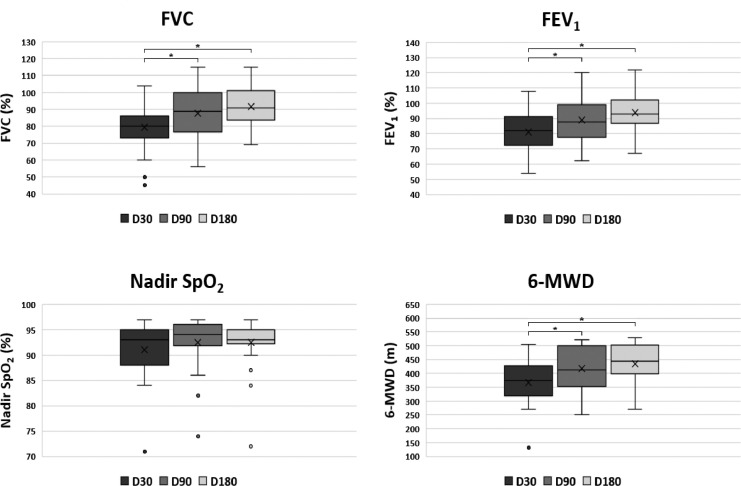
Results: 44 patients were included and 31 (26 men) completed the 6-month follow-up (age mean 53.6 ± 9.6 years). At D180, 28% presented still at least one symptom. The most common was dyspnea (17.2%), followed by cough (13.8%), and myalgia (10.3%). All spirometric parameters showed progressive improvement from D30 to D180. However, 16% maintained a restrictive pattern on spirometry test, 44% presented desaturation on the 6-minute walk-test, and 25% walked < 75% of the predicted value.
Conclusion: 6-months after hospital discharge, reduced pulmonary function and reduced exercise capacity was founded frequently and more than a quarter remained symptomatic. The persistent symptoms and functional impairment suggest that sequels and development of Long COVID-19 are very common. The identification of these patients to provide the necessary health care is a challenging task, considering the large number of patients infected and surviving to COVID-19 disease.
Keywords: COVID-19; Pulmonary function test; SARS-COV-2; Symptoms.
Copyright © 2023 Sociedade Brasileira de Infectologia. Published by Elsevier España, S.L.U. All rights reserved.
Conflict of interest statement
Conflicts of interest The authors declare no conflicts of interest.
Figures

References
-
- World Health Organization [Internet]. WHO Coronavirus Disease (COVID-19) Dashboard. Available from: https://covid19.who.int/.
-
- Center for Disease Control and Prevention [Internet]. Post-COVID Conditions. Available from: https://www.cdc.gov/coronavirus/2019-ncov/long-term-effects.html.
-
- Ahmed H., Patel K., Greenwood D.C., Halpin S., Lewthwaite P., Salawu A., et al. Long-term clinical outcomes in survivors of severe acute respiratory syndrome and Middle East respiratory syndrome coronavirus outbreaks after hospitalization or ICU admission: a systematic review and meta-analysis. J Rehabil Med. 2020;52:jrm00063. - PubMed
-
- Beijing Respiratory Experts Panel of the Medical Staff Severe Acute Respiratory Syndrome P A follow-up study of the lung function and the chest CT changes in medical staff with severe acute respiratory syndrome in Beijing. Zhonghua Jie He He Hu Xi Za Zhi. 2005;28:10–12. - PubMed
MeSH terms
LinkOut - more resources
Full Text Sources
Medical
Miscellaneous
