Review
. 2023 Jul 13;23(1):353.
doi: 10.1186/s12887-023-04182-z.

Central nervous system manifestations of LRBA deficiency: case report of two siblings and literature review

Affiliations
Review

Central nervous system manifestations of LRBA deficiency: case report of two siblings and literature review

T C Mangodt et al. BMC Pediatr. .

Abstract

Background: LPS-responsive beige-like anchor protein (LRBA) deficiency is a primary immunodeficiency disease (PID) characterized by a regulatory T cell defect resulting in immune dysregulation and autoimmunity. We present two siblings born to consanguineous parents of North African descent with LRBA deficiency and central nervous system (CNS) manifestations. As no concise overview of these manifestations is available in literature, we compared our patient's presentation with a reviewed synthesis of the available literature.

Case presentations: The younger brother presented with enteropathy at age 1.5 years, and subsequently developed Evans syndrome and diabetes mellitus. These autoimmune manifestations led to the genetic diagnosis of LRBA deficiency through whole exome sequencing with PID gene panel. At 11 years old, he had two tonic-clonic seizures. Brain MRI showed multiple FLAIR-hyperintense lesions and a T2-hyperintense lesion of the cervical medulla. His sister presented with immune cytopenia at age 9 years, and developed diffuse lymphadenopathy and interstitial lung disease. Genetic testing confirmed the same mutation as her brother. At age 13 years, a brain MRI showed multiple T2-FLAIR-hyperintense lesions. She received an allogeneic hematopoietic stem cell transplantation (allo-HSCT) 3 months later. Follow-up MRI showed regression of these lesions.

Conclusions: Neurological disease is documented in up to 25% of patients with LRBA deficiency. Manifestations range from cerebral granulomas to acute disseminating encephalomyelitis, but detailed descriptions of neurological and imaging phenotypes are lacking. LRBA deficiency amongst other PIDs should be part of the differential diagnosis in patients with inflammatory brain lesions. We strongly advocate for a more detailed description of CNS manifestations in patients with LRBA deficiency, when possible with MR imaging. This will aid clinical decision concerning both anti-infectious and anti-inflammatory therapy and in considering the indication for allo-HSCT.

Keywords: Case report; Central nervous system; Hearing loss; LRBA deficiency; MRI; Neurological.


Conflict of interest statement

The authors declare that they have no competing interests.

Figures
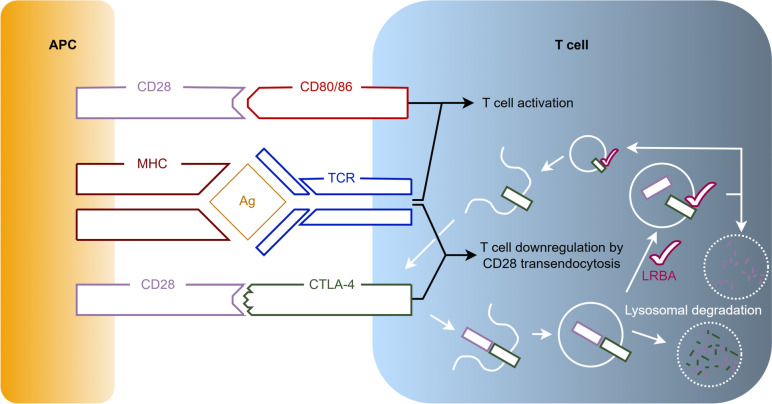
Fig. 1
Fig. 1
Overview of the role of LRBA in the interaction of antigen-presenting cells and T cells. To activate a T cell, an APC couples both its MHC with the TCR, and its CD28 cell surface molecule with the T cell's CD80/86 cell surface molecule. After activation of the TCR, CTLA-4 is trafficked to the T cell’s surface where it can also bind the APC’s CD28 molecule. In contrast to CD80/86, CTLA-4 downregulates the T cell’s activation by removing the CTLA-4/CD28-complexes from the cell surface. Once internalised, this complex is either degraded in lysosomes, or the CTLA-4 component is recycled thanks to the presence of LRBA and returned to the T cell’s surface allowing further downregulation. Abbreviations used: Ag: Antigen; APC: Antigen-presenting Cell; CD: Cluster of Differentiation; CTLA-4: Cytotoxic T lymphocyte Antigen 4; LRBA: Lipopolysaccharide-responsive Beige-like Anchor Protein; MHC: Major Histocompatibility Complex; TCR: T cell Receptor
Fig. 2
Fig. 2
T2-Fluid-attenuated inversion recovery (FLAIR) images (a and b) demonstrating bilateral parieto-occipital hyperintense lesions. Images in conjunction with those in Supplemental figure S1 compatible with PRES. As an incidental finding, a subarachnoidal cyst in the left fossa media can also be observed (b). Images from patient P1
Fig. 3
Fig. 3
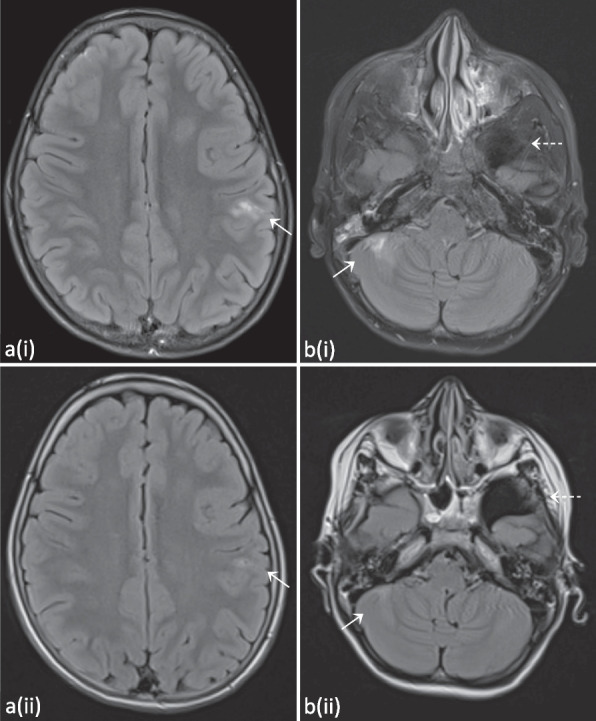
T2-FLAIR hyperintense contrast-enhanced lesions occurring widely spread in the supratentorial (a) and infratentorial (b) grey matter. As in Fig. 2, the arachnoidal cyst in the left temporal region can also be observed (b, dashed arrow). Evolution after 6 months of treatment with abatacept can be seen on the follow-up images depicted with (ii), demonstrating global regression of the lesions and decreased contrast enhancement. Images from patient P1
Fig. 4
Fig. 4
Expansive lesion of the cervical spinal medulla from C3-C4 down to Th1-Th2, best appreciated on the T2-weighted short-tau inversion recovery (STIR) image (a) and the T2-weighted image (b). Evolution after 6 months of treatment with abatacept can be observed on the follow-up images depicted with (ii), demonstrating reduced extent. Please note that image a(ii) is a T2-weighted image without STIR. Images from patient P1
Fig. 5
Fig. 5
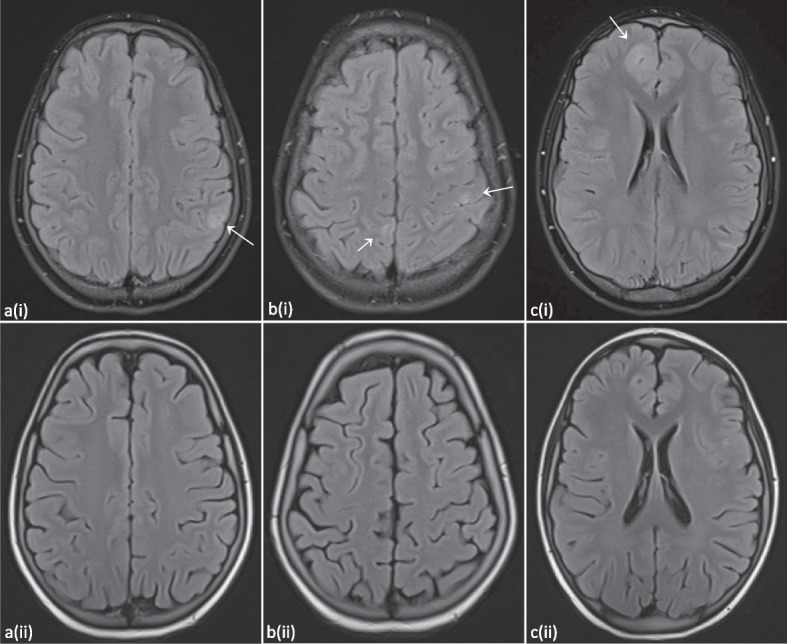
T2-FLAIR hyperintense subcortical supratentorial lesions with rather patchy contrast enhancement. Evolution three months after allo-HSCT can be observed on the follow-up images depicted with (ii), demonstrating full resolution of the lesions. Images from patient P2
Fig. 6
Fig. 6
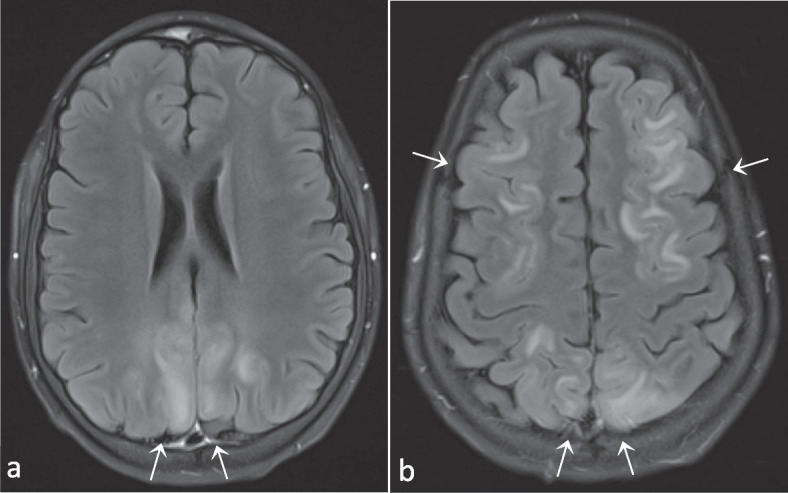
T2-FLAIR images (a and b) demonstrating bilateral fronto-parieto-occipital hyperintense lesions. Images in conjunction with those in Supplemental figure S4 compatible with PRES. Images from patient P2

References

    1. Alkhairy O, Abolhassani H, Rezaei N, Fang M, Andersen K, Chavoshzadeh Z, et al. Spectrum of Phenotypes Associated with Mutations in LRBA. J Clin Immunol. 2016;36:33–45. doi: 10.1007/s10875-015-0224-7. - DOI - PubMed
    1. Lopez-Herrera G, Tampella G, Pan-Hammarström Q, Herholz P, Trujillo-Vargas C, Phadwal K, et al. Deleterious mutations in LRBA are associated with a syndrome of immune deficiency and autoimmunity. Am J Hum Genet. 2012;90:986–1001. doi: 10.1016/j.ajhg.2012.04.015. - DOI - PMC - PubMed
    1. Schapira M, Tyers M, Torrent M, Arrowsmith C. WD40 repeat domain proteins: a novel target class? Nat Rev Drug Discov. 2017;16:773–786. doi: 10.1038/nrd.2017.179. - DOI - PMC - PubMed
    1. Reiser M, Li K, Lockey RF, Wang J-W. Lipopolysaccharide Responsive Beige-Like Anchor Subcellular Localization Involving in Vesicle Trafficking Responsive to Lipopolysaccharide. Austin J Clin Immunol. 2014;1:1020.
    1. Gámez-Díaz L, Seidel M. Different Apples, Same Tree: Visualizing Current Biological and Clinical Insights into CTLA-4 Insufficiency and LRBA and DEF6 Deficiencies. Front Pediatr. 2021;9:662645. - PMC - PubMed

Substances