. 2023 Jul 13;22(1):128.
doi: 10.1186/s12934-023-02137-8.

Genetic inactivation of the Carnitine/Acetyl-Carnitine mitochondrial carrier of Yarrowia lipolytica leads to enhanced odd-chain fatty acid production

Affiliations

Genetic inactivation of the Carnitine/Acetyl-Carnitine mitochondrial carrier of Yarrowia lipolytica leads to enhanced odd-chain fatty acid production

Eugenia Messina et al. Microb Cell Fact. .

Abstract

Background: Mitochondrial carriers (MCs) can deeply affect the intracellular flux distribution of metabolic pathways. The manipulation of their expression level, to redirect the flux toward the production of a molecule of interest, is an attractive target for the metabolic engineering of eukaryotic microorganisms. The non-conventional yeast Yarrowia lipolytica is able to use a wide range of substrates. As oleaginous yeast, it directs most of the acetyl-CoA therefrom generated towards the synthesis of lipids, which occurs in the cytoplasm. Among them, the odd-chain fatty acids (OCFAs) are promising microbial-based compounds with several applications in the medical, cosmetic, chemical and agricultural industries.

Results: In this study, we have identified the MC involved in the Carnitine/Acetyl-Carnitine shuttle in Y. lipolytica, YlCrc1. The Y. lipolytica Ylcrc1 knock-out strain failed to grow on ethanol, acetate and oleic acid, demonstrating the fundamental role of this MC in the transport of acetyl-CoA from peroxisomes and cytoplasm into mitochondria. A metabolic engineering strategy involving the deletion of YlCRC1, and the recombinant expression of propionyl-CoA transferase from Ralstonia eutropha (RePCT), improved propionate utilization and its conversion into OCFAs. These genetic modifications and a lipogenic medium supplemented with glucose and propionate as the sole carbon sources, led to enhanced accumulation of OCFAs in Y. lipolytica.

Conclusions: The Carnitine/Acetyl-Carnitine shuttle of Y. lipolytica involving YlCrc1, is the sole pathway for transporting peroxisomal or cytosolic acetyl-CoA to mitochondria. Manipulation of this carrier can be a promising target for metabolic engineering approaches involving cytosolic acetyl-CoA, as demonstrated by the effect of YlCRC1 deletion on OCFAs synthesis.

Keywords: Acetyl-CoA; Carnitine/Acetyl-Carnitine shuttle; Metabolic engineering; Mitochondrial carrier; Odd-chain fatty acids (OCFAs); Yarrowia lipolytica.


Conflict of interest statement

The authors declare no competing interests.

Figures
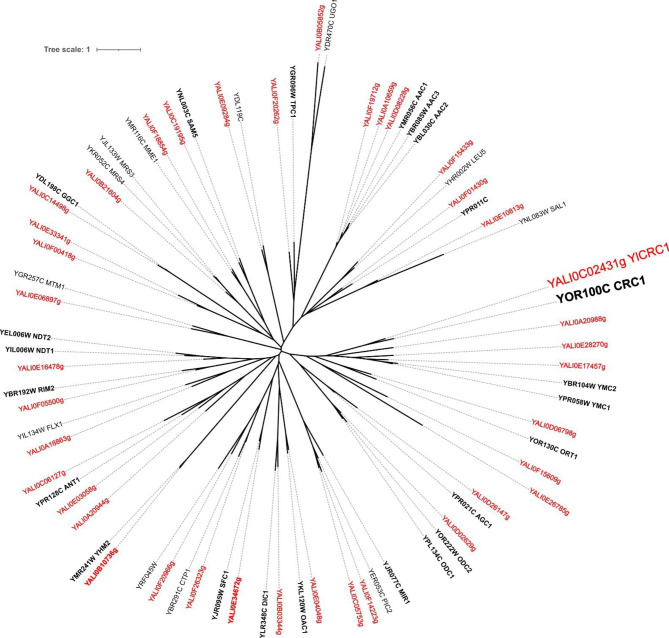
Fig. 1
Fig. 1
Phylogenetic tree of mitochondrial carriers of Saccharomyces cerevisiae and Yarrowia lipolytica. The tree was constructed using the sequences containing the signature motifs characterizing the mitochondrial carrier family (PFAM number PF00153) from S. cerevisiae (black) and Y. lipolytica (red). The names of the mitochondrial carriers and/or their coding genes are found on the terminal nodes
Fig. 2
Fig. 2
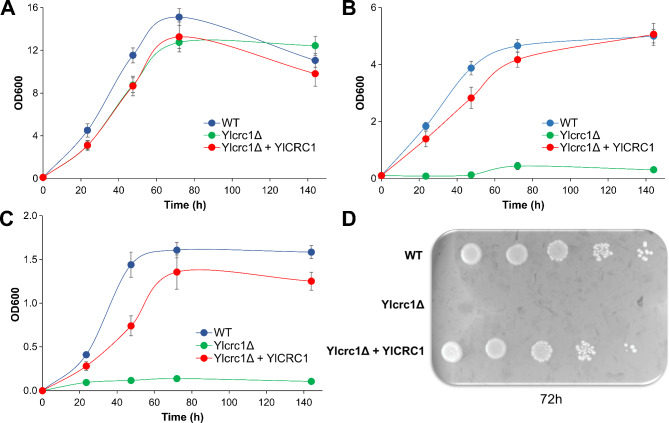
Growth of wild type (blue), strain with deletion of YlCRC1 (green) and Ylcrc1Δ + YlCRC1 strain (red) on YNB medium with different carbon sources (20 g/L) A) glucose, B) acetate, and C) ethanol. Averages and standard errors were obtained from at least three replicate experiments. D) Comparison of growth in wild type, Ylcrc1Δ strain and Ylcrc1Δ + YlCRC1 strain on solid YNB medium with 10 g/L oleic acid, at 72 h of incubation at 28 °C
Fig. 3
Fig. 3
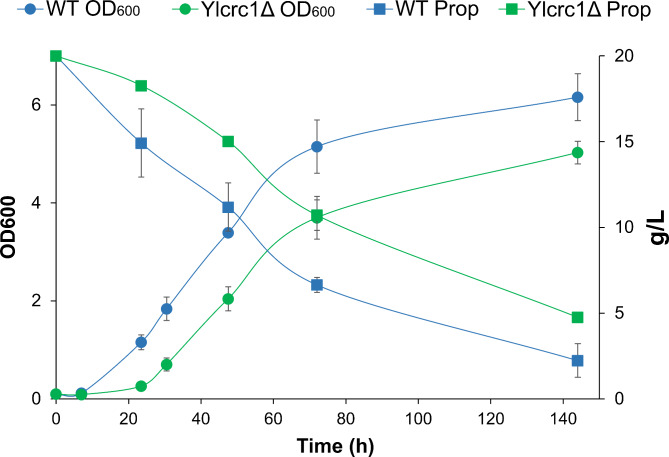
Comparison of growth of the wild type (blue circles) and Ylcrc1Δ strains (green circles) on YNB medium with propionate (20 g/L) as carbon source and consumption of propionate in wild type (blue squares) and strain with deletion of YlCRC1 (green squares). Averages and standard errors were obtained from at least two replicate experiments
Fig. 4
Fig. 4
Expression of YlCRC1, YALI0A20988g, YlCAT2 and YlYAT1 in wild-type cells grown on YNB medium supplemented with glucose (yellow) or oleic acid (orange) (40 g/L) after 15 h (exponential phase) (A) and 72 h (stationary phase) (B). mRNA levels were quantified by qPCR, and the mRNA of YlCRC1 gene, grown on glucose supplemented medium at 15 h, was used as calibrator. The quantification of relative gene expression was calculated according to the comparative method (2−ΔΔCt). Averages and standard errors were obtained from at least three independent experiments. * indicates a statistically significant difference in mRNA expression between glucose and oleic acid media (P < 0.05). P value was calculated by unpaired Student’s t-test
Fig. 5
Fig. 5
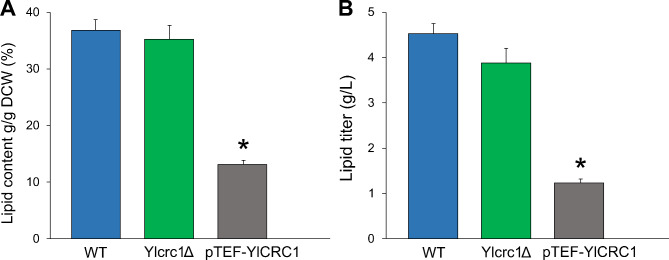
 A) Cellular lipid content expressed as percentage of fatty acids (FAs) in the total dry cell weight (DCW) and B) lipid titer (g/L) of wild type (blue), strain with deletion of YlCRC1 (green) and strain overexpressing YlCRC1 (grey). The strains were cultivated on YNB + 1.5 g/L NH4Cl + 40 g/L glucose medium for 120 h. Averages and standard errors were obtained from two replicate experiments for WT and Ylcrc1Δ strains and from four replicate experiments for pTEF-YlCRC1 strain. * indicates lipid content and lipid titer of pTEF-YlCRC1 strain, significantly different from that of WT and Ylcrc1Δ strains (P < 0.0001 by ANOVA with Fisher’s post hoc test)
Fig. 6
Fig. 6
Lipid accumulation in the strains wild type (WT), Ylcrc1Δ, pTEF-RePCT and pTEF-RePCT Ylcrc1Δ. A) Percentage of total fatty acids and B) percentage of OCFAs in the DCW on D2P0.5A1 (orange and yellow) and D3P0.5 (light orange and light yellow) media. C) Titer (g/L) of total fatty acids and D) total amount (g/L) of OCFAs on D2P0.5A1 (orange and yellow) and D3P0.5 media (light orange and light yellow). Strains were cultivated on nitrogen-limited media (1.5 g/L NH4Cl) for 120 h at 28 °C. Averages and standard errors were obtained from at least three replicate experiments. * indicates a statistically significant difference in lipid accumulation between the same strain cultivated on D2P0.5A1 and D3P0.5 media (P < 0.05). # indicates a statistically significant difference in lipid and OCFAs titer (g/L) of the pTEF-RePCT Ylcrc1Δ strain on D3P0.5, compared to other strains (P < 0.0075), except for Ylcrc1Δ on D3P0.5 (C) and pTEF-RePCT on D2P0.5A1 (D). The significance of the differences was estimated by ANOVA, with Fisher’s post hoc test
Fig. 7
Fig. 7
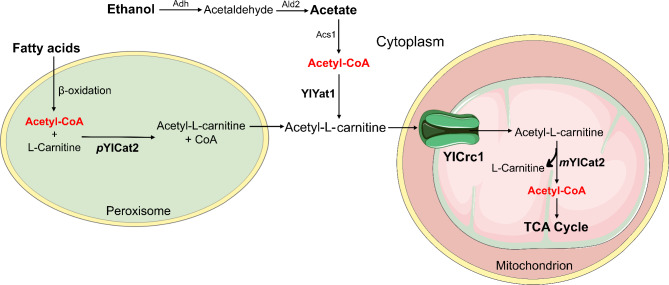
Proposed scheme for metabolism and transport of acetyl groups among peroxisomes, cytosol and mitochondria during growth of Y. lipolytica on non-fermentable substrates. Alcohol dehydrogenase (Adh), Aldehyde dehydrogenases (Ald2), Acetyl-CoA synthetase (Acs1), peroxisomal form of CAT (pYlCat2), cytoplasmic CAT (YlYat1) and mitochondrial form of CAT (mYlCat2). In green the mitochondrial carrier YlCrc1. The figure was produced using the vector image bank of Servier Medical Art (http://smart.servier.com/)

References

    1. Miller KK, Alper HS. Yarrowia lipolytica: more than an oleaginous workhorse. Appl Microbiol Biotechnol. 2019;103(23–24):9251–62. doi: 10.1007/s00253-019-10200-x. - DOI - PubMed
    1. Abdel-Mawgoud AM, Markham KA, Palmer CM, Liu N, Stephanopoulos G, Alper HS. Metabolic engineering in the host Yarrowia lipolytica. Metab Eng. 2018;50:192–208. doi: 10.1016/j.ymben.2018.07.016. - DOI - PubMed
    1. Larroude M, Rossignol T, Nicaud JM, Ledesma-Amaro R. Synthetic biology tools for engineering Yarrowia lipolytica. Biotechnol Adv. 2018;36(8):2150–64. doi: 10.1016/j.biotechadv.2018.10.004. - DOI - PMC - PubMed
    1. Park YK, Ledesma-Amaro R. What makes Yarrowia lipolytica well suited for industry? Trends Biotechnol. 2022 doi: 10.1016/j.tibtech.2022.07.006. - DOI - PubMed
    1. Christen S, Sauer U. Intracellular characterization of aerobic glucose metabolism in seven yeast species by 13 C flux analysis and metabolomics. FEMS Yeast Res. 2011;11(3):263–72. doi: 10.1111/j.1567-1364.2010.00713.x. - DOI - PubMed