Review
. 2023 Jun 25;12(13):1718.
doi: 10.3390/cells12131718.

Synaptonemal Complex in Human Biology and Disease

Affiliations
Review

Synaptonemal Complex in Human Biology and Disease

Elena Llano et al. Cells. .

Abstract

The synaptonemal complex (SC) is a meiosis-specific multiprotein complex that forms between homologous chromosomes during prophase of meiosis I. Upon assembly, the SC mediates the synapses of the homologous chromosomes, leading to the formation of bivalents, and physically supports the formation of programmed double-strand breaks (DSBs) and their subsequent repair and maturation into crossovers (COs), which are essential for genome haploidization. Defects in the assembly of the SC or in the function of the associated meiotic recombination machinery can lead to meiotic arrest and human infertility. The majority of proteins and complexes involved in these processes are exclusively expressed during meiosis or harbor meiosis-specific subunits, although some have dual functions in somatic DNA repair and meiosis. Consistent with their functions, aberrant expression and malfunctioning of these genes have been associated with cancer development. In this review, we focus on the significance of the SC and their meiotic-associated proteins in human fertility, as well as how human genetic variants encoding for these proteins affect the meiotic process and contribute to infertility and cancer development.

Keywords: cancer; infertility; meiosis; meiotic recombination; synaptonemal complex.


Conflict of interest statement

The authors declare no conflict of interest.

Figures
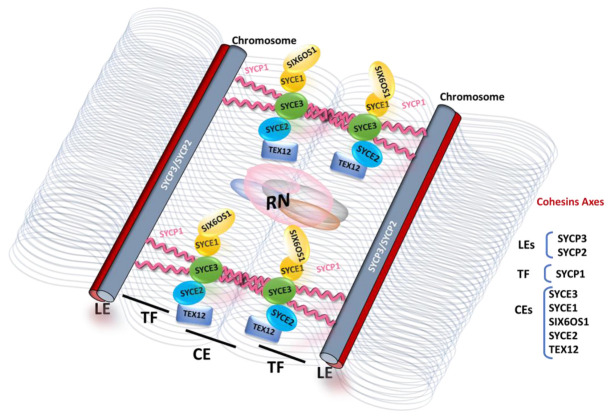
Figure 1
Figure 1
Schematic representation of the synaptonemal complex (SC) based on recent interaction data between central element proteins and the transverse filament [25]. The SC assembly, facilitated by the central element (CE) region, provides a necessary three-dimensional framework for double-strand break (DSB) repair and crossover (CO) formation. This assembly process is directed by recombination intermediates that are enzymatically processed by dynamic macromolecular protein complexes called recombination nodules (RNs). The transverse filament (depicted in pink) is composed of a supramolecular SYCP1 tetramer lattice that binds parallel SYCP1 dimers together. It supports cooperative head-to-head interactions between the N-terminal interaction protein sites of bioriented SYCP1 tetramers, which are anchored to chromosome axes through the back-to-back assembly of their helical C-termini [26]. Strong interactions between central element proteins are depicted by the overlap between the ovals representing SYCE2–TEX12 and SYCE1–SIX6OS1. Weak interactions are shown as punctual contacts, with SYCE2 interacting with SYCE3 and SYCE1 interacting with SYCE3. The grey coiled lines represent DNA loops generated by the meiotic cohesin axes.
Figure 2
Figure 2
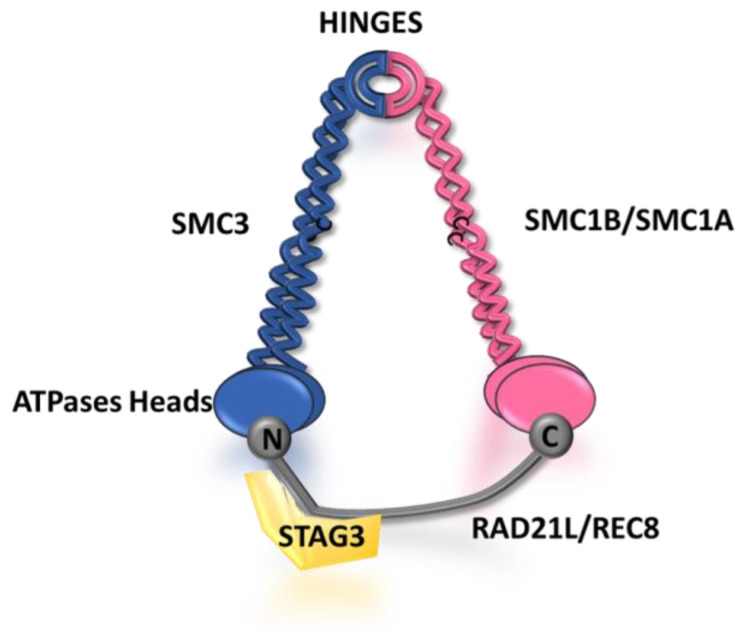
Schematic representation of the male and female meiotic cohesin complex according to the ring model. Meiotic cohesins are composed, both in males and females, of two structural maintenance of chromosomes (SMC) subunits (SMC1A or SMC1B and SMC3), as well as an α-kleisin subunit (Rec8 or RAD21L) and a STAG3 subunit. The SMC subunits contain hinges and ATPase heads which allow them to interact with each other and with the N-terminal and C-terminal domains of the α-kleisin subunit, respectively. The STAG3 subunit is known to interact with REC8/RAD21L and is indeed essential for the integrity of the ring complex. It is believed that cohesins, similar to their activity in somatic cells, generate DNA loops at the synaptonemal complex through DNA extrusion, facilitating proper chromosome organization during meiosis.

References

    1. Handel M.A., Schimenti J.C. Genetics of Mammalian Meiosis: Regulation, Dynamics and Impact on Fertility. Nat. Rev. Genet. 2010;11:124–136. doi: 10.1038/nrg2723. - DOI - PubMed
    1. Veller C., Kleckner N., Nowak M.A. A Rigorous Measure of Genome-Wide Genetic Shuffling That Takes into Account Crossover Positions and Mendel’s Second Law. Proc. Natl. Acad. Sci. USA. 2019;116:1659–1668. doi: 10.1073/pnas.1817482116. - DOI - PMC - PubMed
    1. Hann M.C., Lau P.E., Tempest H.G. Meiotic Recombination and Male Infertility: From Basic Science to Clinical Reality? Asian J. Androl. 2011;13:212–218. doi: 10.1038/aja.2011.1. - DOI - PMC - PubMed
    1. Hassold T., Hall H., Hunt P. The Origin of Human Aneuploidy: Where We Have Been, Where We Are Going. Hum. Mol. Genet. 2007;16:R203–R208. doi: 10.1093/hmg/ddm243. - DOI - PubMed
    1. Moses M.J. Chromosomal Structures in Crayfish Spermatocytes. J. Biophys. Biochem. Cytol. 1956;2:215–218. doi: 10.1083/jcb.2.2.215. - DOI - PMC - PubMed

Publication types