


Unraveling the Potential of Orange Pulp for Improving Laying Rate, Egg Quality, Oxidative Stability, Fatty Acids Composition, and Reproductive Tract Morphology of Laying Hens
- PMID: 37443997
- PMCID: PMC10340070
- DOI: 10.3390/ani13132199
Unraveling the Potential of Orange Pulp for Improving Laying Rate, Egg Quality, Oxidative Stability, Fatty Acids Composition, and Reproductive Tract Morphology of Laying Hens
Abstract
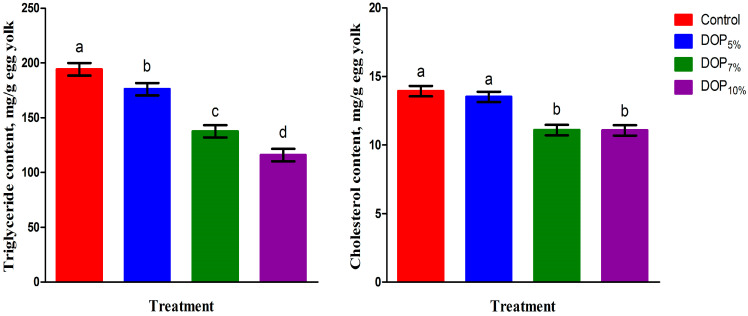
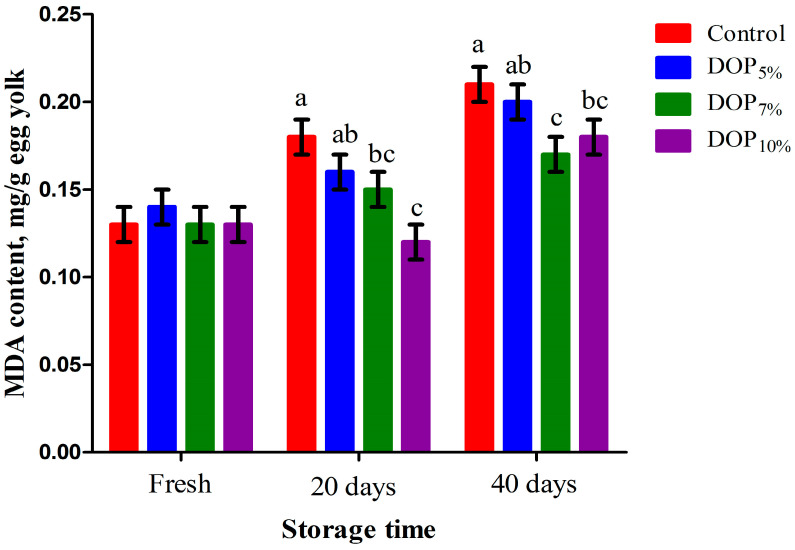
The current study aimed to demonstrate the effects of dietary dried orange pulp (DOP) on the laying performance, egg quality, antioxidant status, yolk fatty acid composition, serum biochemistry, and reproductive tract morphology of laying hens. A total of 200 Lohman Brown Lite laying hens were randomly allotted into 4 dietary treatments with 10 replicates each. The experimental treatment groups were the control group, a basal diet containing 50 g DOP/kg feed (DOP5%), a basal diet containing 70 g DOP/kg feed (DOP7%), and a basal diet containing 100 g DOP/kg feed (DOP10%). Data were statistically analyzed by one-way ANOVA following a completely randomized design, and the incremental levels of dietary DOP were tested by orthogonal polynomial contrasts. The body weight gain, feed intake, egg production%, egg weight, egg mass, and feed conversion ratio of laying hens fed the DOP7% and DOP10% diets were greater (p < 0.01) than those fed the control diet. Eggs obtained from the DOP7% and DOP10% groups had a heavier shell weight% and shell thickness, as well as a greater yolk color score (p < 0.01; linear, p < 0.01). Dietary DOP improved the egg yolk concentrations of PUFA, n-3 PUFA, and n-6 PUFA (linear, p < 0.001; quadratic, p < 0.05), whereas the content of SFA was reduced (p < 0.001; linear, p < 0.001). The egg yolk cholesterol and triglyceride levels were linearly decreased (p < 0.001) with the inclusion of DOP in the diets of hens. After storage for 40 days, the malondialdehyde (MDA) contents in the egg yolk were reduced, whereas the glutathione peroxidase content was increased (p < 0.01) due to dietary DOP. The DOP7% and DOP10% hens had an obvious reduction in the levels of serum total lipids, total cholesterol, triglycerides, low-density lipoprotein, and MDA, whereas high-density lipoprotein and GPx levels were increased (p < 0.01) compared with those fed the control diet. The relative weights of the ovary, oviduct, uterus, and follicle of hens receiving diets containing 7% and 10% DOP were heavier (p < 0.01) than those of the control hens. Moreover, the number of large yellow follicles was increased (p < 0.001; linear, p < 0.001) in the hens-fed diets containing 7% and 10% DOP. In conclusion, dietary DOP at up to 100 g/kg of feed improves laying performance, health status, antioxidant capacity, egg nutritive value, and egg shelf life in laying hens.
Keywords: dried orange pulp; egg quality; egg shelf life; laying hens; oxidative stability; reproduction; serum metabolites.
Conflict of interest statement
The authors declare no conflict of interest.
Figures

Similar articles
-
Grape Pomace: Agrifood By-Product with Potential to Enhance Performance, Yolk Quality, Antioxidant Capacity, and Eggshell Ultrastructure in Laying Hens.Vet Sci. 2023 Jul 13;10(7):461. doi: 10.3390/vetsci10070461. Vet Sci. 2023. PMID: 37505865 Free PMC article.
-
Productive Performance, Egg Quality and Yolk Lipid Oxidation in Laying Hens Fed Diets including Grape Pomace or Grape Extract.Animals (Basel). 2022 Apr 21;12(9):1076. doi: 10.3390/ani12091076. Animals (Basel). 2022. PMID: 35565504 Free PMC article.
-
Effect of Dietary Cold-Pressed Hempseed Cake Supplemented with Tomato Waste on Laying Hen Performance and Egg Yolk Lipid Profile and Antioxidant Status Before and After Storage.Animals (Basel). 2024 Nov 28;14(23):3444. doi: 10.3390/ani14233444. Animals (Basel). 2024. PMID: 39682408 Free PMC article.
-
Effect of Oils in Feed on the Production Performance and Egg Quality of Laying Hens.Animals (Basel). 2021 Dec 7;11(12):3482. doi: 10.3390/ani11123482. Animals (Basel). 2021. PMID: 34944258 Free PMC article. Review.
-
Protective effect of Artemisia capillaris on hepatic lipid accumulation in laying hens with fatty liver and the study of its mechanism.Br Poult Sci. 2025 Jun 9:1-12. doi: 10.1080/00071668.2025.2512585. Online ahead of print. Br Poult Sci. 2025. PMID: 40488218 Review.
Cited by
-
Performance, Egg Quality, and Composition in Isa Brown Laying Hens Fed with Different Levels of Desmodium tortuosum Leaf Flour.Animals (Basel). 2024 Oct 5;14(19):2868. doi: 10.3390/ani14192868. Animals (Basel). 2024. PMID: 39409817 Free PMC article.
-
Evaluation of the effect of red cabbage waste on performance, egg quality, and yolk oxidative stability of laying Japanese quails (Coturnix coturnix Japonica).Trop Anim Health Prod. 2025 Feb 27;57(2):82. doi: 10.1007/s11250-025-04336-4. Trop Anim Health Prod. 2025. PMID: 40014174 Free PMC article.
-
Effects of Curcumin on the Egg Quality and Hepatic Lipid Metabolism of Laying Hens.Animals (Basel). 2023 Dec 30;14(1):138. doi: 10.3390/ani14010138. Animals (Basel). 2023. PMID: 38200869 Free PMC article.
-
Nutritional, Productive, and Qualitative Characteristics of European Quails Fed with Diets Containing Lipid Sources of Plant and Animal Origin.Animals (Basel). 2023 Nov 10;13(22):3472. doi: 10.3390/ani13223472. Animals (Basel). 2023. PMID: 38003090 Free PMC article.
-
Phytogenic feed additives as an approach to prevent fatty liver hemorrhagic syndrome in laying hens.Poult Sci. 2025 Jul 14;104(10):105573. doi: 10.1016/j.psj.2025.105573. Online ahead of print. Poult Sci. 2025. PMID: 40729808 Free PMC article.
References
-
- Vasta V., Luciano G. The effects of dietary consumption of plants secondary compounds on small ruminants’ products quality. Small Rumin. Res. 2011;101:150–159. doi: 10.1016/j.smallrumres.2011.09.035. - DOI
-
- Abbate J.M., Macrì F., Capparucci F., Iaria C., Briguglio G., Cicero L., Salvo A., Arfuso F., Ieni A., Piccione G., et al. Administration of Protein Hydrolysates from Anchovy (Engraulis Encrasicolus) Waste for Twelve Weeks Decreases Metabolic Dysfunction-Associated Fatty Liver Disease Severity in ApoE–/–Mice. Animals. 2020;10:2303. doi: 10.3390/ani10122303. - DOI - PMC - PubMed
-
- Piccione G., Arfuso F., Fazio F., Bazzano M., Giannetto C. Serum lipid modification related to exercise and polyunsaturated fatty acid supplementation in jumpers and thoroughbred horses. J. Equine Vet. Sci. 2014;34:1181–1187. doi: 10.1016/j.jevs.2014.07.005. - DOI
LinkOut - more resources
Full Text Sources
