


Screening for Patients with Visual Acuity Loss in Primary Health Care: A Cross Sectional Study in a Deprived Hungarian Population
- PMID: 37444777
- PMCID: PMC10341402
- DOI: 10.3390/healthcare11131941
Screening for Patients with Visual Acuity Loss in Primary Health Care: A Cross Sectional Study in a Deprived Hungarian Population
Abstract
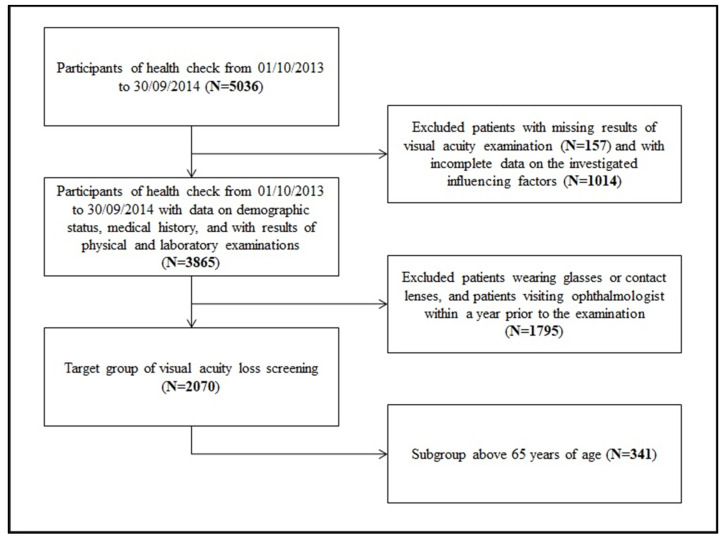
Screening for visual acuity loss (VAL) is not applied systematically because of uncertain recommendations based on observations from affordable countries. Our study aimed to evaluate the effectiveness of primary health care-based screening. A cross-sectional investigation was carried out among adults who did not wear glasses and did not visit an ophthalmologist in a year (N = 2070). The risk factor role of sociodemographic factors and the cardiometabolic status for hidden VAL was determined by multivariable linear regression models. The prevalence of unknown VAL of at least 0.5 was 3.7% and 9.1% in adults and in the above-65 population. Female sex (b = 1.27, 95% CI: 0.35; 2.18), age (b = 0.15, 0.12; 0.19), and Roma ethnicity (b = 2.60, 95% CI: 1.22; 3.97) were significant risk factors. Higher than primary school (bsecondaryschoolwithoutgraduation = -2.06, 95% CI: -3.64; -0.47; and bsecondaryschoolwithgraduation = -2.08, 95% CI: -3.65; -0.51), employment (b = -1.33, 95% CI: -2.25; 0.40), and properly treated diabetes mellitus (b = -2.84, 95% CI: -5.08; -0.60) were protective factors. Above 65 years, female sex (b = 3.85, 95% CI: 0.50; 7.20), age (b = 0.39, 95% CI: 0.10; 0.67), Roma ethnicity (b = 24.79, 95% CI: 13.83; 35.76), and untreated diabetes (b = 7.30, 95% CI: 1.29; 13.31) were associated with VAL. Considering the huge differences between the health care and the population's social status of the recommendation-establishing countries and Hungary which represent non-high-income countries, the uncertain recommendation of VAL screening should not discourage general practitioners from organizing population-based screening for VAL in non-affordable populations.
Keywords: deprivation; general health check; primary care; screening; visual acuity loss.
Conflict of interest statement
The authors declare no conflict of interest.
Figures
References
-
- World Health Organization; Oct 13, 2022. [(accessed on 7 June 2023)]. Vision Impairment and Blindness. Available online: https://www.who.int/news-room/fact-sheets/detail/blindness-and-visual-im....
-
- World Health Organization; Oct 8, 2019. [(accessed on 7 June 2023)]. World Report on Vision. Available online: https://www.who.int/publications/i/item/9789241516570.
-
- Bourne R., Steinmetz J.D., Flaxman S., Briant P.S., Taylor H.R., Resnikoff S., Casson R.J., Abdoli A., Abu-Gharbieh E., Afshin A., et al. Trends in Prevalence of Blindness and Distance and near Vision Impairment over 30 Years: An Analysis for the Global Burden of Disease Study. Lancet Glob. Health. 2020;9:E130–E143. doi: 10.1016/S2214-109X(20)30425-3. - DOI - PMC - PubMed
Grants and funding
LinkOut - more resources
Full Text Sources
