


Factors Contributing to the Link between Physical Well-Being and Chronic Pain in Young People from Galicia, Northwest Spain
- PMID: 37445263
- PMCID: PMC10342911
- DOI: 10.3390/jcm12134228
Factors Contributing to the Link between Physical Well-Being and Chronic Pain in Young People from Galicia, Northwest Spain
Abstract
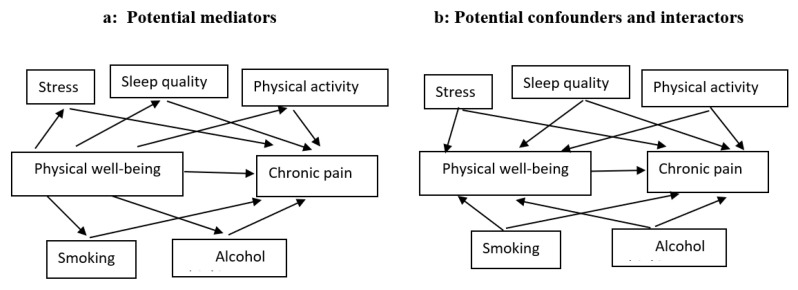
Introduction: The relation between physical well-being and chronic pain is complex and involves several subjective and objective covariates. We aimed to assess the role of mediator, confounder, or interactor played by covariates, including sleep quality, physical activity, perceived stress, smoking, and alcohol drinking in the relation between physical well-being and chronic pain. Method: We used Poisson regression to obtain incidence rate ratios (IRR) of the association between physical well-being and chronic pain in a cohort study carried out among university students. We applied General Structural Equation Modeling (GSEM) to assess mediation and stratum-specific analyses to distinguish confounding from interaction. We computed Relative Excess Risks due to Interaction (RERI), Attributable Proportion (AP), and the Synergy index (S) to measure additive interaction. Results: High physical well-being is related to a large decrease in the risk of chronic pain (IRRTotal Effect = 0.58; 95% CI: 0.50-0.81). Perceived stress mediates 12.5% of the total effect of physical well-being on chronic pain. The stratum-specific IRRs of current smokers and non-current smokers were different from each other and were larger than the crude IRR (IRR = 1.49; 95% CI: 1.24-1.80), which indicates that smoking could be both confounder and interactor. Interaction analyses showed that physical activity could act as a potential interactor (RERI = 0.25; 95% CI: 0.13, 0.60). Conclusions: Perceived stress is an important mediator of the relation between physical well-being and chronic pain, while smoking is both a confounder and an interactor. Our findings may prove useful in distinguishing high-risk groups from low-risk groups, in the interventions aimed at reducing chronic pain.
Keywords: chronic pain; confounding; interaction analysis; mediation analysis; physical well-being.
Conflict of interest statement
The authors declare no conflict of interest.
Figures
References
-
- Cieza A., Causey K., Kamenov K., Hanson S.W., Chatterji S., Vos T. Global estimates of the need for rehabilitation based on the Global Burden of Disease study 2019: A systematic analysis for the Global Burden of Disease Study 2019. Lancet. 2020;396:2006–2017. doi: 10.1016/S0140-6736(20)32340-0. - DOI - PMC - PubMed
Grants and funding
LinkOut - more resources
Full Text Sources
