


Efficacy of Serum Ferritin-Zinc Ratio for Predicting Advanced Liver Fibrosis in Patients with Autoimmune Hepatitis
- PMID: 37445498
- PMCID: PMC10342266
- DOI: 10.3390/jcm12134463
Efficacy of Serum Ferritin-Zinc Ratio for Predicting Advanced Liver Fibrosis in Patients with Autoimmune Hepatitis
Abstract
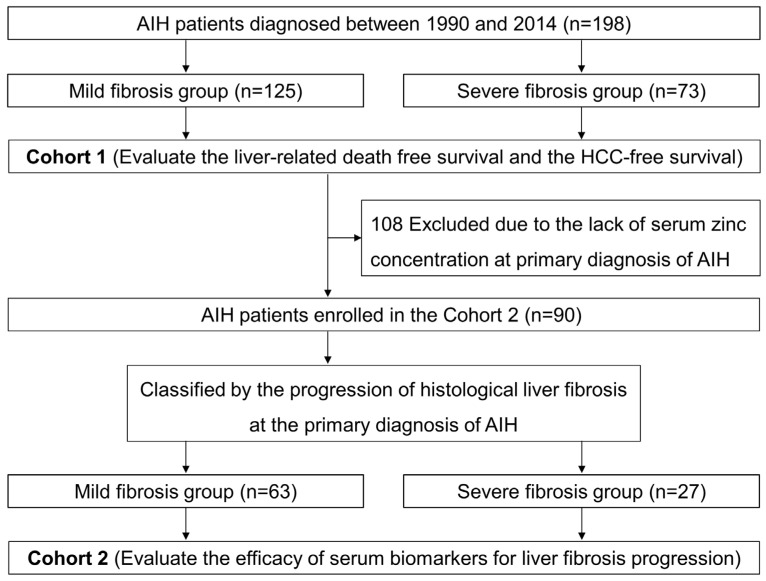
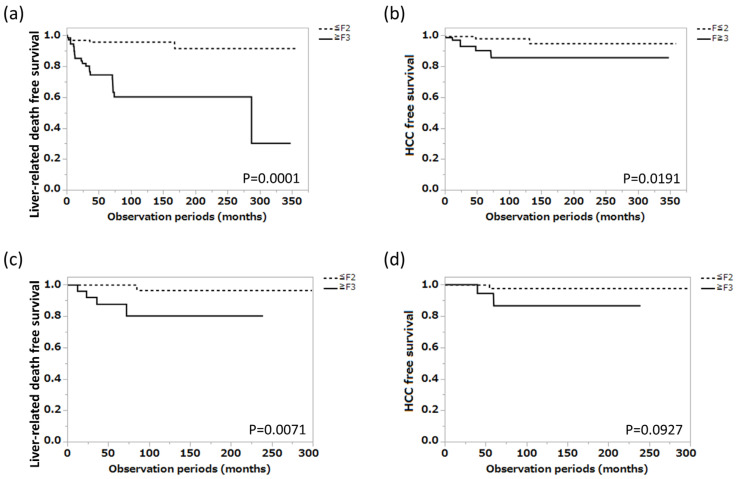
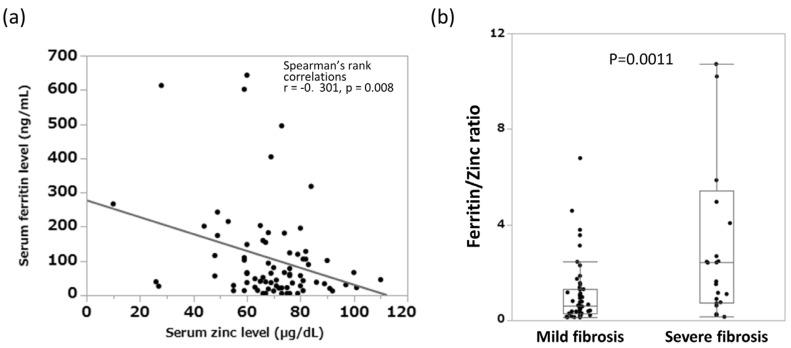
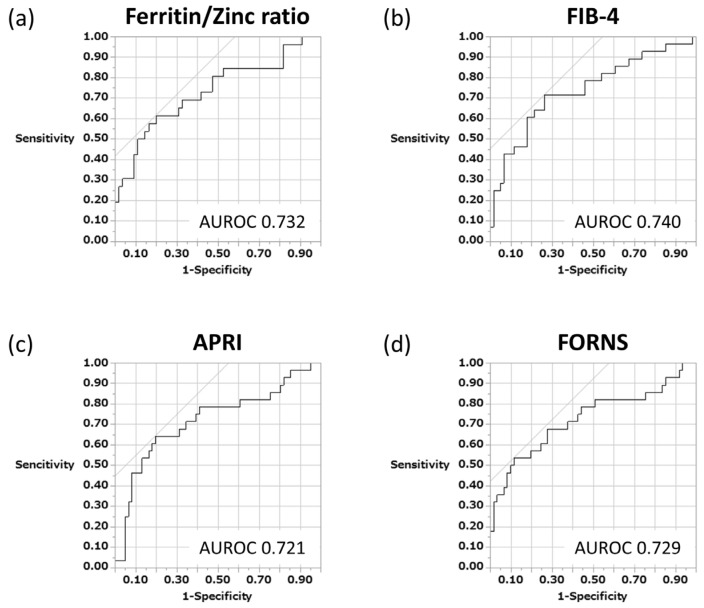
Background/Aims: The search for noninvasive biomarkers that can efficiently estimate the extent of liver fibrosis progression is ongoing. Although Fibrosis-4 (FIB-4), the aspartate transaminase-to-platelet ratio index (APRI), and the Forns index have been reported as useful biomarkers, their investigation in autoimmune hepatitis (AIH) is limited. This study aimed to examine the usefulness of these serological indices and a newly developed index in predicting liver fibrosis progression in AIH. Methods: The study analyzed data from 190 patients diagnosed with AIH at our institution between 1990 and 2015. Their histological liver fibrosis progression and clinical long-term prognosis were evaluated retrospectively (cohort 1). In 90 patients, receiver operating characteristic (ROC) curves were compared to choose severe fibrosis cases with respect to existing indices (FIB-4, APRI, and Forns index) and the ferritin-zinc ratio (cohort 2). Results: In cohort 1, liver-related death and hepatocellular carcinoma rates were significantly higher in the severe (n = 27) than in the mild (n = 63) fibrosis group (p = 0.0001 and 0.0191, respectively). In cohort 2, liver-related death in the severe fibrosis group was significantly frequent (p = 0.0071), and their ferritin-zinc ratio was higher (median 2.41 vs. 0.62, p = 0.0011). ROC analyses were performed to compare the ability of the ferritin-zinc ratio, FIB-4, APRI, and the Forns index to predict severe and mild fibrosis. Accordingly, areas under the ROC were 0.732, 0.740, 0.721, and 0.729, respectively. Conclusions: The serum ferritin-zinc ratio can noninvasively predict liver fibrosis progression in AIH and be applied to predict long-term prognosis.
Keywords: autoimmune hepatitis; biomarker; ferritin; liver fibrosis; zinc.
Conflict of interest statement
The authors declare no conflict of interest.
Figures
References
-
- Estirado Gómez A., Justo Gil S., Limia A., Avellón A., Arce Arnáez A., González-Rubio R., Diaz A., Del Amo J., Working group of the HCV prevalence study in Spain in 2017–2018 Prevalence and undiagnosed fraction of hepatitis C infection in 2018 in Spain: Results from a national population-based survey. Eur. J. Public Health. 2021;31:1117–1122. doi: 10.1093/eurpub/ckab069. - DOI - PubMed
-
- Angulo P., Kleiner D.E., Dam-Larsen S., Adams L.A., Bjornsson E.S., Charatcharoenwitthaya P., Mills P.R., Keach J.C., Lafferty H.D., Stahler A., et al. Liver fibrosis, but no other histologic features, is associated with long-term outcomes of patients with nonalcoholic fatty liver disease. Gastroenterology. 2015;149:389–397.e10. doi: 10.1053/j.gastro.2015.04.043. - DOI - PMC - PubMed
-
- Danielsson Borssén Å., Marschall H.U., Bergquist A., Rorsman F., Weiland O., Kechagias S., Nyhlin N., Verbaan H., Nilsson E., Werner M. Epidemiology and causes of death in a Swedish cohort of patients with autoimmune hepatitis. Scand. J. Gastroenterol. 2017;52:1022–1028. doi: 10.1080/00365521.2017.1335772. - DOI - PubMed
LinkOut - more resources
Full Text Sources
