


Review
doi: 10.3390/ijms241310772.
Successful Use of Methylene Blue in Catecholamine-Resistant Septic Shock: A Case Report and Short Literature Review
Affiliations
- PMID: 37445952
- PMCID: PMC10342053
- DOI: 10.3390/ijms241310772
Item in Clipboard
Review
Successful Use of Methylene Blue in Catecholamine-Resistant Septic Shock: A Case Report and Short Literature Review
Int J Mol Sci.
.
Abstract
Despite efforts to improve treatment outcomes, mortality in septic shock remains high. In some patients, despite the use of several adrenergic drugs, features of refractory vasoplegic shock with progressive multiorgan failure are observed. We present a case report of the successful reversal of vasoplegic shock following the use of methylene blue, a selective inhibitor of the inducible form of nitric oxide synthase, which prevents vasodilation in response to inflammatory cytokines. We also briefly review the literature.
Keywords: methylene blue; sepsis; vasoplegic shock.
Conflict of interest statement
The authors declare no conflict of interest.
Figures
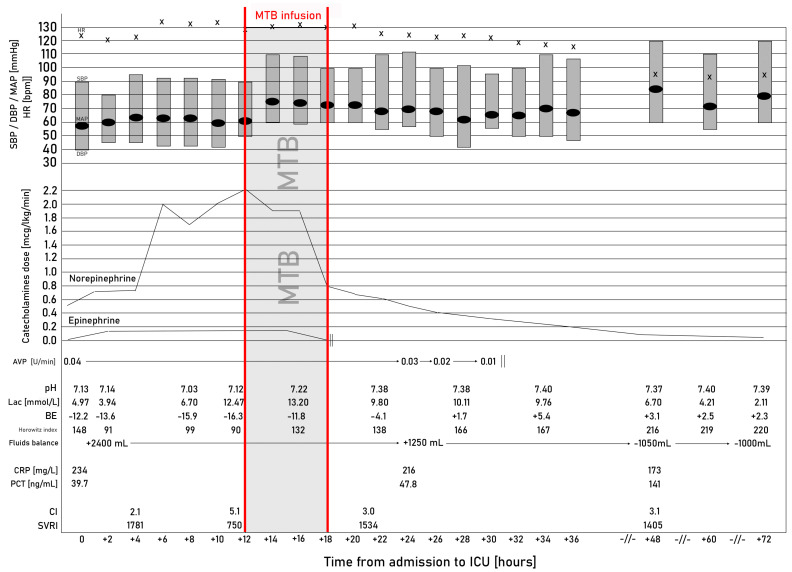
Selected clinical and laboratory parameters at subsequent time point (SBP, systolic blood pressure; DBP, diastolic blood pressure; MAP, mean arterial pressure; HR, heart rate; AVP, arginine vasopressin; Lac, lactates; BE, base excess; CRP, C-reactive protein; PCT, procalcitonin; CI, cardiac index; SVRI, systemic vascular resistance index; MTB, methylene blue).
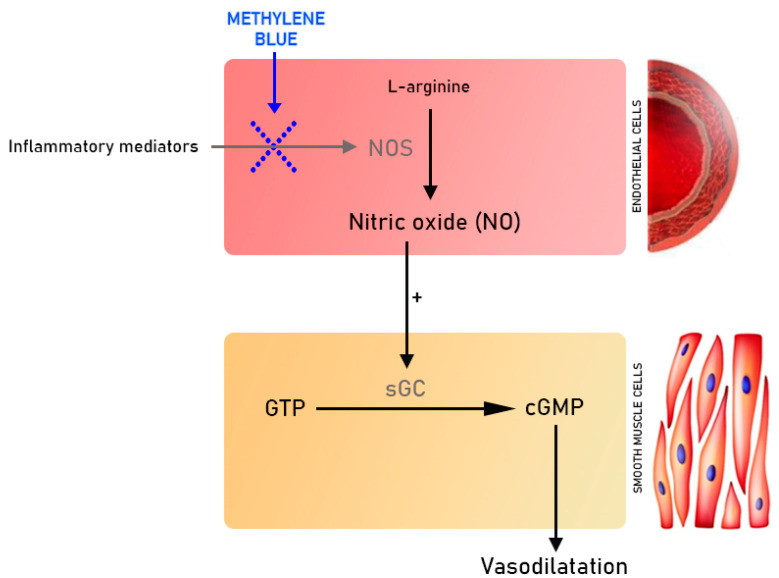
Mechanism of action of methylene blue (NOS, nitric oxide synthase; GTP, guanosine triphosphate; cGMP, nitric oxide-cyclic guanosine monophosphate; sGC, soluble guanylate cyclase).
References
-
- Evans L., Rhodes A., Alhazzani W., Antonelli M., Coopersmith C.M., French C., Machado F.R., Mcintyre L., Ostermann M., Prescott H.C., et al. Surviving sepsis campaign: International guidelines for management of sepsis and septic shock 2021. Intensive Care Med. 2021;47:1181–1247. doi: 10.1007/s00134-021-06506-y. - DOI - PMC - PubMed
-
- Enna S.J., Bylund D.B. The Comprehensive Pharmacology Reference: Inducible Nitric Oxide Synthase. Elsevier; Amsterdam, The Netherlands: 2007. pp. 1–12.
Publication types
MeSH terms
Substances
LinkOut - more resources
Full Text Sources
Medical
