


Current Understanding on Why Ovarian Cancer Is Resistant to Immune Checkpoint Inhibitors
- PMID: 37446039
- PMCID: PMC10341806
- DOI: 10.3390/ijms241310859
Current Understanding on Why Ovarian Cancer Is Resistant to Immune Checkpoint Inhibitors
Abstract
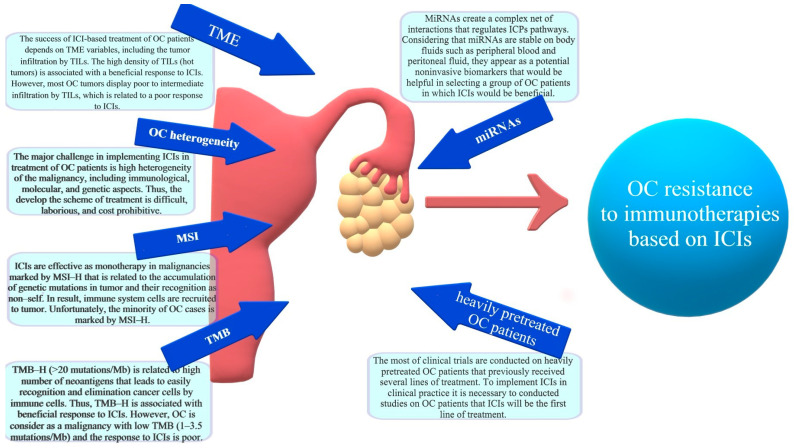
The standard treatment of ovarian cancer (OC) patients, including debulking surgery and first-line chemotherapy, is unsatisfactory because of recurrent episodes in the majority (~70%) of patients with advanced OC. Clinical trials have shown only a modest (10-15%) response of OC individuals to treatment based on immune checkpoint inhibitors (ICIs). The resistance of OC to therapy is caused by various factors, including OC heterogeneity, low density of tumor-infiltrating lymphocytes (TILs), non-cellular and cellular interactions in the tumor microenvironment (TME), as well as a network of microRNA regulating immune checkpoint pathways. Moreover, ICIs are the most efficient in tumors that are marked by high microsatellite instability and high tumor mutation burden, which is rare among OC patients. The great challenge in ICI implementation is connected with distinguishing hyper-, pseudo-, and real progression of the disease. The understanding of the immunological, molecular, and genetic mechanisms of OC resistance is crucial to selecting the group of OC individuals in whom personalized treatment would be beneficial. In this review, we summarize current knowledge about the selected factors inducing OC resistance and discuss the future directions of ICI-based immunotherapy development for OC patients.
Keywords: PD-1/PD-L1; TIGIT; immune checkpoints; immunotherapy; microRNA; ovarian cancer; resistance.
Conflict of interest statement
The authors declare no conflict of interest.
Figures
References
-
- Cancer (IARC), T.I.A. for R. on Global Cancer Observatory. [(accessed on 12 February 2022)]. Available online: https://gco.iarc.fr/
-
- Bonifácio V.D.B. Ovarian Cancer Biomarkers: Moving Forward in Early Detection. In: Serpa J., editor. Tumor Microenvironment: The Main Driver of Metabolic Adaptation. Springer International Publishing; Cham, Switzerland: 2020. pp. 355–363. Advances in Experimental Medicine and Biology. - PubMed
Publication types
MeSH terms
Substances
LinkOut - more resources
Full Text Sources
Medical
Research Materials
