Review
. 2023 Jun 30;24(13):10915.
doi: 10.3390/ijms241310915.

Plants' Response to Abiotic Stress: Mechanisms and Strategies

Affiliations
Review

Plants' Response to Abiotic Stress: Mechanisms and Strategies

Yan Zhang et al. Int J Mol Sci. .

Abstract

Abiotic stress is the adverse effect of any abiotic factor on a plant in a given environment, impacting plants' growth and development. These stress factors, such as drought, salinity, and extreme temperatures, are often interrelated or in conjunction with each other. Plants have evolved mechanisms to sense these environmental challenges and make adjustments to their growth in order to survive and reproduce. In this review, we summarized recent studies on plant stress sensing and its regulatory mechanism, emphasizing signal transduction and regulation at multiple levels. Then we presented several strategies to improve plant growth under stress based on current progress. Finally, we discussed the implications of research on plant response to abiotic stresses for high-yielding crops and agricultural sustainability. Studying stress signaling and regulation is critical to understand abiotic stress responses in plants to generate stress-resistant crops and improve agricultural sustainability.

Keywords: abiotic stress; response; signal transduction; stress sensors.


Conflict of interest statement

The authors declare no conflict of interest.

Figures
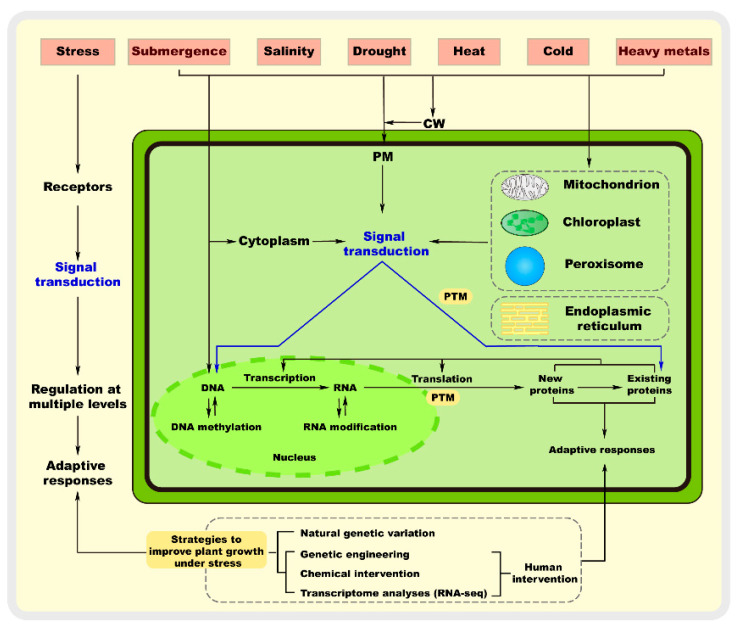
Figure 1
Figure 1
Plant resistance to abiotic stresses at the molecular level through sensing mechanisms and genetic responses. Abiotic stress can be perceived in different cellular compartments, including the cell wall (CW), plasma membrane (PM), cytoplasm, mitochondria, chloroplasts, peroxisomes, endoplasmic reticulum, and nucleus, leading to the initiation of molecular responses. These stress sensors then transmit the signals downstream through secondary messengers and regulatory proteins, such as Ca2+, ROS, and protein kinases. Furthermore, it is now well known that abiotic stress induces different responses involving stress sensing, signal transduction, and regulation at multiple levels. Therefore, plants have evolved mechanisms to adjust their growth to survive and reproduce under stress. PTM: post-translational modifications.

References

    1. Zhang H., Zhu J., Gong Z., Zhu J.-K. Abiotic stress responses in plants. Nat. Rev. Genet. 2022;23:104–119. doi: 10.1038/s41576-021-00413-0. - DOI - PubMed
    1. Zhang H., Liu S., Ren T., Niu M., Liu X., Liu C., Wang H., Yin W., Xia X. Crucial abiotic stress regulatory network of NF-Y transcription factor in plants. Int. J. Mol. Sci. 2023;24:4426. doi: 10.3390/ijms24054426. - DOI - PMC - PubMed
    1. Zhang H., Zhao Y., Zhu J.-K. Thriving under stress: How plants balance growth and the stress response. Dev. Cell. 2020;55:529–543. doi: 10.1016/j.devcel.2020.10.012. - DOI - PubMed
    1. Swain R., Sahoo S., Behera M., Rout G.R. Instigating prevalent abiotic stress resilience in crop by exogenous application of phytohormones and nutrient. Front. Plant Sci. 2023;14:1104874. doi: 10.3389/fpls.2023.1104874. - DOI - PMC - PubMed
    1. Markham K.K., Greenham K. Abiotic stress through time. New Phytol. 2021;231:40–46. doi: 10.1111/nph.17367. - DOI - PubMed

LinkOut - more resources
