Review
. 2023 Jul 6;23(13):6187.
doi: 10.3390/s23136187.

Machine Learning Approaches in Brillouin Distributed Fiber Optic Sensors

Affiliations
Review

Machine Learning Approaches in Brillouin Distributed Fiber Optic Sensors

Christos Karapanagiotis et al. Sensors (Basel). .

Abstract

This paper presents reported machine learning approaches in the field of Brillouin distributed fiber optic sensors (DFOSs). The increasing popularity of Brillouin DFOSs stems from their capability to continuously monitor temperature and strain along kilometer-long optical fibers, rendering them attractive for industrial applications, such as the structural health monitoring of large civil infrastructures and pipelines. In recent years, machine learning has been integrated into the Brillouin DFOS signal processing, resulting in fast and enhanced temperature, strain, and humidity measurements without increasing the system's cost. Machine learning has also contributed to enhanced spatial resolution in Brillouin optical time domain analysis (BOTDA) systems and shorter measurement times in Brillouin optical frequency domain analysis (BOFDA) systems. This paper provides an overview of the applied machine learning methodologies in Brillouin DFOSs, as well as future perspectives in this area.

Keywords: BOFDA; BOTDA; Brillouin scattering; artificial neural networks; distributed fiber optic sensors; machine learning; strain and temperature measurements; structural health monitoring.


Conflict of interest statement

The authors declare no conflict of interest.

Figures

Figure 1
Figure 1
Schematic representation of the Rayleigh, Brillouin and Raman scattering effects in optical fibers providing a rough estimation of the backscattered intensity or frequency changes with temperature or strain. Copyright 2021 licensed under a Creative Commons Attribution 4.0 International license [84].
Figure 2
Figure 2
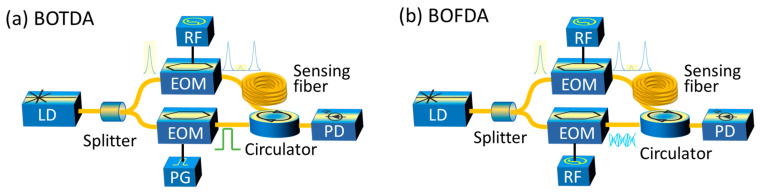
Two most common types of Brillouin-distributed fiber optic sensors based on the time (a) and frequency (b) domain. BOTDA: Brillouin optical time domain analysis; BOFDA: Brillouin optical frequency domain analysis; EOM: electro-optic modulator; RF: radio frequency; PG: pulse generator; PD: photodiode.
Figure 3
Figure 3
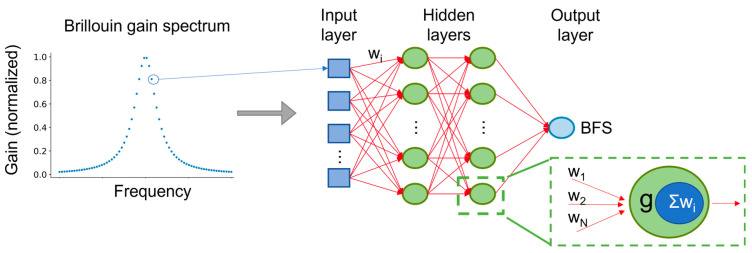
Brillouin frequency shift (BFS) extraction using an artificial neural network (ANN). w: weight; Σw: weighted sum; g: activation function.
Figure 4
Figure 4
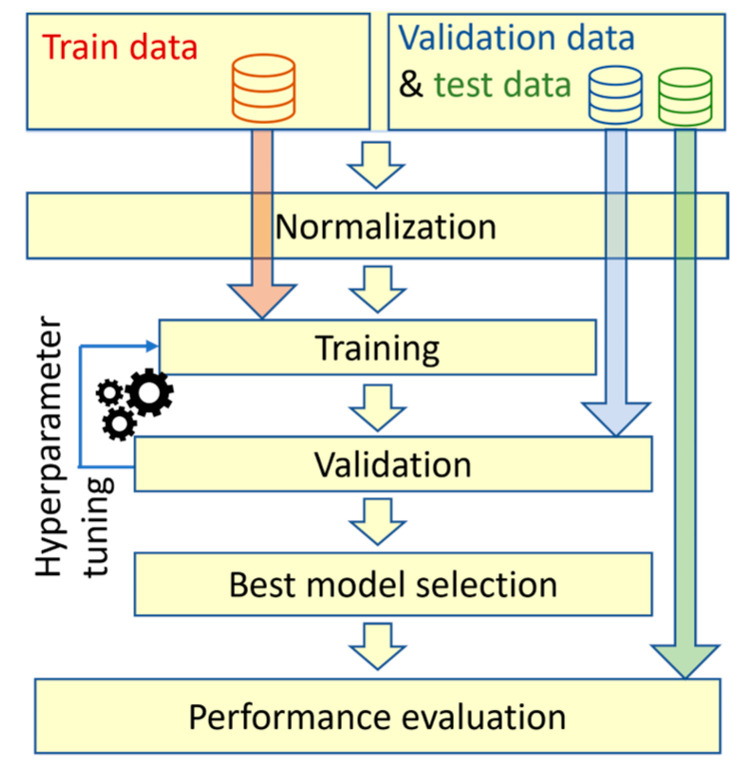
Common training procedure in machine learning.
Figure 5
Figure 5
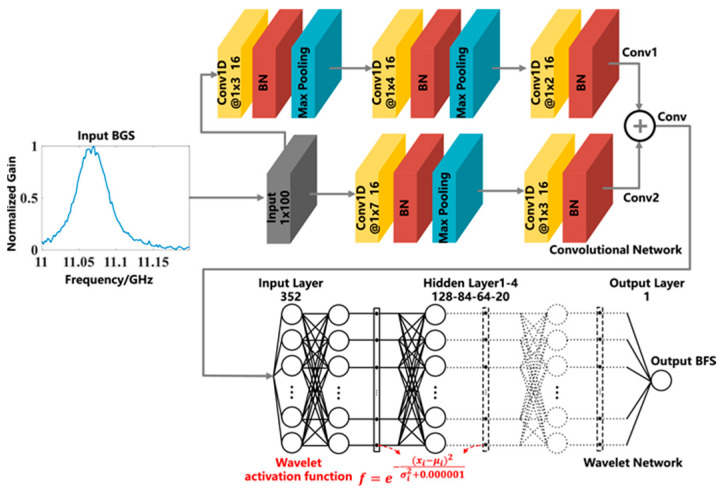
Architecture of the “wavelet” convolutional neural network (CNN) consisting of two paths of convolutional layers (top) and a stack of fully connected wavelet layers (bottom). One-dimensional convolutional layer (Conv 1D); Batch normalization (BN). Reprinted with permission from [98] © Optica Publishing Group.
Figure 6
Figure 6
The root mean square error (RMSE) of the extracted temperature using Lorentzian curve fitting (LCF), artificial neural networks (ANN) and convolutional neural networks (CNN), adapted with permission from [98] © Optica Publishing Group.
Figure 7
Figure 7
Convolutional neural network (CNN) for distributed Brillouin frequency shift (BFS) extraction. Reprinted with permission from [99] © Chinese Laser Press.
Figure 8
Figure 8
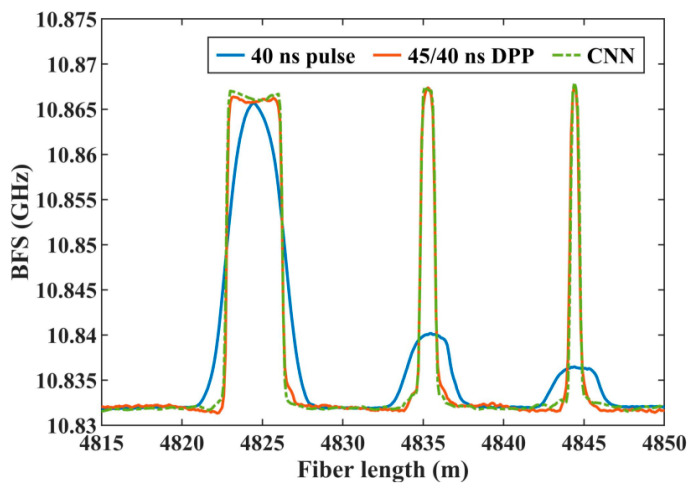
Brillouin frequency shift (BFS) estimation using a conventional BOTDA, a DPP-BOTDA and a CNN-BOTDA. Reprinted with permission from [68] © IEEE.
Figure 9
Figure 9
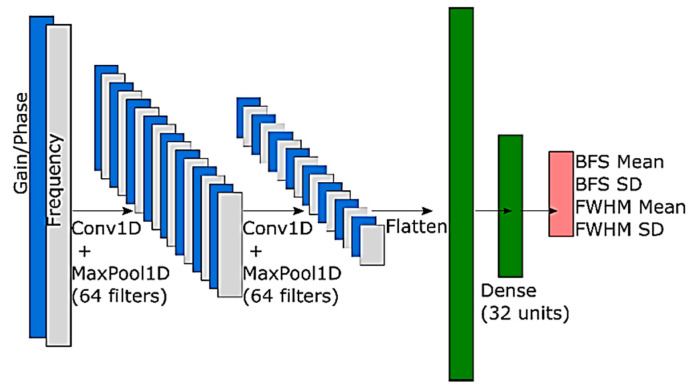
Probabilistic convolutional neural network for Brillouin frequency shift and linewidth extraction. Reprinted with permission from [103] © SPIE.
Figure 10
Figure 10
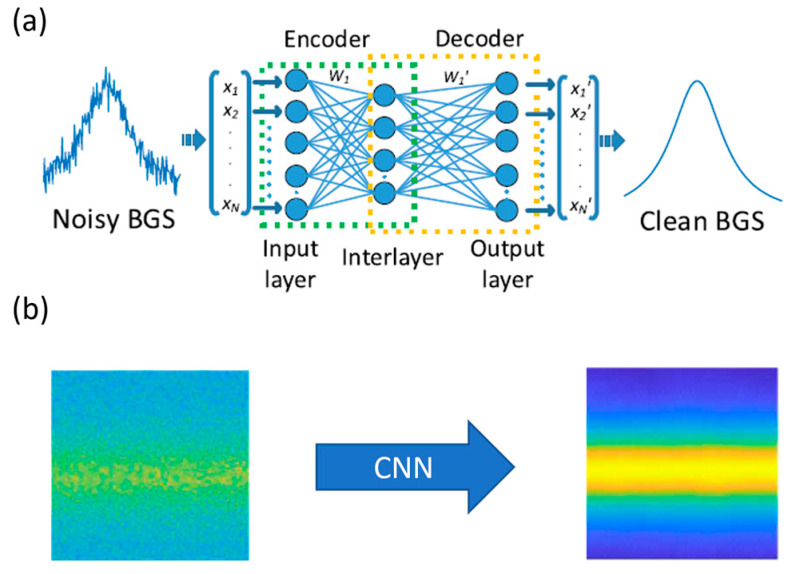
(a) Single Brillouin gain spectrum denoising using autoencoder-based neural networks. Reprinted with permission from [124] © IEEE; (b) 2D Brillouin gain spectrum denoising using convolutional neural networks. Adapted with permission from [125] © IEICE.
Figure 11
Figure 11
Performance comparison of the ANN, LCF and XCM in terms of the temperature RMSE when the fiber is heated to 29.90 °C (a), 39.14 °C (b) and 48.63 °C (c). Reprinted with permission from [133] © Optica Publishing Group.
Figure 12
Figure 12
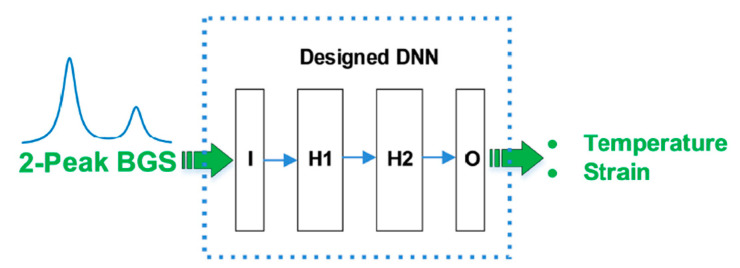
Simultaneous temperature and strain extraction using a two-peak Brillouin gain spectrum from a large effective area fiber (LEAF) and artificial neural networks. I: input layer; H1: first hidden layer; H2: second hidden layer; O: output layer. Reprinted with permission from [72] © Optica Publishing Group.
Figure 13
Figure 13
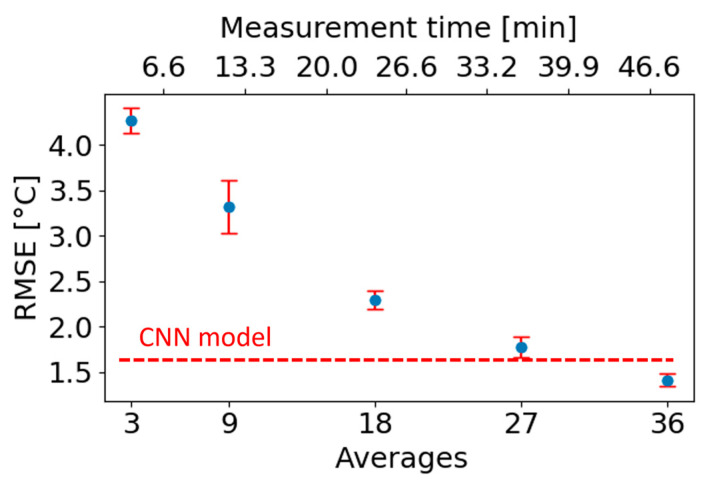
Temperature RMSE of the conventional LCF method (blue dots) vs. the measurement time. The dashed red line corresponds to the CNN performance based on data obtained using 4 min measurements. Adapted from [69]. Copyright 2021 licensed under a Creative Commons Attribution 4.0 International license.
Figure 14
Figure 14
Temperature and strain discrimination using the BFS extracted via conventional Lorentzian curve-fitting. Adapted with permission from [70] © Optica Publishing Group.

References

    1. Ecke W., Nöther N., Peters K.J., Wosniok A., Krebber K., Meyendorf N.G., Thiele E. A distributed fiber optic sensor system for dike monitoring using Brillouin optical frequency domain analysis; Proceedings of the Smart Sensor Phenomena, Technology, Networks, and Systems; San Diego, CA, USA. 10–12 March 2008.
    1. Schenato L. A Review of Distributed Fibre Optic Sensors for Geo-Hydrological Applications. Appl. Sci. 2017;7:896. doi: 10.3390/app7090896. - DOI
    1. Bado M.F., Casas J.R. A Review of Recent Distributed Optical Fiber Sensors Applications for Civil Engineering Structural Health Monitoring. Sensors. 2021;21:1818. doi: 10.3390/s21051818. - DOI - PMC - PubMed
    1. Monsberger C.M., Bauer P., Buchmayer F., Lienhart W. Large-scale distributed fiber optic sensing network for short and long-term integrity monitoring of tunnel linings. J. Civ. Struct. Health. 2022;12:1317–1327. doi: 10.1007/s13349-022-00560-w. - DOI
    1. Wu T., Liu G., Fu S., Xing F. Recent Progress of Fiber-Optic Sensors for the Structural Health Monitoring of Civil Infrastructure. Sensors. 2020;20:4517. doi: 10.3390/s20164517. - DOI - PMC - PubMed

LinkOut - more resources