


Are Electrocardiographic Criteria Reliable for Left Ventricular Hypertrophy Detection in Indian Adults?
- PMID: 37448432
- PMCID: PMC10337698
- DOI: 10.7759/cureus.40306
Are Electrocardiographic Criteria Reliable for Left Ventricular Hypertrophy Detection in Indian Adults?
Abstract
Background: Left ventricular hypertrophy (LVH) detection is vital to the risk stratification of adults at risk of adverse cardiovascular events such as coronary heart disease, cerebrovascular disease, and aortic aneurysms. Electrocardiogram (ECG), a non-invasive, cost-effective instrument has been widely used as a screening tool for LVH. The objective of this study was to determine the diagnostic accuracy of seven frequently used ECG criteria in high-risk Indian adults in comparison with echocardiography.
Methods: ECG and transthoracic echocardiography were performed in adults older than 18 years with at least one cardiac risk factor (chronic hypertension, obesity, ischemic heart disease, and type 2 diabetes mellitus). Precision and accuracy were calculated for the various ECG criteria against LVH based on left ventricular mass index (LVMI) and cardiac remodeling by echocardiography.
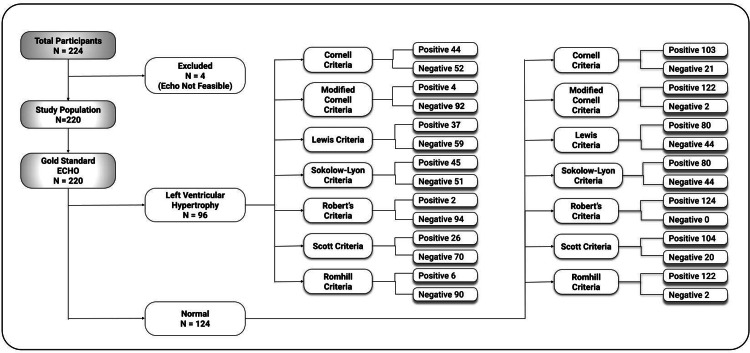
Results: A total of 220 participants were enrolled. Of these, 96 had LVH by echocardiography. There was marked variability in LVH detection by the different ECG criteria: 28 by Sokolow-Lyon criteria, 26 by Cornell criteria, 24 by Lewis criteria, 46 by Scott criteria, eight by Romhilt-Estes criteria, six by Modified Cornell criteria, and only two by Roberts criteria. Agreement statistics between ECG criteria and LVMI showed that none of them had a good agreement for LVH detection.
Conclusion: None of the ECG criteria were sensitive enough to rule out ventricular hypertrophy. In the context of cardiac remodeling, the ECG criteria had high sensitivity but low specificity and, hence, limited clinical relevance.
Keywords: 12-lead ecg; ecg criteria; echocardiography; left ventricular hypertrophy; south indian.
Copyright © 2023, Kothendaraman et al.
Conflict of interest statement
The authors have declared that no competing interests exist.
Figures
References
-
- Myocardial remodeling in hypertension. Nadruz W. J Hum Hypertens. 2015;29:1–6. - PubMed
-
- Left ventricular hypertrophy as a predictor of cardiovascular risk. Gosse P. J Hypertens Suppl. 2005;23:0–33. - PubMed
-
- Left ventricular hypertrophy increases cardiovascular risk independently of in-office and out-of-office blood pressure values. Bombelli M, Facchetti R, Carugo S, et al. J Hypertens. 2009;27:2458–2464. - PubMed
-
- Prognostic significance of left ventricular hypertrophy regression. Agabiti-Rosei E, Muiesan ML. Adv Exp Med Biol. 1997;432:199–205. - PubMed
-
- 2003 European Society of Hypertension-European Society of Cardiology guidelines for the management of arterial hypertension. J Hypertens. 2003;21:1011–1053. - PubMed
LinkOut - more resources
Full Text Sources