


Epidemiology of C2 fractures in the United States: A National Electronic Injury Surveillance System database study
- PMID: 37448502
- PMCID: PMC10336903
- DOI: 10.4103/jcvjs.jcvjs_37_23
Epidemiology of C2 fractures in the United States: A National Electronic Injury Surveillance System database study
Abstract
Introduction: C2 fractures are one of the most common traumatic injuries of the cervical spine, with high rates of morbidity and mortality. Current literature on the incidence of C2 fractures is limited to populations outside of the United States (US), prior to 2014, or specific age cohorts. The purpose of this study is to report the incidence rate (IR) of C2 fractures and associated patient demographics in the US between 2002 and 2021 using the National Electronic Injury Surveillance System (NEISS) database.
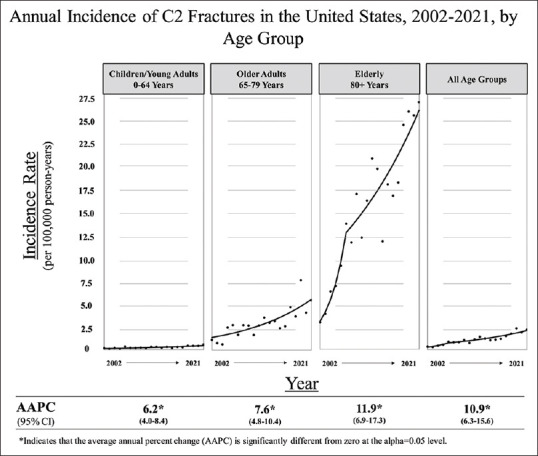
Methods: This study analyzed the NEISS database to identify cases of C2 fractures presenting to US Emergency Departments (EDs) from 2002 to 2021. Annual and overall numbers of fractures, IR, and patient demographics were analyzed. IR is expressed as the number of fractures per 100,000 person-years at risk (PYR). Patients were split into three different age groups for comparison (children and young adults, 0-64 years; older adults, 65-79 years; elderly individuals, 80 + years).
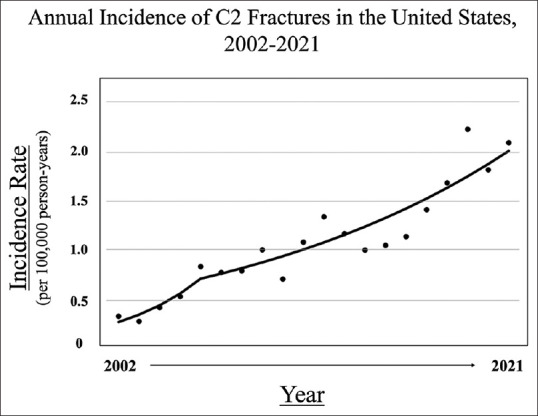
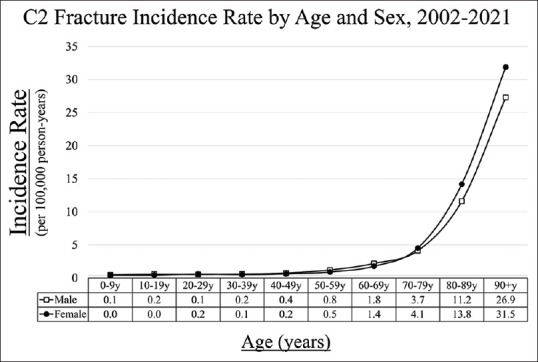
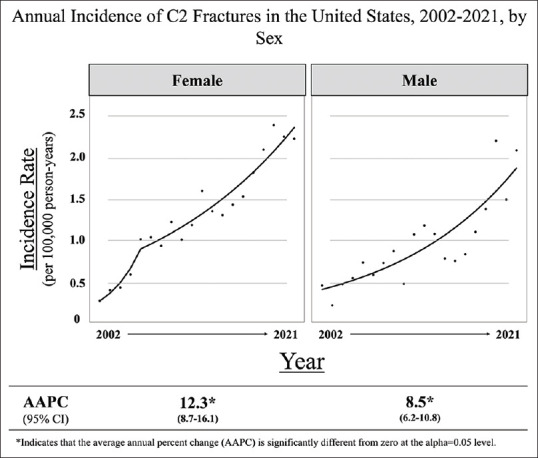
Results: A national estimate of n = 72,764 patients (95% confidence interval [CI] = 54,371-91,156) presented to US EDs with a C2 fracture (IR was 1.17/PYR; 95% CI = 0.87-1.46), and elderly individuals had the highest IR overall (IR = 15.9; P < 0.05). The IR of C2 fractures between 2002 and 2021, reported as average annual percent change (AAPC), increased significantly, regardless of age or sex (AAPC = 10.9; 95% CI = 6.3-15.6; P < 0.0001).
Conclusion: C2 fractures occur at higher rates than previous years, with especially high IR in elderly individuals. Emphasis of public health efforts toward osteoporosis and coordination difficulties in elderly individuals would likely significantly reduce the overall IR of these injuries.
Keywords: Axis; C2; epidemiology; national electronic injury surveillance system.
Copyright: © 2023 Journal of Craniovertebral Junction and Spine.
Conflict of interest statement
There are no conflicts of interest.
Figures
References
-
- Tang A, Pawar J, Bridge C, King R, Kakarmath S, Harris M, et al. Traumatic cervical spine fracture patterns on CT: A retrospective analysis at a level 1 trauma center. Emerg Radiol. 2021;28:965–76. - PubMed
-
- Khanpara S, Ruiz-Pardo D, Spence SC, West OC, Riascos R. Incidence of cervical spine fractures on CT: A study in a large level I trauma center. Emerg Radiol. 2020;27:1–8. - PubMed
-
- Barrey CY, di Bartolomeo A, Barresi L, Bronsard N, Allia J, Blondel B, et al. C1-C2 Injury: Factors influencing mortality, outcome, and fracture healing. Eur Spine J. 2021;30:1574–84. - PubMed
-
- Lomoschitz FM, Blackmore CC, Mirza SK, Mann FA. Cervical spine injuries in patients 65 years old and older: Epidemiologic analysis regarding the effects of age and injury mechanism on distribution, type, and stability of injuries. AJR Am J Roentgenol. 2002;178:573–7. - PubMed
LinkOut - more resources
Full Text Sources
Miscellaneous