


Emerging threat of candida resistance among neonates at a teaching institute of Jharkhand
- PMID: 37448944
- PMCID: PMC10336938
- DOI: 10.4103/jfmpc.jfmpc_2104_22
Emerging threat of candida resistance among neonates at a teaching institute of Jharkhand
Abstract
Purpose: In the past few decades, candidemia has escalated to worrisome levels, leading to substantial morbidity and mortality in neonates. The rise in anti-fungal drug resistance demands prompt diagnosis and treatment. This study aimed to determine the speciation and susceptibility pattern of Candida species recovered from special care new-born units and identify risk factors for developing candidemia in neonates.
Method: A total of 580 blood samples from clinically suspected septicemic neonates were collected and subjected to culture. Cultures positive for yeasts were sub-cultured on Sabouraud dextrose agar. Identification of a suspected purified colony of Candida was confirmed to the species level by both conventional and automated techniques matrix-assisted laser desorption and ionization time-of-flight mass spectrometry. Anti-fungal susceptibility of isolates was performed by an automated method (VITEK 2 system) using VITEK 2 cards. Multi-variate logistic regression analysis was used to identify risk factors associated with candidemia.
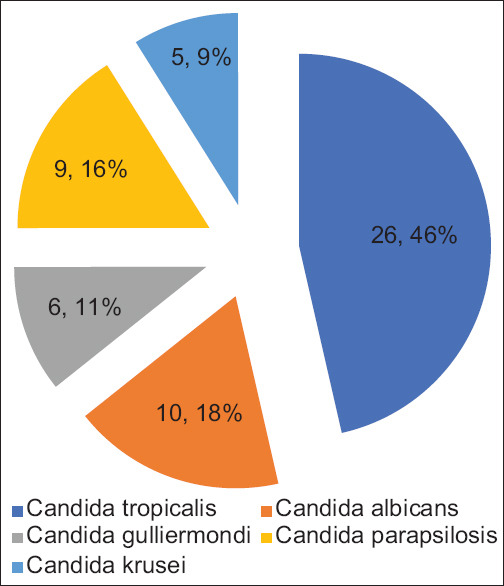
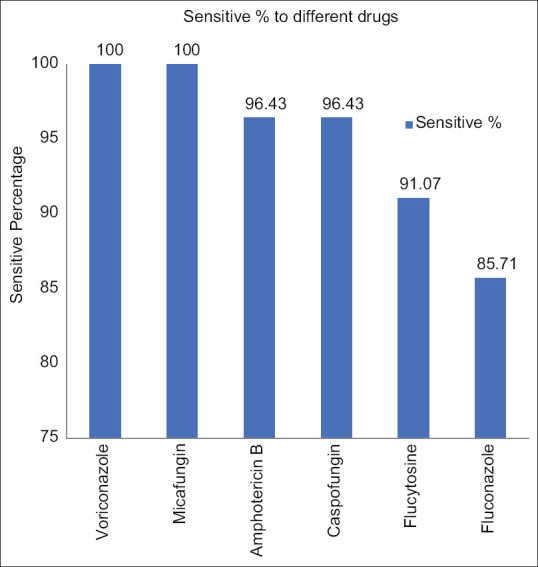
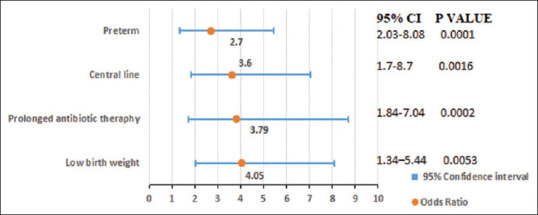
Result: A total of 56 (9.66%) isolates of Candida species were recovered from 580 blood cultures. Non-albicans Candida species predominated with 82.14% of cases, whereas 17.86% of cases were caused by Candida albicans. Candida tropicalis (46.42%) was the most common isolate recovered, followed by Candida albicans (17.8%). Risk factor analyses identified a very low birth weight [odds ratio (OR) =4.05, 95% confidence interval (CI) =2.03-8.08] and prolonged antibiotic therapy (OR = 3.79, 95% CI = 1.7-8.7) among others as significant predictors of candidemia. All the Candida isolates showed 100% sensitivity to voriconazole and micafungin, whereas the overall sensitivities for fluconazole, amphotericin B, caspofungin, and flucytosine were 85.71%, 96.43%, 96.43%, and 91.07%, respectively.
Conclusion: Candidemia is a life-threatening condition in neonates. Identification of Candida species and routine anti-fungal susceptibility is a must to select a suitable and effective anti-fungal therapy to revoke emerging resistance to anti-fungals.
Keywords: Anti-fungal susceptibility tests; candida tropicalis; candidemia; very low birth weight.
Copyright: © 2023 Journal of Family Medicine and Primary Care.
Conflict of interest statement
There are no conflicts of interest.
Figures
References
-
- Makhoul IR, Sujov P, Smolkin T, Lusky A, Reichman B. Epidemiological, clinical and microbiological characteristics of late-onset sepsis among very low birth weight infants in Israel:A national survey. Pediatrics. 2002;109:34–9. - PubMed
-
- Rodriguez D, Almirante B, Park BJ, Cuenca-Estrella M, Planes AM, Sanchez F, et al. Candidemia in neonatal intensive care units:Barcelona, Spain. Pediatr Infect Dis J. 2006;25:224–9. - PubMed
-
- Zaoutis TE, Argon J, Chu J, Berlin JA, Walsh TJ, Feudtner C, et al. The epidemiology and attributable outcomes of candidemia in adults and children hospitalized in the United States:A propensity analysis. Clin Infect Dis. 2005;41:1232–9. - PubMed
LinkOut - more resources
Full Text Sources
Miscellaneous