


A bibliometric approach to understanding the recent development of self-sufficient fish feed production utilizing agri-food wastes and by-products towards sustainable aquaculture
- PMID: 37449123
- PMCID: PMC10336519
- DOI: 10.1016/j.heliyon.2023.e17573
A bibliometric approach to understanding the recent development of self-sufficient fish feed production utilizing agri-food wastes and by-products towards sustainable aquaculture
Abstract
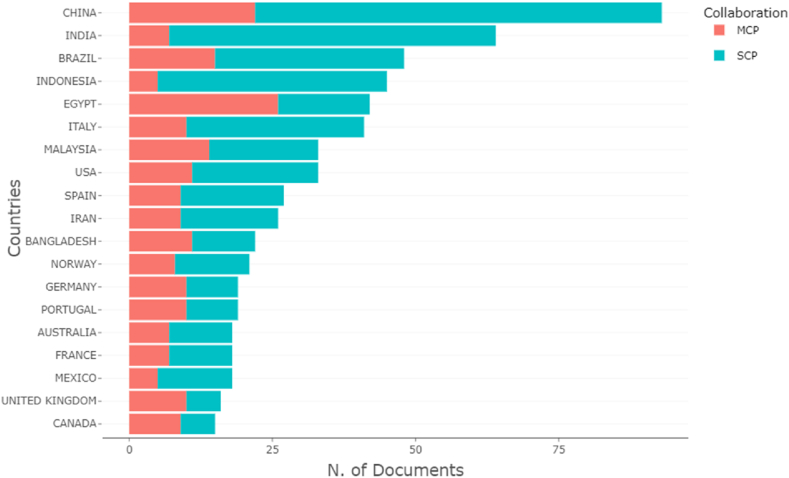
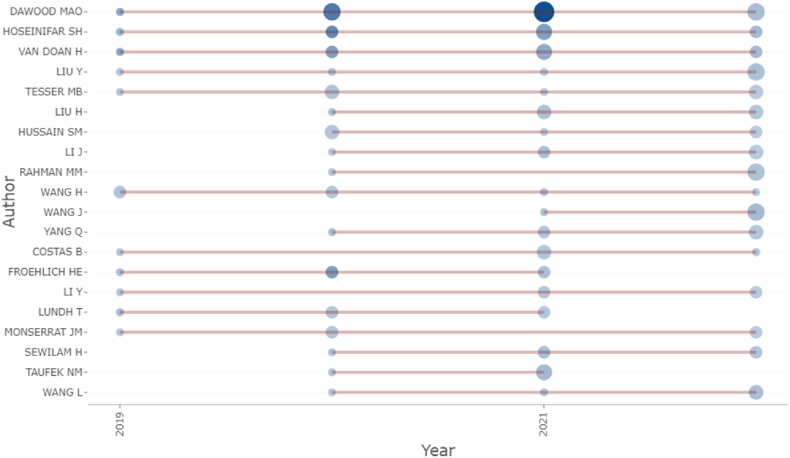
The global agri-food industry generates a large volume of waste annually, which causes both environmental and economic problems. Recently, there has been a growing interest in the use of agri-food wastes and by-products to produce self-sufficient fish feed. This study aimed to analyze the intellectual structure of the recent research on the utilization of agri-food wastes and by-products as self-sufficient fish feed materials based on 922 Scopus-indexed core collection documents from 252 journals written by 4420 authors from 73 countries with an annual growth rate of 18.65% over the last four years (2019-2022). This bibliometric study implemented knowledge domain visualization (KDV) using VOSViewer and Biblioshiny in the Bibliometrix R-package to investigate the basic scientometric profile of the selected fields. The results showed that Dawood M.A.O., with PageRanks of 0.0732, 19 total publications, 695 global citations from 2019 to 2022, and closeness values of 0.25, was the most productive author within the field. Subsequently, China was determined to be the most productive country (93 valid documents) and have the strongest collaboration network. Major research hotspots in the field included aquaculture and sustainable aquaculture, fish feed with agri-food waste, rainbow trout species, the development of a circular economy, probiotic applications, and cell signaling cytokines and peptides. This bibliometric study provides comprehensive information on the intellectual domain and research landscape on self-sufficient fish feed and also shows how interest in this research topic and similar ones is growing.
Keywords: Agri-food wastes and by-products; Bibliometric approach; Fish feed; Intellectual structure; Sustainable aquaculture.
© 2023 The Authors. Published by Elsevier Ltd.
Conflict of interest statement
The authors declare that they have no known competing financial interests or personal relationships that could have appeared to influence the work reported in this paper.
Figures






References
-
- Food Security Information Network (FSIN) Global Network against Food Crises (GNAFC), Global report on food crises: food security information network joint analysis for better decisions 2023, Rome: Italy. 2023. https://www.fsinplatform.org/sites/default/files/resources/files/GRFC202... 6–10. (accessed May 16, 2023)
-
- Vilariño M.V., Franco C., Quarrington C. Food loss and waste reduction as an integral part of a circular economy. Front. Environ. Sci. 2017;5(MAY) doi: 10.3389/fenvs.2017.00021. - DOI
-
- Jia L., Qiao G. Quantification, environmental impact, and behavior management: a bibliometric analysis and review of global food waste research based on citespace. Sustainability. 2022;14(18) doi: 10.3390/su141811293. - DOI
-
- Abeliotis K., Lasaridi K. Food waste prevention: reduction, reuse, and recycling. Resources. 2023;12(1) doi: 10.3390/resources12010003. - DOI
Associated data
LinkOut - more resources
Full Text Sources
