. 2023 Nov;48(11):3402-3419.
doi: 10.1007/s11064-023-03978-w. Epub 2023 Jul 14.

Preserving Retinal Structure and Function with the Novel Nitroxide Antioxidant, DCTEIO

Affiliations

Preserving Retinal Structure and Function with the Novel Nitroxide Antioxidant, DCTEIO

Cassie L Rayner et al. Neurochem Res. 2023 Nov.

Abstract

Oxidative stress is a major contributor to progressive neurodegenerative disease and may be a key target for the development of novel preventative and therapeutic strategies. Nitroxides have been successfully utilised to study changes in redox status (biological probes) and modulate radical-induced oxidative stress. This study investigates the efficacy of DCTEIO (5,6-dicarboxy-1,1,3,3-tetraethyllisoindolin-2-yloxyl), a stable, kinetically-persistent, nitroxide-based antioxidant, as a retinal neuroprotectant. The preservation of retinal function following an acute ischaemic/reperfusion (I/R) insult in the presence of DCTEIO was quantified by electroretinography (ERG). Inflammatory responses in retinal glia were analysed by GFAP and IBA-1 immunohistochemistry, and retinal integrity assessed by histology. A nitroxide probe combined with flow cytometry provided a rapid technique to assess oxidative stress and the mitigation offered by antioxidant compounds in cultured 661W photoreceptor cells. DCTEIO protected the retina from I/R-induced damage, maintaining retinal function. Histological analysis showed preservation of retinal integrity with reduced disruption and disorganisation of the inner and outer nuclear layers. I/R injury upregulated GFAP expression, indicative of retinal stress, which was significantly blunted by DCTEIO. The number of 'activated' microglia, particularly in the outer retina, in response to cellular stress was also significantly reduced by DCTEIO, potentially suggesting reduced inflammasome activation and cell death. DCTEIO mitigated oxidative stress in 661W retinal cell cultures, in a dose-dependent fashion. Together these findings demonstrate the potential of DCTEIO as a neuroprotective therapeutic for degenerative diseases of the CNS that involve an ROS-mediated component, including those of the retina e.g. age-related macular degeneration and glaucoma.

Keywords: Antioxidant; Ischemia; Neuroprotection; Nitroxide; Oxidative stress; Retina.


Conflict of interest statement

The authors have no relevant financial or non-financial interests to declare that are relevant to the content of this article.

Figures

Fig. 1
Fig. 1
Treatment timelines for a I.P control group and b sham I/R and acute I/R treatment groups
Fig. 2
Fig. 2
a Representative ERG waveforms elicited by flash stimulus intensities delivered over the range of -4.2 to 3.0 log cd.s.m−2 obtained from the control and experimental groups. b Mean ± SEM (n = 6) ERG amplitudes plotted as a function of increasing flash intensity and fitted with the Naka-Rushton equation to determine a- and b-wave Rmax values respectively
Fig. 3
Fig. 3
ERG analysis of vehicle (50% ethanol) and DCTEIO (20 mg/kg) treated animals administered I.P injections alone, 0 (pre-treatment) and 8 days post-treatment (mean ± SEM, n = 6). Graphs represent the Rmax amplitude for a- and b-waves (a & b), cone-isolated b-wave (2.1 log cd.s.m−2) (c) and oscillatory potentials (OPs) (1.2 log cd.s.m−2) (d) responses. These data confirm no significant systemic effect of vehicle or DCTEIO administration on normal retinal function
Fig. 4
Fig. 4
ERG analysis of vehicle (50% ethanol I.P; 2.5% DMSO I.O) and DCTEIO (20 mg/kg I.P; 250 µM I.O) treated animals subjected to ‘sham I/R’ injury, 0 (pre-treatment) and 8 days post-treatment (mean ± SEM, n = 6). Graphs represent the Rmax amplitude for a- and b-waves (a & b), cone-isolated b-wave (2.1 log cd.s.m−2) (c) and oscillatory potentials (OPs) (1.2 log cd.s.m−2) (d) responses. These data confirm that an I.O injection of vehicle or DCTEIO has no effect on normal retinal function
Fig. 5
Fig. 5
ERG analysis of vehicle (50% ethanol I.P; 2.5% DMSO I.O) and DCTEIO (20 mg/kg I.P; 250 µM I.O) treated animals, 0 (pre-treatment) and 8 days post I/R injury (mean ± SEM, n = 6). Graphs represent the Rmax amplitude for a- and b-waves (a & b), cone-isolated b-wave (2.1 log cd.s.m−2) (c) and oscillatory potentials (OPs) (1.2 log cd.s.m−2) (d) responses. A significant decrease in a- and b-wave amplitude was observed in ‘acute I/R injury:vehicle’ treated animals 8 days post-treatment (a), when compared to pre-treatment, day 0 (**p = 0.0028, ***p = 0.0006) data. Administration of the antioxidant DCTEIO blunted the damaging effects of I/R on retinal function (b), with no significant differences detected between all treatment groups. DCTEIO partially protected the cone-isolated b-wave (c) and OP (d) responses from I/R insult, with post-treatment response amplitudes no longer significantly different from the pre-treatment control data (cones: p = 0.2807, OPs: p = 0.06)
Fig. 6
Fig. 6
GFAP immunohistochemistry (af) of rat retinas with fluorescence quantification (g), 8 days post-treatment. No differences in labelling were apparent between ‘I.P: vehicle’ (a) and ‘I.P: DCTEIO’ (d) animals, with GFAP expression predominantly restricted to the astrocytes and Müller cell endfeet in the ganglion cell/nerve fibre layer (arrowheads). An intraocular injection in ‘sham I/R’ animals, resulted in minor activation of the Müller cells (b, e and g, arrows). In contrast, an ischaemic insult (acute I/R: vehicle) followed by 8 days of reperfusion resulted in a significant upregulation in GFAP immunoreactivity associated with activated Müller cells (c and g, **p = 0.0011, n = 6, arrows). The administration of DCTEIO substantially reduced GFAP upregulation with only minor activation of the Müller cells (f and g, ***p = 0.0004 compared with acute I/R: vehicle, n = 6)
Fig. 7
Fig. 7
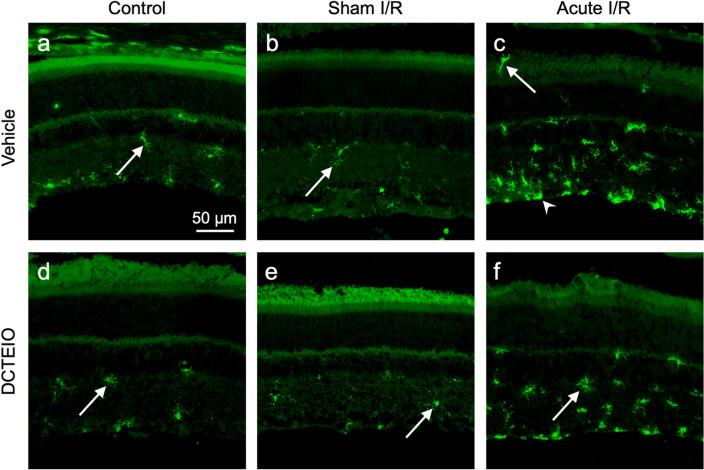
IBA-1 immunohistochemistry of rat retinas 8 days post-treatment. ‘I.P’ (a & d) and ‘sham I/R’ treated animals (b & e) displayed limited numbers of microglia in a ‘resting ramified’ state (white arrows). The induction of ischaemia (acute I/R) resulted in an upregulation of IBA-1 expression, increased microglial migration and numerous microglia displaying a small, spherical, amoeboid-like morphology indicative of ‘reactive’ microglia (c, white arrowhead). DCTEIO successfully reduced the overall number of ‘reactive’ microglia (f), ultimately reducing the immunological response
Fig. 8
Fig. 8
The effect of DCTEIO on the number and distribution of ‘ramified’ (resting) and ‘active’ (amoeboid) microglial cells in the retina 8 days post treatment (mean ± SEM, n = 3 for I.P & acute I/R, and n = 4 for I.O treatment groups). DCTEIO significantly reduced both classes of microglia in the inner retina (IR), outer nuclear layer (ONL) and photoreceptor segments (PRS) in ‘acute I/R treated animals. *p < 0.05, **p < 0.005, ***p < 0.0005, ****p < 0.0001. p < 0.0001 when comparing ‘acute I/R’ and ‘sham I/R’ treatment groups
Fig. 9
Fig. 9
Hematoxylin–eosin staining of rat retinas 8 days post-treatment. Undamaged sham I/R: vehicle (a) and sham I/R: DCTEIO (d) retinas. Damage to ‘acute I/R: vehicle’ treated retinas varied from minor cell loss (b, black arrow), to complete disruption and disorganisation of the nuclear layers (c, white arrow). DCTEIO preserved the structural integrity of each cell layer, with minor to indiscernible cell loss observed in the inner nuclear layer (e and f, black arrows)
Fig. 10
Fig. 10
Quantification of oxidative stress and the protection offered by antioxidant compounds in the 661W photoreceptor cell line by flow cytometry. a Accumulation of red fluorescent ME-TRN probe by the mitochondria of cultured 661W cells. b Dose–response characteristics of the mitochondrial complex III inhibitor, antimycin (AMC), in the reduction of ME-TRN MFI. c Histograms of the MFI for vehicle (red), AMC 1 µM (black) and antioxidant (green) treated cells. d Example of calculating change in % fluorescence (% reduction and % mitigation). e Mitigation of the AMC-induced pro-oxidant effect upon ME-TRN fluorescence by the carotenoid antioxidant lutein and the nitroxide antioxidant DCTEIO (f). Data are expressed as the mean ± SEM (n ≥ 5). *p = 0.0143, ***p = 0.0002

References

    1. Pardue MT, Allen RS. Neuroprotective strategies for retinal disease. Prog Retin Eye Res. 2018;65:50–76. doi: 10.1016/j.preteyeres.2018.02.002. - DOI - PMC - PubMed
    1. Hill D, Compagnoni C, Cordeiro MF. Investigational neuroprotective compounds in clinical trials for retinal disease. Expert Opin Investig Drugs. 2021;30:571–577. doi: 10.1080/13543784.2021.1896701. - DOI - PubMed
    1. Adornetto A, Russo R, Parisi V. Neuroinflammation as a target for glaucoma therapy. Neural Regen Res. 2019;14:391–394. doi: 10.4103/1673-5374.245465. - DOI - PMC - PubMed
    1. Saccà SC, Corazza P, Gandolfi S, Ferrari D, Sukkar S, Iorio EL, Traverso CE. Substances of interest that support glaucoma therapy. Nutrients. 2019 doi: 10.3390/nu11020239. - DOI - PMC - PubMed
    1. Schwartz M, Baruch K. The resolution of neuroinflammation in neurodegeneration: leukocyte recruitment via the choroid plexus. EMBO J. 2014;33:7–22. doi: 10.1002/embj.201386609. - DOI - PMC - PubMed