Body Composition, Relative Dose Intensity, and Adverse Events among Patients with Colon Cancer
- PMID: 37450841
- PMCID: PMC10592319
- DOI: 10.1158/1055-9965.EPI-23-0227
Body Composition, Relative Dose Intensity, and Adverse Events among Patients with Colon Cancer
Abstract
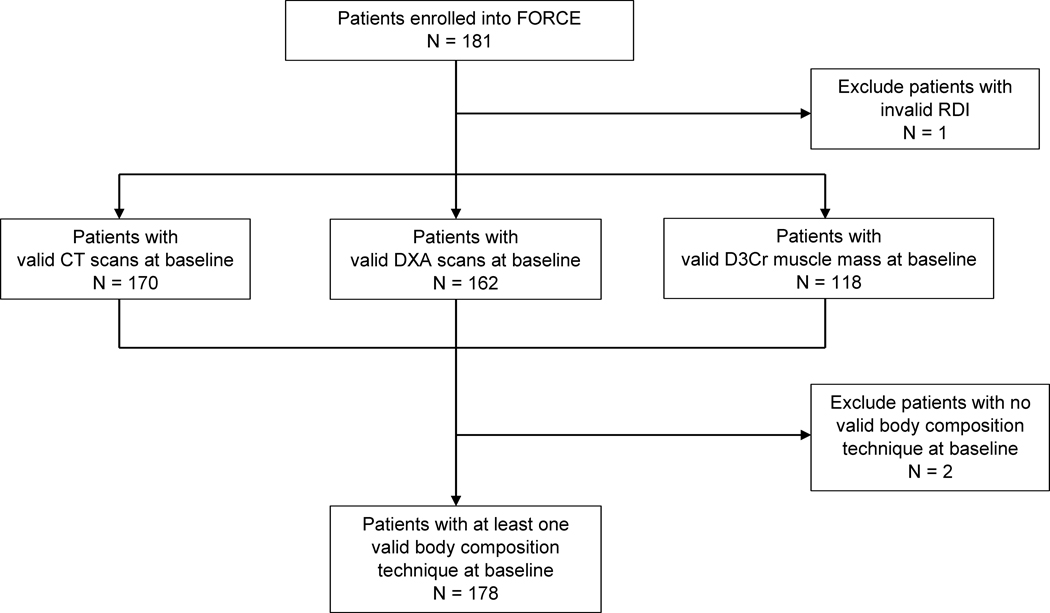
Background: Despite evidence that low muscle increases the risk of chemotoxicity, most chemotherapies are dosed on body surface area without considering body composition. Among 178 patients with colon cancer, we assessed muscle and adipose tissue with multiple techniques and examined their associations with relative dose intensity (RDI) and adverse events.
Methods: We estimated (i) cross-sectional skeletal muscle area (SMA) and total adipose tissue (TAT) area at L3 from computed tomography (CT); (ii) appendicular lean mass (ALM) and total body fat (TBF) mass from dual-energy X-ray absorptiometry (DXA); and (iii) total body skeletal muscle mass using D3-creatine (D3Cr) dilution. We standardized each measurement by its sex-specific standard deviation (SD). The primary outcome was reduced RDI (RDI <85%). The secondary outcome was the number of moderate and severe adverse events during each cycle of chemotherapy. We estimated the associations of muscle and adipose tissue measurements (per SD increase) with reduced RDI using logistic regression and adverse events using generalized estimating equations for repeated measures.
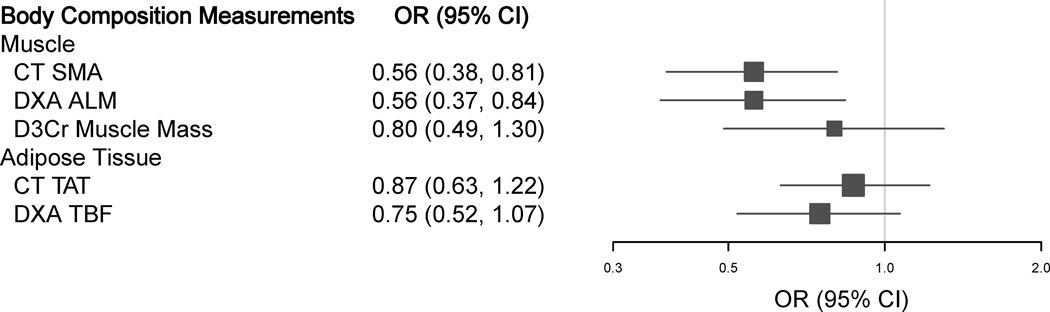
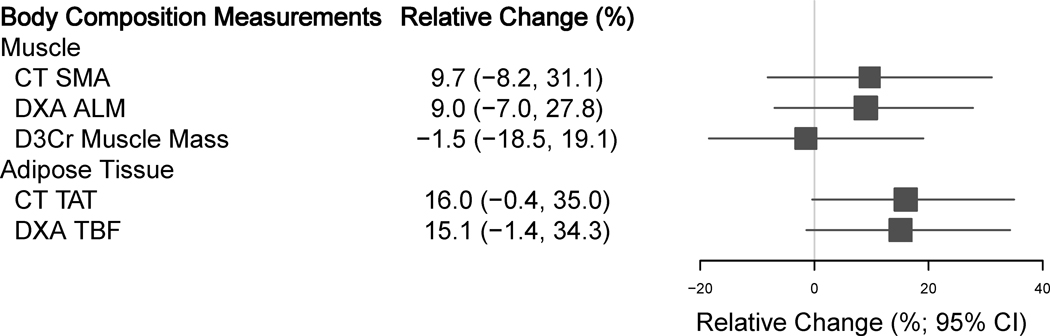
Results: Higher CT SMA and DXA ALM were significantly associated with a lower risk of reduced RDI [odds ratios: 0.56 (0.38-0.81) for CT SMA; 0.56 (0.37-0.84) for DXA ALM]. No measurements of muscle or adipose tissue were associated with adverse events.
Conclusions: More muscle was associated with improved chemotherapy completion among patients with colon cancer, whereas muscle and adipose tissue were not associated with adverse events.
Impact: Considering body composition may help personalize dosing for colon cancer chemotherapy by identifying patients at risk for poor chemotherapy outcomes.
©2023 American Association for Cancer Research.
Conflict of interest statement
Conflict of Interest:
Dr. Jeffrey A. Meyerhardt has served as an advisor/consultant to Merck Pharmaceutical and COTA Healthcare.
Figures
References
-
- Silvestris N, Argentiero A, Natalicchio A, D’Oronzo S, Beretta GD, Acquati S, et al. Antineoplastic dosing in overweight and obese cancer patients: an Associazione Italiana Oncologia Medica (AIOM)/Associazione Medici Diabetologi (AMD)/Societa Italiana Endocrinologia (SIE)/Societa Italiana Farmacologia (SIF) multidisciplinary consensus position paper. ESMO Open 2021;6(3):100153 doi 10.1016/j.esmoop.2021.100153. - DOI - PMC - PubMed
Publication types
MeSH terms
Grants and funding
LinkOut - more resources
Full Text Sources