


The latest breakthrough on genetic characteristics of inflammatory bowel disease in Chinese and other East Asian ancestries
- PMID: 37456986
- PMCID: PMC10346401
- DOI: 10.1093/pcmedi/pbad017
The latest breakthrough on genetic characteristics of inflammatory bowel disease in Chinese and other East Asian ancestries
Abstract
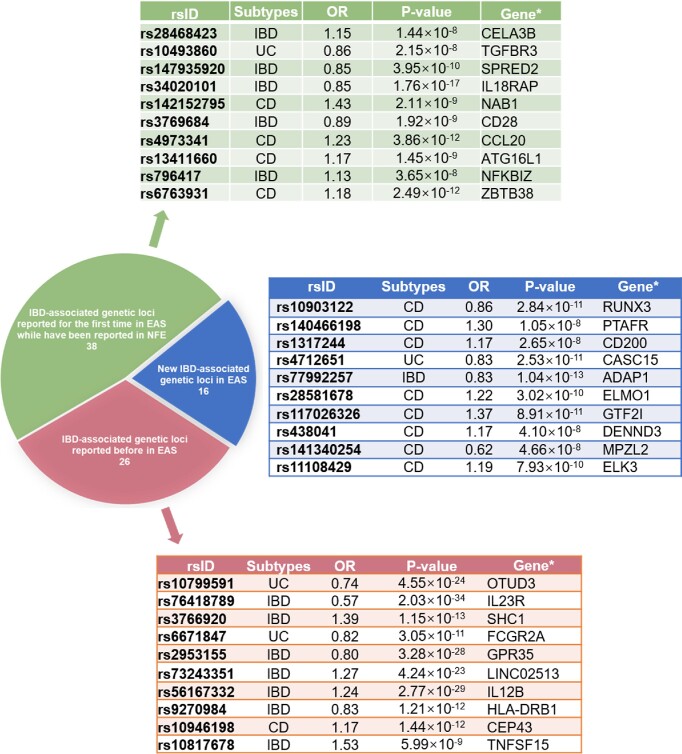
Inflammatory bowel diseases (IBDs) are complex chronic disorders of the gastrointestinal tract with the following two subtypes: Crohn's disease and ulcerative colitis. Disease presentation and progression within and across IBDs, especially Crohn's disease, are highly heterogeneous in the location, severity of inflammation, intestinal stenosis and obstruction, and extraintestinal manifestations. Clinical classifications fail to accurately predict the disease course and response to therapies. To date, most IBD genetic associations are derived from individuals of European ancestries, leading to a limitation of the discovery and application of IBD genetics in the rest of the world populations. In this mini-review, we summarize the latest progress of genome-wide association studies of IBD across global ancestries especially the Chinese population, the similarities and differences in genetic architecture between European and East Asian ancestries, as well as, the clinical significances relevant to IBD genetic study.
Keywords: Chinese population; Crohn's disease; East Asian; inflammatory bowel disease; susceptible gene; ulcerative colitis.
© The Author(s) 2023. Published by Oxford University Press on behalf of the West China School of Medicine & West China Hospital of Sichuan University.
Conflict of interest statement
The authors have no conflicts of interest to disclose. In addition, as an Editorial Board Member of Precision Clinical Medicine, the corresponding author Zhanju Liu was blinded from reviewing and making decision on this manuscript.
Figures
References
-
- Collaborators GBDIBD . The global, regional, and national burden of inflammatory bowel disease in 195 countries and territories, 1990-2017: a systematic analysis for the Global Burden of Disease Study 2017. Lancet Gastroenterol Hepatol. 2020;5:17–30. doi: 10.1016/S2468-1253(19)30333-4. - DOI - PMC - PubMed
LinkOut - more resources
Full Text Sources