Review
. 2023 Jun 29:17:1201971.
doi: 10.3389/fnins.2023.1201971. eCollection 2023.

Potential role of creatine as an anticonvulsant agent: evidence from preclinical studies

Affiliations
Review

Potential role of creatine as an anticonvulsant agent: evidence from preclinical studies

Eman A Alraddadi et al. Front Neurosci. .

Abstract

Epilepsy is one of the most common neurological disorders affecting people of all ages representing a significant social and public health burden. Current therapeutic options for epilepsy are not effective in a significant proportion of patients suggesting a need for identifying novel targets for the development of more effective therapeutics. There is growing evidence from animal and human studies suggesting a role of impaired brain energy metabolism and mitochondrial dysfunction in the development of epilepsy. Candidate compounds with the potential to target brain energetics have promising future in the management of epilepsy and other related neurological disorders. Creatine is a naturally occurring organic compound that serves as an energy buffer and energy shuttle in tissues, such as brain and skeletal muscle, that exhibit dynamic energy requirements. In this review, applications of creatine supplements in neurological conditions in which mitochondrial dysfunction is a central component in its pathology will be discussed. Currently, limited evidence mainly from preclinical animal studies suggest anticonvulsant properties of creatine; however, the exact mechanism remain to be elucidated. Future work should involve larger clinical trials of creatine used as an add-on therapy, followed by large clinical trials of creatine as monotherapy.

Keywords: anticonvulsant; antioxidant; creatine; epilepsy; mitochondrial dysfunction; seizure.


Conflict of interest statement

The authors declare that the research was conducted in the absence of any commercial or financial relationships that could be construed as a potential conflict of interest.

Figures
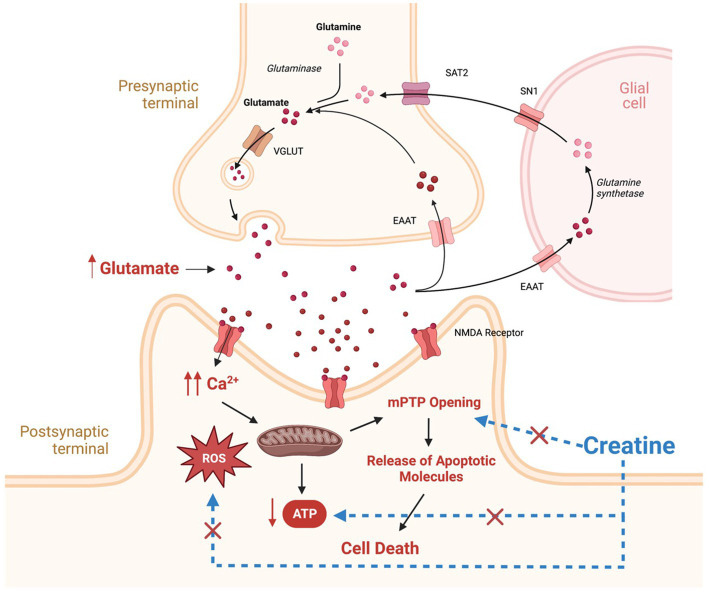
Figure 1
Figure 1
Potential mechanisms involved in the pathogenesis of epilepsy and potential targets for creatine neuroprotective effects. Therapeutic targets for creatine supplementation are denoted by blue dashed lines. SAT2, system A transporter 2; SN1, system N transporter 1; EAAT, excitatory amino acid transporter; VGLUT, vesicular glutamate transporter; NMDA, N-methyl-D-aspartate; ROS, reactive oxygen species; MPTP, mitochondrial permeability transition pore. This figure is created with BioRender.com.
Figure 2
Figure 2
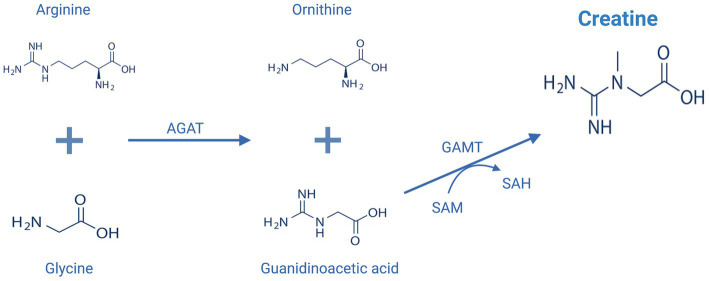
Endogenous creatine biosynthesis pathway. AGAT, L-arginine:glycine amidinotransferase; GAMT, S-adenosyl-L-methionine:N-guanidinoacetate methyltransferase; SAM, S-adenosylmethionine, SAH: S-adenosylhomocysteine. This figure is created with BioRender.com.
Figure 3
Figure 3
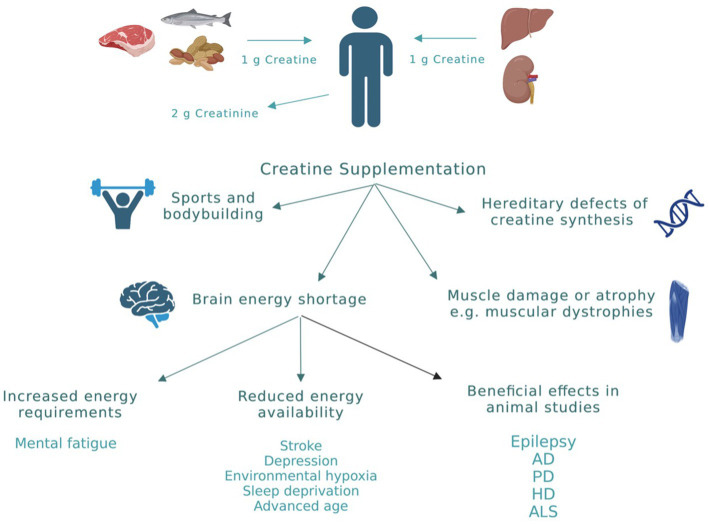
Creatine sources and applications. Physiologically, the daily loss of creatine due to its break down to creatinine is around 2 g. This amount is replenished by endogenous synthesis (≈ 1 g/daily) and through dietary creatine (≈ 1 g/daily). However, in cases of high-energy demands or reduced energy production, exogenous creatine supplementation is required to produce beneficial effects. Clinical conditions in which there is evidence for beneficial effects of creatine from human studies are highlighted in this figure. AD, Alzheimer’s disease; PD, Parkinson’s disease; HD, huntington’s disease; ALS, amyotrophic lateral sclerosis. This figure is created with BioRender.com.

References

    1. Adhihetty P. J., Beal M. F. (2008). Creatine and its potential therapeutic value for targeting cellular energy impairment in neurodegenerative diseases. NeuroMolecular Med. 10, 275–290. doi: 10.1007/s12017-008-8053-y, PMID: - DOI - PMC - PubMed
    1. Alqahtani F., Imran I., Pervaiz H., Ashraf W., Perveen N., Rasool M. F., et al. . (2020). Non-pharmacological interventions for intractable epilepsy. Saudi Pharm J. 28, 951–962. doi: 10.1016/j.jsps.2020.06.016, PMID: - DOI - PMC - PubMed
    1. Alraddadi E. A., Lillico R., Vennerstrom J. L., Lakowski T. M., Miller D. W. (2018). Absolute Oral bioavailability of Creatine monohydrate in rats: debunking a myth. Pharmaceutics 10:31. doi: 10.3390/pharmaceutics10010031, PMID: - DOI - PMC - PubMed
    1. Atkins C. M., Truettner J. S., Lotocki G., Sanchez-Molano J., Kang Y., Alonso O. F., et al. . (2010). Post-traumatic seizure susceptibility is attenuated by hypothermia therapy. Eur. J. Neurosci. 32, 1912–1920. doi: 10.1111/j.1460-9568.2010.07467.x, PMID: - DOI - PMC - PubMed
    1. Balestrini S., Arzimanoglou A., Blumcke I., Scheffer I. E., Wiebe S., Zelano J., et al. . (2021). The aetiologies of epilepsy. Epileptic Disord. 23, 1–16. doi: 10.1684/epd.2021.1255, PMID: - DOI - PubMed

LinkOut - more resources