Review
. 2023 Jun 29:13:1200617.
doi: 10.3389/fcimb.2023.1200617. eCollection 2023.

Changing patterns of infectious diseases in children during the COVID-19 pandemic

Affiliations
Review

Changing patterns of infectious diseases in children during the COVID-19 pandemic

Ming-Chun Yang et al. Front Cell Infect Microbiol. .

Abstract

Each infectious disease has had its own epidemic pattern and seasonality for decades. However, public health mitigation measures during the coronavirus disease 2019 (COVID-19) pandemic have resulted in changing epidemic patterns of infectious diseases. Stringent measures resulted in low incidences of various infectious diseases during the outbreak of COVID-19, including influenza, respiratory syncytial virus, pneumococcus, enterovirus, and parainfluenza. Owing to the prevalence of severe acute respiratory syndrome coronavirus 2 (SARS-CoV-2) infections and subsequent immunity development, decreasing virulence of SARS-CoV-2, and worldwide immunization against SARS-CoV-2 in children beyond 6 months of age, mitigation measures are lifted country by country. Consequently, the immunity debt to infectious respiratory viruses other than SARS-CoV-2 contributed to the "off-season," "see-saw," and "upsurge" patterns of various infectious diseases in children. Moreover, apart from the persistence of SARS-CoV-2, the coexistence of other circulating viruses or bacterial outbreaks may lead to twindemics or tripledemics during the following years. Therefore, it is necessary to maintain hand hygiene and immunization policies against various pathogens to alleviate the ongoing impact of infectious diseases on children.

Keywords: coronavirus disease 2019; immune debt; influenza; pediatric; pneumococcus; respiratory syncytial virus; respiratory tract infection.


Conflict of interest statement

The authors declare that the research was conducted in the absence of any commercial or financial relationships that could be construed as a potential conflict of interest.

Figures
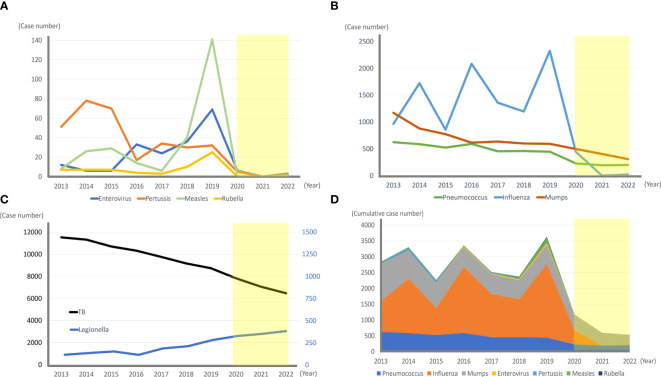
Figure 1
Figure 1
The incidence of various infectious diseases in Taiwan before (2013–2019) and during (2020–2022, light yellow box) the COVID-19 pandemic. (A, B) Annual reported cases of invasive pneumococcal diseases, influenza-associated critical illnesses, mumps, enterovirus-associated critical illnesses, pertussis, measles, and rubella in Taiwan from 2013–2022 are shown. The annual incidence dropped dramatically in 2020–2022 during the COVID-19 pandemic. (C) Annual tuberculosis cases decreased at a steady rate during the past 10 years, and the slope of 2020–2022 did not differ from the slope of 2013–2019 significantly. In contrast, the number of Legionella cases has steadily increased over the past 10 years. (D) Annual cumulative number of invasive pneumococcal diseases, influenza-associated critical illnesses, mumps, enterovirus-associated critical illnesses, pertussis, measles, and rubella significantly decreased from 2020 to 2022.
Figure 2
Figure 2
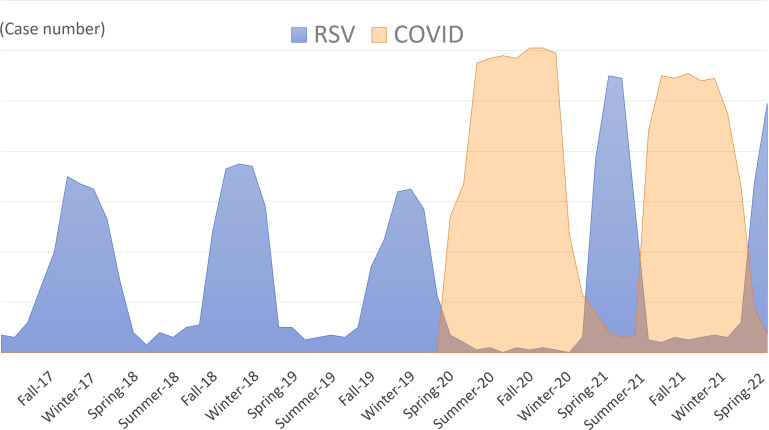
The schematic diagram showing the “off-season”, “see-sawing”, and “upsurge” patterns of respiratory syncytial viruses (RSV) infection in children. Previously RSV infections had a seasonal peak; however, the impact of COVID-19 mitigation measures contributed to the “off-season” resurgence of RSV. The “see-sawing” pattern of the RSV outbreak alternated with the COVID-19 epidemic. Strict restrictions during the COVID-19 outbreak periods result in the flattening of the RSV epidemic; in contrast, unrestrained regulations after the cooldown of COVID-19 led to resurgence of the RSV outbreak. Public health measures lead to immunity debt to RSV, which further results in RSV infections reaching the highest peak after the dismissal of public health mitigation policies (“upsurge” pattern).

References

    1. Agha R., Avner J. R. (2021). Delayed seasonal RSV surge observed during the COVID-19 pandemic. Pediatrics 148 (3), e2021052089. doi: 10.1542/peds.2021-052089 - DOI - PubMed
    1. Anestad G., Vainio K., Hungnes O. (2007). Interference between outbreaks of epidemic viruses. Scand. J. Infect. Dis. 39 (6-7), 653–654. doi: 10.1080/00365540701253860 - DOI - PubMed
    1. Baker R. E., Park S. W., Yang W., Vecchi G. A., Metcalf C. J. E., Grenfell B. T. (2020). The impact of COVID-19 nonpharmaceutical interventions on the future dynamics of endemic infections. Proc. Natl. Acad. Sci. U S A 117 (48), 30547–30553. doi: 10.1073/pnas.2013182117 - DOI - PMC - PubMed
    1. Belingheri M., Paladino M. E., Piacenti S., Riva M. A. (2021). Effects of COVID-19 lockdown on epidemic diseases of childhood. J. Med. Virol. 93 (1), 153–154. doi: 10.1002/jmv.26253 - DOI - PMC - PubMed
    1. Benschop K. S., Albert J., Anton A., Andrés C., Aranzamendi M., Armannsdóttir B., et al. (2021). Re-emergence of enterovirus D68 in Europe after easing the COVID-19 lockdown, September 2021. Euro Surveill 26 (45), 2100998. doi: 10.2807/1560-7917.ES.2021.26.45.2100998 - DOI - PMC - PubMed

Publication types