


Prevalence of Alzheimer's disease dementia in the 50 US states and 3142 counties: A population estimate using the 2020 bridged-race postcensal from the National Center for Health Statistics
- PMID: 37458371
- PMCID: PMC10593099
- DOI: 10.1002/alz.13081
Prevalence of Alzheimer's disease dementia in the 50 US states and 3142 counties: A population estimate using the 2020 bridged-race postcensal from the National Center for Health Statistics
Abstract
Introduction: This study estimates the prevalence and number of people living with Alzheimer's disease (AD) dementia in 50 US states and 3142 counties.
Methods: We used cognitive data from the Chicago Health and Aging Project, a population-based study, and combined it with the National Center for Health Statistics 2020 bridged-race population estimates to determine the prevalence of AD in adults ≥65 years.
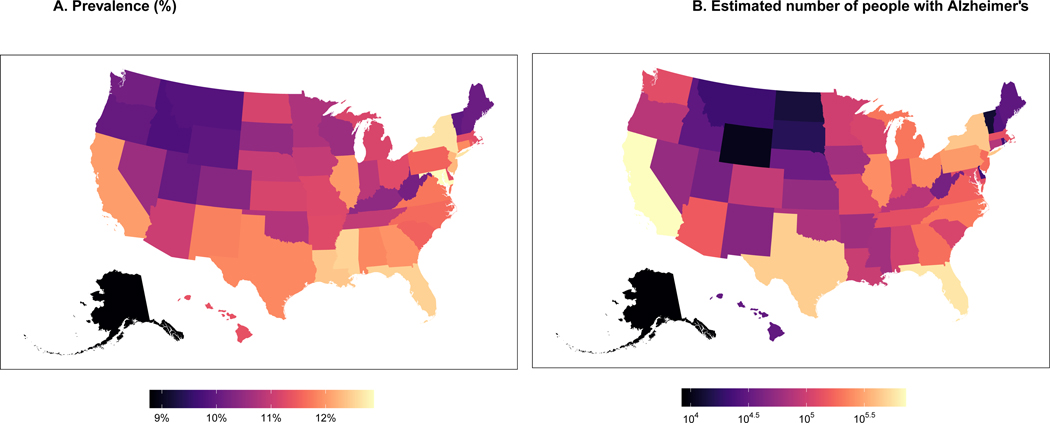
Results: A higher prevalence of AD was estimated in the east and southeastern regions of the United States, with the highest in Maryland (12.9%), New York (12.7%), and Mississippi (12.5%). US states with the highest number of people with AD were California, Florida, and Texas. Among larger counties, those with the highest prevalence of AD were Miami-Dade County in Florida, Baltimore city in Maryland, and Bronx County in New York.
Discussion: The state- and county-specific estimates could help public health officials develop region-specific strategies for caring for people with AD.
Keywords: 2020 US prevalence; Alzheimer's disease; aging; dementia; epidemiology; prevalence.
© 2023 the Alzheimer's Association.
Conflict of interest statement
Conflicts
KD and KBR are funded by Alzheimer’s Association and NIH research grants and reports no conflicts of interest. TB, PD, RSW, and DAE reports no conflicts of interest.
Figures

References
-
- (2022) 2022 alzheimer’s disease facts and figures. Alzheimer’s & Dementia 18, 700–789. - PubMed
-
- Taylor DH, Fillenbaum GG, Ezell ME (2002) The accuracy of medicare claims data in identifying Alzheimer’s disease. Journal of Clinical Epidemiology 55, 929–937. - PubMed
-
- Newcomer R, Clay T, Luxenberg JS, Miller RH (1999) Misclassification and selection bias when identifying alzheimer’s disease solely from medicare claims records. Journal of the American Geriatrics Society 47, 215–9. - PubMed
Publication types
MeSH terms
Grants and funding
LinkOut - more resources
Full Text Sources
Medical
