. 2023 Jul 25;120(30):e2219925120.
doi: 10.1073/pnas.2219925120. Epub 2023 Jul 17.

In vivo versus in silico assessment of potentially pathogenic missense variants in human reproductive genes

Affiliations

In vivo versus in silico assessment of potentially pathogenic missense variants in human reproductive genes

Xinbao Ding et al. Proc Natl Acad Sci U S A. .

Abstract

Infertility is a heterogeneous condition, with genetic causes thought to underlie a substantial fraction of cases. Genome sequencing is becoming increasingly important for genetic diagnosis of diseases including idiopathic infertility; however, most rare or minor alleles identified in patients are variants of uncertain significance (VUS). Interpreting the functional impacts of VUS is challenging but profoundly important for clinical management and genetic counseling. To determine the consequences of these variants in key fertility genes, we functionally evaluated 11 missense variants in the genes ANKRD31, BRDT, DMC1, EXO1, FKBP6, MCM9, M1AP, MEI1, MSH4 and SEPT12 by generating genome-edited mouse models. Nine variants were classified as deleterious by most functional prediction algorithms, and two disrupted a protein-protein interaction (PPI) in the yeast two hybrid (Y2H) assay. Though these genes are essential for normal meiosis or spermiogenesis in mice, only one variant, observed in the MCM9 gene of a male infertility patient, compromised fertility or gametogenesis in the mouse models. To explore the disconnect between predictions and outcomes, we compared pathogenicity calls of missense variants made by ten widely used algorithms to 1) those annotated in ClinVar and 2) those evaluated in mice. All the algorithms performed poorly in terms of predicting the effects of human missense variants modeled in mice. These studies emphasize caution in the genetic diagnoses of infertile patients based primarily on pathogenicity prediction algorithms and emphasize the need for alternative and efficient in vitro or in vivo functional validation models for more effective and accurate VUS description to either pathogenic or benign categories.

Keywords: CRISPR/Cas9; infertility; meiosis; pathogenicity prediction algorithms; variants of uncertain significance.


Conflict of interest statement

The authors declare no competing interest.

Figures

Fig. 1.
Fig. 1.
Scheme for functionally interpreting missense variants in reproduction genes. Variants were divided into three groups according to distinct variant prioritization pipelines.
Fig. 2.
Fig. 2.
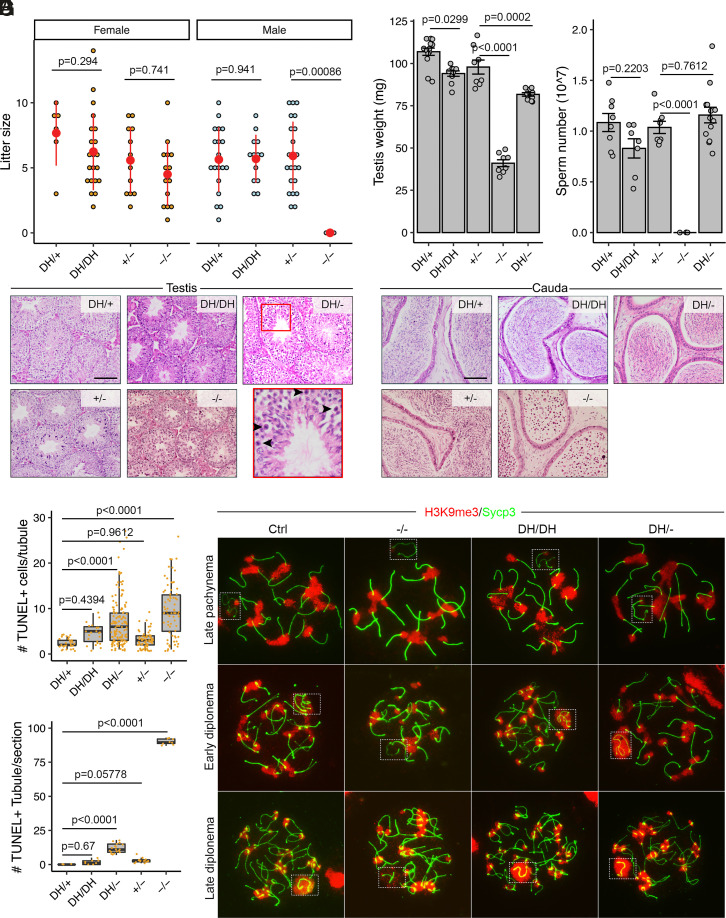
Phenotypic analysis of BrdtD550H mice. (A) Litter sizes from mating of BrdtD550H/D550H (DH/DH), BrdtD550H/+ (DH/+), Brdt+/− (+/−), and Brdt−/− (−/−) animals to WT partners. N = 2 for DH/DH male and female mice, N = 3 for −/− male and female mice. (B) Testis weights of 2-mo-old males. (C) Epididymal sperm counts. (D) Histological sections of 2-mo-old testes and cauda epididymides. Round germ cells were present in −/− epididymides. (Scale bars, 100 μm.) Black arrowheads in the inset indicate meiotic metaphase I–arrested cells. (E) Quantification of TUNEL+ cells in each tubule. (F) Number of tubules containing > 4 TUNEL+ cells. No control (DH/+) tubules section had >4. N = 3 mice. (G) Immunolocalization of H3K9me3 and Sycp3 on meiotic prophase I chromosomes in indicated spermatocytes stages. Dashed boxes highlight XY bodies. Data in AC are represented as the mean ± SEM. Data in AC, E, and F were analyzed using one-way ANOVA with Tukey’s post hoc test.
Fig. 3.
Fig. 3.
Phenotypic analysis of Sept12 V162M and Sept12V222I mice. (A) Litter sizes from mating of WT (+/+), Sept12V162M/V162M (VM/VM), and Sept12V222I/V222I (VI/VI) males to WT partners. N = 2 for VM/VM and VI/VI mice. (B) Testis weight of 2-mo-old mice. (C) Sperm counts. (D) Histological analyses of 2-mo-old testes. (Scale bars, 100 μm.) Data in AC are represented as the mean ± SEM and were analyzed using one-way ANOVA with Tukey’s post hoc test.
Fig. 4.
Fig. 4.
Phenotypic analysis of Mcm9 R581H mice. (A) Testis weights of 2-mo-old mice. (B) Sperm counts. (C) Histological analyses of 2-mo-old testes. (Scale bars, 100 μm.) (D) Representative ovary sections from 2-mo-old mice. The boxed regions are magnifications of follicles. (Scale bars, 250 μm.) Data in A and B are represented as the mean ± SEM and were analyzed using a two-tailed unpaired t test.
Fig. 5.
Fig. 5.
Comparison of predicted and actual deleterious variants analyzed with various pathogenicity predictors. (A) In silico prediction outcomes of 10 commonly used algorithms for 29 functionally interpreted variants in mouse models. The in vitro experiments of DMC1_M200V variants were performed by ref. . The variants below the dotted line all were tested by at least one in vitro prescreen experiment. The bond font represents that the variants were identified from infertility patients. N.A., not available. (B) Overview of how the Mouse_all and Mouse_infertility datasets were derived. For missense variants modeled in mice, only those with SNP rsIDs were considered. (C) Prediction accuracy (ACC), (D) positive predictive value (PPV), and (E) Matthews correlation coefficient (MCC) of predictors using ClinVar_infertility (n = 851; only pathogenic and benign variants were used), Mouse_all (n = 235) and Mouse_infertility (n = 42) datasets. (F) ROC (receiver operating characteristic) curves of 10 predictors in three datasets and the AUC (area under the curve) values were labeled in brackets.
Fig. 6.
Fig. 6.
Comparison of allele frequency and variant interpretation. (A) Distribution of missense variants from three datasets comparing total AF vs. Popmax Filtering AF (95% confidence). (B) Classification of functionally interpreted missense variants in ClinVar. Variants modeled in mice (n = 172 interpreted in the ClinVar database) were classified as either benign or deleterious according to the reported phenotype description. These variants were correlated with ClinVar classifications (benign/likely benign, conflicting interpretations, VUS, and pathogenic/likely pathogenic).

References

    1. Mahmood K., et al. , Variant effect prediction tools assessed using independent, functional assay-based datasets: Implications for discovery and diagnostics. Hum. Genomics 11, 1–8 (2017). - PMC - PubMed
    1. Schimenti J. C., Handel M. A., Unpackaging the genetics of mammalian fertility: Strategies to identify the “reproductive genome”. Biol. Reprod. 99, 1119–1128 (2018). - PubMed
    1. Singh P., Schimenti J. C., The genetics of human infertility by functional interrogation of SNPs in mice. Proc. Natl. Acad. Sci. U.S.A. 112, 10431–10436 (2015). - PMC - PubMed
    1. Tran T. N., Schimenti J. C., A segregating human allele of SPO11 modeled in mice disrupts timing and amounts of meiotic recombination, causing oligospermia and a decreased ovarian reserve†. Biol. Reprod. 101, 347–359 (2019). - PMC - PubMed
    1. Tran T. N., Schimenti J. C., A putative human infertility allele of the meiotic recombinase DMC1 does not affect fertility in mice. Hum. Mol. Genet. 27, 3911–3918 (2018). - PMC - PubMed

Publication types