


Assessment of androgen receptor expression in breast cancer patients using 18 F-FDG PET/CT radiomics and clinicopathological characteristics
- PMID: 37460990
- PMCID: PMC10353086
- DOI: 10.1186/s12880-023-01052-z
Assessment of androgen receptor expression in breast cancer patients using 18 F-FDG PET/CT radiomics and clinicopathological characteristics
Abstract
Objective: In the present study, we mainly aimed to predict the expression of androgen receptor (AR) in breast cancer (BC) patients by combing radiomic features and clinicopathological factors in a non-invasive machine learning way.
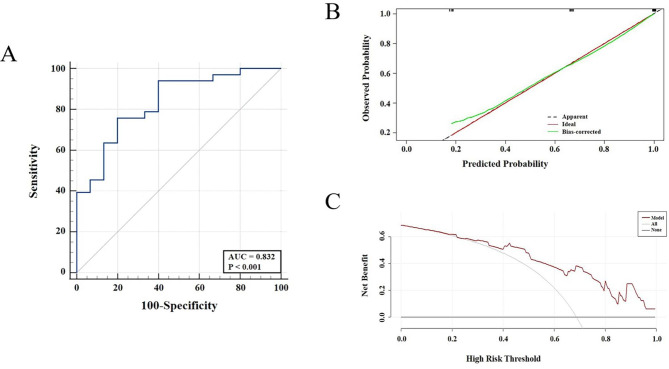
Materials and methods: A total of 48 BC patients, who were initially diagnosed by 18F-FDG PET/CT, were retrospectively enrolled in this study. LIFEx software was used to extract radiomic features based on PET and CT data. The most useful predictive features were selected by the LASSO (least absolute shrinkage and selection operator) regression and t-test. Radiomic signatures and clinicopathologic characteristics were incorporated to develop a prediction model using multivariable logistic regression analysis. The receiver operating characteristic (ROC) curve, Hosmer-Lemeshow (H-L) test, and decision curve analysis (DCA) were conducted to assess the predictive efficiency of the model.
Results: In the univariate analysis, the metabolic tumor volume (MTV) was significantly correlated with the expression of AR in BC patients (p < 0.05). However, there only existed feeble correlations between estrogen receptor (ER), progesterone receptor (PR), and AR status (p = 0.127, p = 0.061, respectively). Based on the binary logistic regression method, MTV, SHAPE_SphericityCT (CT Sphericity from SHAPE), and GLCM_ContrastCT (CT Contrast from grey-level co-occurrence matrix) were included in the prediction model for AR expression. Among them, GLCM_ContrastCT was an independent predictor of AR status (OR = 9.00, p = 0.018). The area under the curve (AUC) of ROC in this model was 0.832. The p-value of the H-L test was beyond 0.05.
Conclusions: A prediction model combining radiomic features and clinicopathological characteristics could be a promising approach to predict the expression of AR and noninvasively screen the BC patients who could benefit from anti-AR regimens.
Keywords: 18F-FDG PET/CT; Androgen receptor; Breast cancer; Clinicopathological; Machine learning; Radiomics.
© 2023. The Author(s).
Conflict of interest statement
The authors declare that the research was conducted in the absence of any commercial or financial relationships that could be construed as a potential conflict of interest.
Figures


References
Publication types
MeSH terms
Substances
LinkOut - more resources
Full Text Sources
Medical
Research Materials
