


Treatment strategies and survival of patients with connective tissue disease and pulmonary arterial hypertension: a COMPERA analysis
- PMID: 37462520
- PMCID: PMC10986797
- DOI: 10.1093/rheumatology/kead360
Treatment strategies and survival of patients with connective tissue disease and pulmonary arterial hypertension: a COMPERA analysis
Abstract
Objectives: Pulmonary arterial hypertension (PAH) occurs in various connective tissue diseases (CTDs). We sought to assess contemporary treatment patterns and survival of patients with various forms of CTD-PAH.
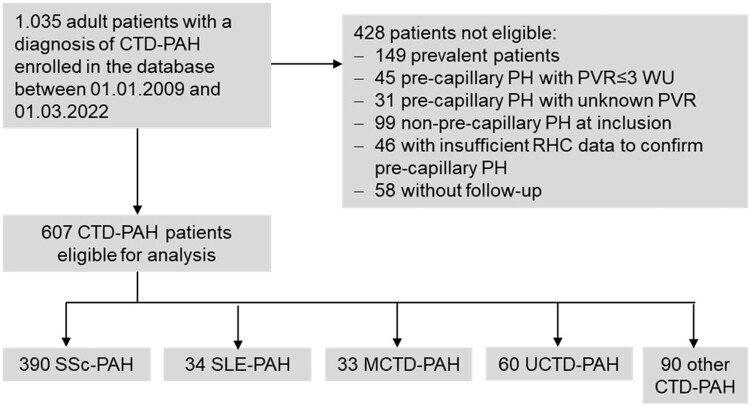
Methods: We analysed data from COMPERA, a European pulmonary hypertension registry, to describe treatment strategies and survival in patients with newly diagnosed PAH associated with SSc, SLE, MCTD, UCTD and other types of CTD. All-cause mortality was analysed according to the underlying CTD. For patients with SSc-PAH, we also assessed survival according to initial therapy with endothelin receptor antagonists (ERAs), phosphodiesterase type 5 inhibitors (PDE5is) or a combination of these two drug classes.
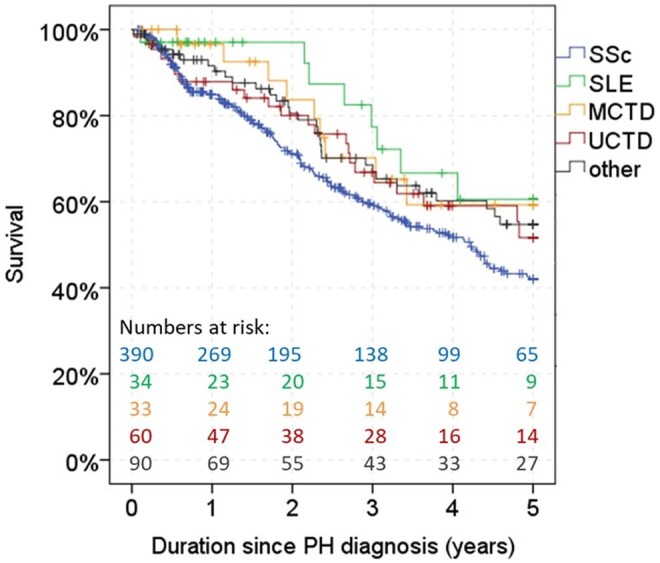
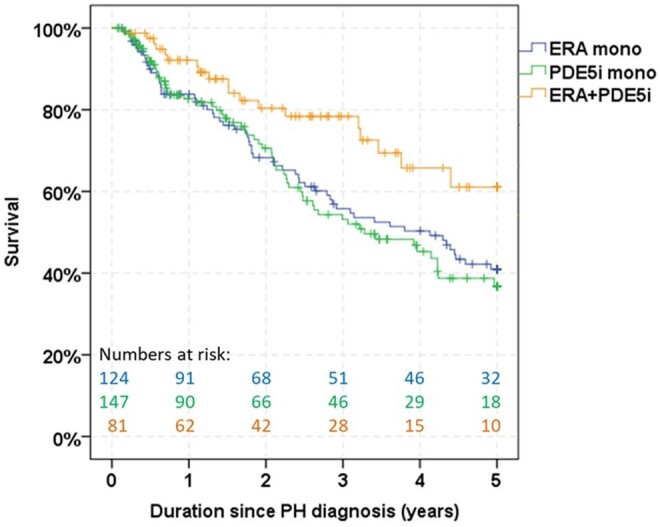
Results: This analysis included 607 patients with CTD-PAH. Survival estimates at 1, 3 and 5 years for SSc-PAH (n = 390) were 85%, 59% and 42%; for SLE-PAH (n = 34) they were 97%, 77% and 61%; for MCTD-PAH (n = 33) they were 97%, 70% and 59%; for UCTD-PAH (n = 60) they were 88%, 67% and 52%; and for other CTD-PAH (n = 90) they were 92%, 69% and 55%, respectively. After multivariable adjustment, the survival of patients with SSc-PAH was significantly worse compared with the other conditions (P = 0.001). In these patients, the survival estimates were significantly better with initial ERA-PDE5i combination therapy than with initial ERA or PDE5i monotherapy (P = 0.016 and P = 0.012, respectively).
Conclusions: Mortality remains high in patients with CTD-PAH, especially for patients with SSc-PAH. However, for patients with SSc-PAH, our results suggest that long-term survival may be improved with initial ERA-PDE5i combination therapy compared with initial monotherapy.
Keywords: connective tissue disease (CTD); endothelin receptor antagonists (ERA); phosphodiesterase type 5 inhibitor (PDE5i); pulmonary arterial hypertension; systemic sclerosis (SSc).
© The Author(s) 2023. Published by Oxford University Press on behalf of the British Society for Rheumatology.
Figures
References
-
- Thakkar V, Lau EM.. Connective tissue disease-related pulmonary arterial hypertension. Best Pract Res Clin Rheumatol 2016;30:22–38. - PubMed
-
- Galie N, Humbert M, Vachiery JL. et al. 2015 ESC/ERS guidelines for the diagnosis and treatment of pulmonary hypertension: the Joint Task Force for the Diagnosis and Treatment of Pulmonary Hypertension of the European Society of Cardiology (ESC) and the European Respiratory Society (ERS): Endorsed by: association for European Paediatric and Congenital Cardiology (AEPC), International Society for Heart and Lung Transplantation (ISHLT). Eur Respir J 2015;46:903–75. - PubMed
-
- Gurubhagavatula I, Palevsky HI.. Pulmonary hypertension in systemic autoimmune disease. Rheum Dis Clin North Am 1997;23:365–94. - PubMed
-
- Callejas-Rubio JL, Moreno-Escobar E, de la Fuente PM. et al. Prevalence of exercise pulmonary arterial hypertension in scleroderma. J Rheumatol 2008;35:1812–6. - PubMed
