


Frequency and predictors of concurrent complications in multi-suture release for syndromic craniosynostosis
- PMID: 37462812
- PMCID: PMC10761552
- DOI: 10.1007/s00381-023-06076-y
Frequency and predictors of concurrent complications in multi-suture release for syndromic craniosynostosis
Abstract
Purpose: Understanding the complication profile of craniosynostosis surgery is important, yet little is known about complication co-occurrence in syndromic children after multi-suture craniosynostosis surgery. We examined concurrent perioperative complications and predictive factors in this population.
Methods: In this retrospective cohort study, children with syndromic diagnoses and multi-suture involvement who underwent craniosynostosis surgery in 2012-2020 were identified from the National Surgical Quality Improvement Program-Pediatric database. The primary outcome was concurrent complications; factors associated with concurrent complications were identified. Correlations between complications and patient outcomes were assessed.
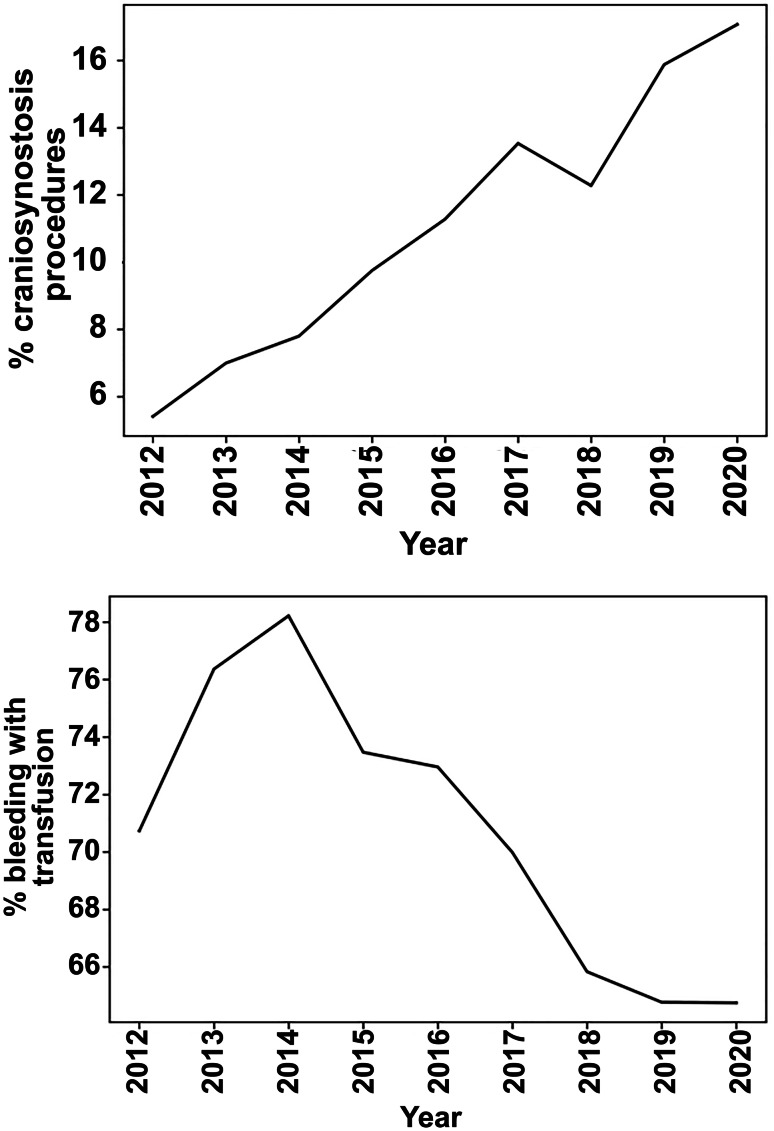
Results: Among 5,848 children identified, 161 children (2.75%) had concurrent complications: 129 (2.21%) experienced two complications and 32 (0.55%) experienced ≥ 3. The most frequent complication was bleeding/transfusion (69.53%). The most common concurrent complications were transfusion/superficial infection (27.95%) and transfusion/deep incisional infection (13.04%) or transfusion/sepsis (13.04%). Two cardiac factors (major cardiac risk factors (odds ratio (OR) 3.50 [1.92-6.38]) and previous cardiac surgery (OR 4.87 [2.36-10.04])), two pulmonary factors (preoperative ventilator dependence (OR 3.27 [1.16-9.21]) and structural pulmonary/airway abnormalities (OR 2.89 [2.05-4.08])), and preoperative nutritional support (OR 4.05 [2.34-7.01]) were independently associated with concurrent complications. Children who received blood transfusion had higher odds of deep surgical site infection (OR 4.62 [1.08-19.73]; p = 0.04).
Conclusions: Our results indicate that several cardiac and pulmonary risk factors, along with preoperative nutritional support, were independently associated with concurrent complications but procedural factors were not. This information can help inform presurgical counseling and preoperative risk stratification in this population.
Keywords: Complication; Concurrent; Craniosynostosis; National Surgical Quality Improvement Program; Pediatric; Perioperative.
© 2023. This is a U.S. Government work and not under copyright protection in the US; foreign copyright protection may apply.
Conflict of interest statement
None.
Figures

References
-
- McCarthy JG, Warren SM, Bernstein J, Burnett W, Cunningham ML, Edmond JC, Figueroa AA, Kapp-Simon KA, Labow BI, Peterson-Falzone SJ, Proctor MR, Rubin MS, Sze RW, Yemen TA, Craniosynostosis Working G. Parameters of care for craniosynostosis. Cleft Palate Craniofac J. 2012;49(Suppl):1S–24S. doi: 10.1597/11-138. - DOI - PubMed
-
- Warren SM, Proctor MR, Bartlett SP, Blount JP, Buchman SR, Burnett W, Fearon JA, Keating R, Muraszko KM, Rogers GF, Rubin MS, McCarthy JG. Parameters of care for craniosynostosis: craniofacial and neurologic surgery perspectives. Plast Reconstr Surg. 2012;129:731–737. doi: 10.1097/PRS.0b013e3182412a50. - DOI - PubMed
-
- Bonfield CM, Tamber MS, Losee JE (2014) Blindness from late presenting undiagnosed pancraniosynostosis mimicking pseudotumor cerebri. J Child Neurol 29:NP24–27. 10.1177/0883073813495307 - PubMed
