


Brain-Derived Neurotrophic Factor rs6265 polymorphism is associated with severe cancer-related fatigue and neuropathic pain in female cancer survivors
- PMID: 37462904
- PMCID: PMC11502548
- DOI: 10.1007/s11764-023-01426-w
Brain-Derived Neurotrophic Factor rs6265 polymorphism is associated with severe cancer-related fatigue and neuropathic pain in female cancer survivors
Abstract
Purpose: This study examined the relationships between a single-nucleotide polymorphism (SNP) of brain-derived neurotrophic factor (BDNF) rs6265 and psychoneurological (PN) symptoms in female cancer survivors.
Methods: This secondary analysis examined 393 study participants. In addition to demographic variables, self-reported PN symptom scores (anxiety, bodily pain, depression, fatigue, neuropathic pain, and sleep disturbance) were collected using the Patient-Reported Outcomes Measurement Information System and 36-Item Short-Form Health Survey. Buccal swab samples were collected to obtain genotypes for BDNF rs6265 (Val/Val, Val/Met, or Met/Met). The PN symptom scores were compared across genotypes, and the relationships were examined using a regression model. We also explored correlations between different symptoms within each genotype.
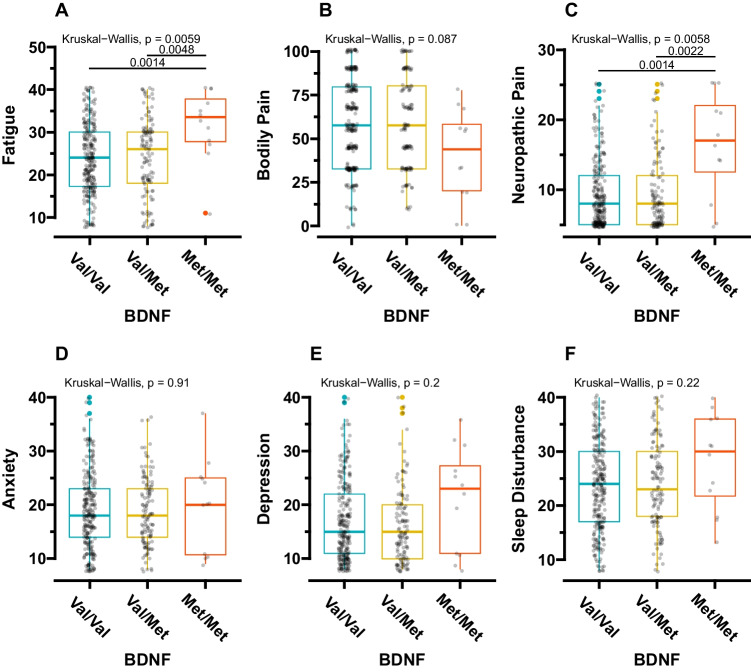
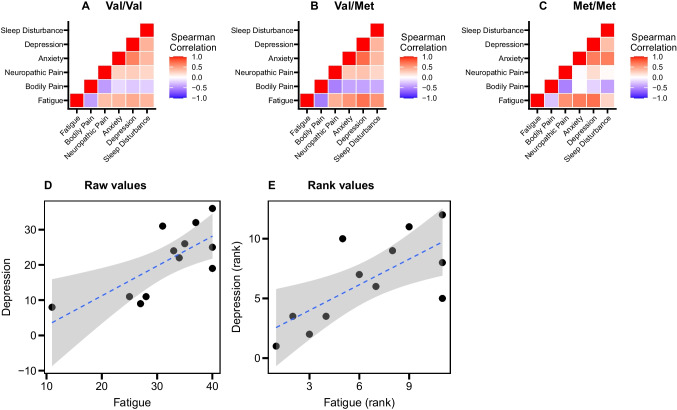
Results: Participants with the Met/Met genotype reported significantly worse cancer-related fatigue and neuropathic pain, which was confirmed by rank-based regression analysis. In addition, cancer-related fatigue was correlated with other PN symptoms, particularly depression. These correlations were stronger in study participants with the Met/Met genotype than those with other genotypes.
Conclusion: Our study suggests that female cancer survivors with the Met/Met genotype of BDNF rs6265 are likely to experience worse cancer-related fatigue and neuropathic pain and that cancer-related fatigue is a good predictor of co-occurring PN symptoms in this population.
Implications for cancer survivors: Our findings advance the scientific community's understanding of cancer-related PN symptoms experienced by female cancer survivors, especially the unique role of BDNF rs6265 polymorphism in these symptoms. Our findings offer valuable insights for clinical practice that the symptom experience among female cancer survivors may vary based on BDNF genotypes.
Keywords: Cancer-related symptoms; Depression; Fatigue; Neuropathic pain; Supportive care; Val66Met.
© 2023. This is a U.S. Government work and not under copyright protection in the US; foreign copyright protection may apply.
Conflict of interest statement
None.
Figures
Similar articles
-
Associations of brain-derived neurotrophic factor rs6265 polymorphism and cognitive function in breast cancer survivors from a cross-sectional study.Cancer Med. 2024 Jan;13(2):e6975. doi: 10.1002/cam4.6975. Cancer Med. 2024. PMID: 38379321 Free PMC article.
-
A protective effect of the BDNF Met/Met genotype in obesity in healthy Caucasian subjects but not in patients with coronary heart disease.Eur Rev Med Pharmacol Sci. 2016 Aug;20(16):3417-26. Eur Rev Med Pharmacol Sci. 2016. PMID: 27608901
-
Low brain-derived neurotrophic factor protein levels and single-nucleotide polymorphism Val66Met are associated with peripheral neuropathy in type II diabetic patients.Acta Diabetol. 2020 Jul;57(7):891-898. doi: 10.1007/s00592-020-01508-6. Epub 2020 Mar 2. Acta Diabetol. 2020. PMID: 32124075
-
The association of the BDNF Val66Met polymorphism and the hippocampal volumes in healthy humans: a joint meta-analysis of published and new data.Neurosci Biobehav Rev. 2014 May;42:267-78. doi: 10.1016/j.neubiorev.2014.03.011. Epub 2014 Mar 24. Neurosci Biobehav Rev. 2014. PMID: 24674929 Review.
-
A Meta-Analysis of Brain-Derived Neurotrophic Factor Effects on Brain Volume in Schizophrenia: Genotype and Serum Levels.Neuropsychobiology. 2021;80(5):411-424. doi: 10.1159/000514126. Epub 2021 Mar 11. Neuropsychobiology. 2021. PMID: 33706323 Free PMC article. Review.
Cited by
-
The Role of the Brain-Derived Neurotrophic Factor in Chronic Pain: Links to Central Sensitization and Neuroinflammation.Biomolecules. 2024 Jan 5;14(1):71. doi: 10.3390/biom14010071. Biomolecules. 2024. PMID: 38254671 Free PMC article. Review.
-
Associations of brain-derived neurotrophic factor rs6265 polymorphism and cognitive function in breast cancer survivors from a cross-sectional study.Cancer Med. 2024 Jan;13(2):e6975. doi: 10.1002/cam4.6975. Cancer Med. 2024. PMID: 38379321 Free PMC article.
-
Characterization of cancer survivors clustered by subjective and objective cognitive function scores.Cancer Med. 2024 Jun;13(12):e7255. doi: 10.1002/cam4.7255. Cancer Med. 2024. PMID: 39185749 Free PMC article.
-
HEalth-Related Quality of Life-Intervention in Survivors of Breast and Other Cancers Experiencing Cancer-Related Fatigue and Associated Cognitive Symptoms Using TraditionAL Chinese Medicine: The 'HERBAL' Trial.Integr Cancer Ther. 2025 Jan-Dec;24:15347354251314514. doi: 10.1177/15347354251314514. Integr Cancer Ther. 2025. PMID: 39840742 Free PMC article. Clinical Trial.
-
The links between neuroinflammation, brain structure and depressive disorder: A cross-sectional study protocol.PLoS One. 2024 Nov 20;19(11):e0311218. doi: 10.1371/journal.pone.0311218. eCollection 2024. PLoS One. 2024. PMID: 39565757 Free PMC article.
References
-
- Reuben SH. Living Beyond Cancer: Finding a New Balance. President’s Cancer Panel 2003–2004 Annual Report2004.
-
- Schmitz KH, Cappola AR, Stricker CT, Sweeney C, Norman SA. The intersection of cancer and aging: establishing the need for breast cancer rehabilitation. Cancer Epidemiol Biomarkers Prev. 2007;16(5):866–72. 10.1158/1055-9965.EPI-06-0980. - PubMed
-
- Stewart A, Bielajew C, Collins B, Parkinson M, Tomiak E. A meta-analysis of the neuropsychological effects of adjuvant chemotherapy treatment in women treated for breast cancer. Clin Neuropsychol. 2006;20(1):76–89. 10.1080/138540491005875. - PubMed
-
- Berger AM, Mitchell SA. Modifying cancer-related fatigue by optimizing sleep quality. J Natl Compr Canc Netw. 2008;6(1):3–13. 10.6004/jnccn.2008.0002. - PubMed
-
- Pinto BM, Dunsiger S, Waldemore M. Physical activity and psychosocial benefits among breast cancer patients. Psychooncology. 2013;22(10):2193–9. 10.1002/pon.3272. - PubMed
MeSH terms
Substances
LinkOut - more resources
Full Text Sources
Medical
Miscellaneous
