


The combination of non-contrast abbreviated MRI and alpha foetoprotein has high performance for hepatocellular carcinoma screening
- PMID: 37464111
- PMCID: PMC10511584
- DOI: 10.1007/s00330-023-09906-4
The combination of non-contrast abbreviated MRI and alpha foetoprotein has high performance for hepatocellular carcinoma screening
Abstract
Objectives: This study aimed to compare two abbreviated MRI (AMRI) protocols to complete MRI for HCC detection: non-contrast (NC)-AMRI without/with alpha foetoprotein (AFP) and dynamic contrast-enhanced (Dyn)-AMRI.
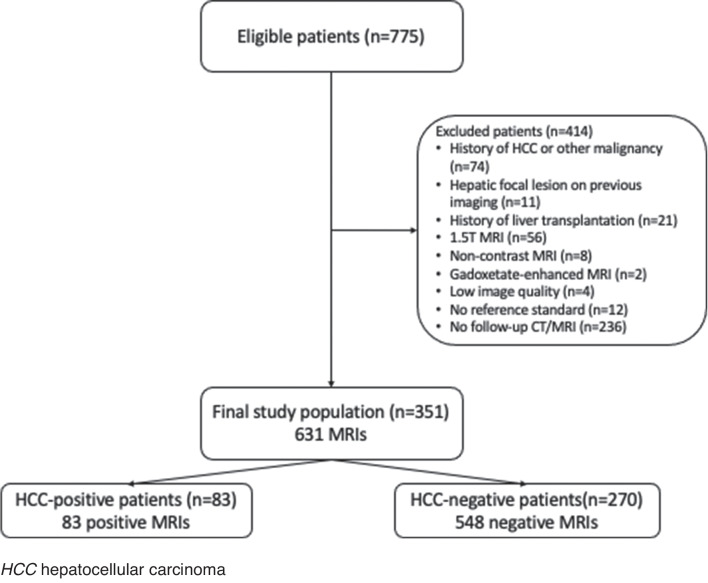
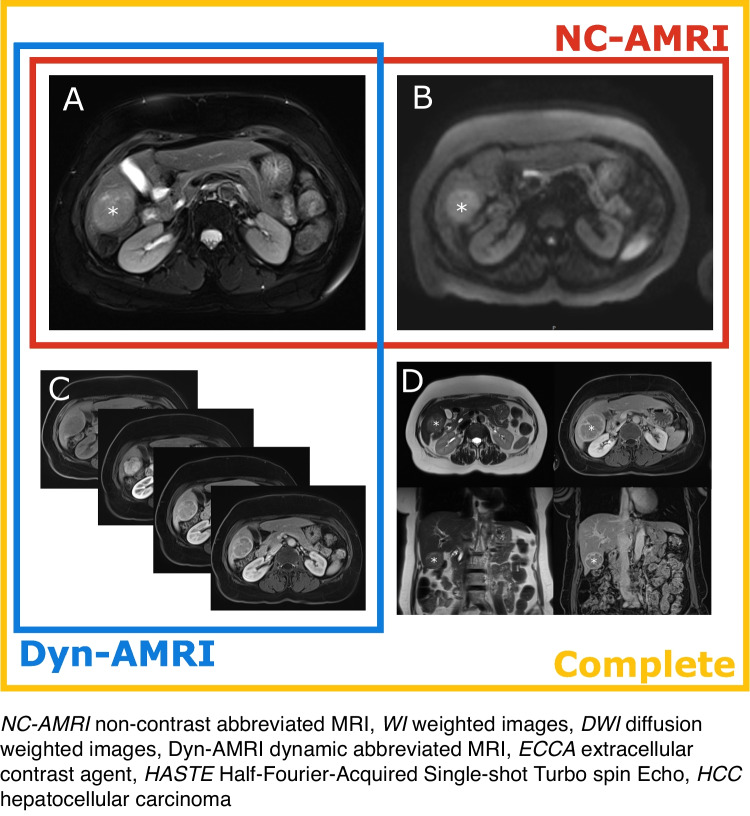
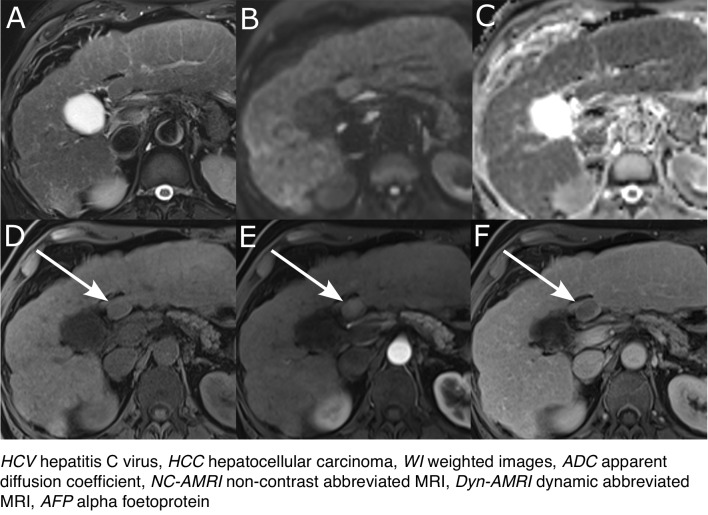
Methods: This retrospective single-center study included 351 patients (M/F: 264/87, mean age: 57y) with chronic liver disease, who underwent MRI for HCC surveillance between 2014 and 2020. Two reconstructed AMRI sets were obtained based on complete MRI: NC-AMRI (T2-weighted imaging (WI) + diffusion-WI) and Dyn-AMRI (T2-WI + dynamic T1-WI) and were assessed by 2 radiologists who reported all suspicious lesions, using LI-RADS/adapted LI-RADS classification. The reference standard was based on all available patient data. Inter-reader agreement was assessed and MRI diagnostic performance was compared to the reference standard.
Results: The reference standard demonstrated 83/351 HCC-positive patients (prevalence: 23.6%, median size: 22 mm, and positive MRIs: 83/631). Inter-reader agreement was substantial for all sets. Sensitivities of Dyn-AMRI and complete MRI (both 92.8%) were similar, higher than NC-AMRI (72.3%, p < 0.001). Specificities were not different between sets. NC-AMRI + AFP (92.8%) had similar sensitivity to Dyn-AMRI and complete MRI. In patients with small size HCCs (≤ 2 cm), sensitivities of Dyn-AMRI (85.3%) and complete MRI (88.2%) remained similar (p = 0.564), also outperforming NC-AMRI (52.9%, p < 0.05). NC-AMRI + AFP had similar sensitivity (88.2%) to Dyn-AMRI and complete MRI (p = 0.706 and p = 1, respectively).
Conclusions: Dyn-AMRI has similar diagnostic performance to complete MRI for HCC detection, while both outperform NC-AMRI, especially for small size HCCs. NC-AMRI + AFP demonstrates similar sensitivity to Dyn-AMRI and complete MRI.
Clinical relevance statement: Due to the low sensitivity of ultrasound for hepatocellular screening, new screening methods are needed. Abbreviated MRI (AMRI) is a candidate, especially non-contrast AMRI with serum alpha foetoprotein as the acquisition time is low, without the need for contrast medium injection.
Key points: • Dynamic contrast-enhanced abbreviated MRI using extracellular gadolinium-based contrast agent and complete MRI have similar diagnostic performance for hepatocellular carcinoma detection in an at-risk population. • Non-contrast abbreviated MRI with alpha foetoprotein has similar diagnostic performance to dynamic contrast-enhanced abbreviated MRI and complete MRI, including when considering small size hepatocellular carcinoma ≤ 2 cm. • Non-contrast abbreviated MRI and dynamic contrast-enhanced abbreviated MRI can be performed in 7 and 10 min, excluding patient setup time.
Keywords: Carcinoma, hepatocellular; Contrast agent; Magnetic resonance imaging; Screening.
© 2023. The Author(s).
Conflict of interest statement
The authors of this manuscript declare no relationships with any companies, whose products or services may be related to the subject matter of the article.
Figures
Comment in
-
HCC screening with non-contrast MRI and alpha-fetoprotein: combining a new player with an old friend.Eur Radiol. 2023 Oct;33(10):6927-6928. doi: 10.1007/s00330-023-09934-0. Epub 2023 Aug 7. Eur Radiol. 2023. PMID: 37548693 No abstract available.
References
-
- European Association for the Study of the Liver (2018) EASL clinical practice guidelines: management of hepatocellular carcinoma. J Hepatol 69:182-236 - PubMed
MeSH terms
Substances
Grants and funding
LinkOut - more resources
Full Text Sources
Medical
