


Type 2 diabetes and in-hospital sudden cardiac arrest in ST-elevation myocardial infarction in the US
- PMID: 37465457
- PMCID: PMC10351872
- DOI: 10.3389/fcvm.2023.1175731
Type 2 diabetes and in-hospital sudden cardiac arrest in ST-elevation myocardial infarction in the US
Abstract
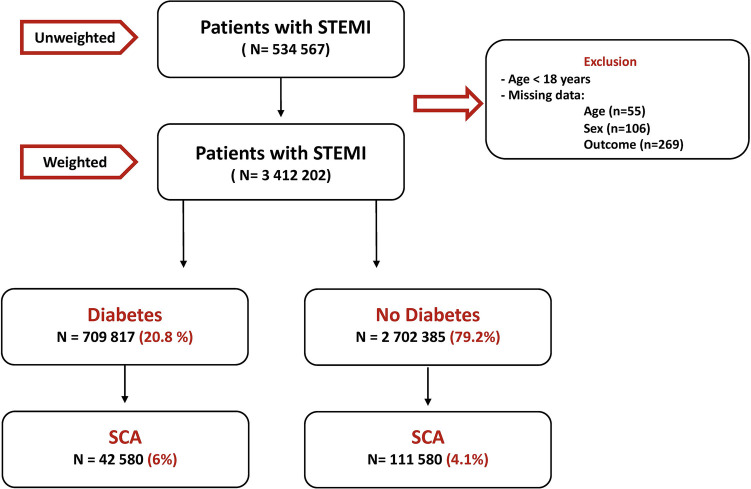
Aims: We aimed to assess the impact of diabetes on sudden cardiac arrest (SCA) in US patients hospitalized for ST-elevation myocardial infarction (STEMI).
Methods: We used the National Inpatient Sample (2005-2017) data to identify adult patients with STEMI. The primary outcome was in-hospital SCA. Secondary outcomes included in-hospital mortality, ventricular tachycardia (VT), ventricular fibrillation (VF), cardiogenic shock (CS), acute renal failure (ARF), and the revascularization strategy in SCA patients.
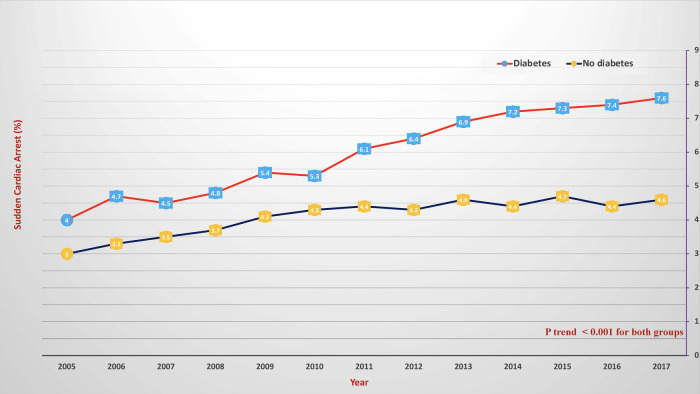
Results: SCA significantly increased from 4% in 2005 to 7.6% in 2018 in diabetes patients and from 3% in 2005 to 4.6% in 2018 in non-diabetes ones (p < 0.001 for both). Further, diabetes was associated with an increased risk of SCA [aOR = 1.432 (1.336-1.707)]. In SCA patients with diabetes, the mean age (SD) decreased from 68 (13) to 66 (11) years old, and mortality decreased from 65.7% to 49.3% during the observation period (p < 0.001). Compared to non-diabetes patients, those with T2DM had a higher adjusted risk of mortality, ARF, and CS [aOR = 1.72 (1.62-1.83), 1.52 (1.43-1.63), 1.25 (1.17-1.33); respectively] but not VF or VT. Those patients were more likely to undergo revascularization with CABG [aOR = 1.197 (1.065-1.345)] but less likely to undergo PCI [aOR = 0.708 (0.664-0.754)].
Conclusion: Diabetes is associated with an increased risk of sudden cardiac arrest in ST-elevation myocardial infarction. It is also associated with a higher mortality risk in SCA patients. However, the recent temporal mortality trend in SCA patients shows a steady decline, irrespective of diabetes.
Keywords: ST elevation myocardial infarction; cardiovascular disease; diabetes; mortality; sudden cardiac arrest.
© 2023 Mhaimeed, Pillai, Dargham, Al Suwaidi, Jneid and Abi Khalil.
Conflict of interest statement
The authors declare that the research was conducted in the absence of any commercial or financial relationships that could be construed as a potential conflict of interest.
Figures

References
-
- Jimenez-Pavon D, Artero EG, Lee DC, Espana-Romero V, Sui X, Pate RR, et al. Cardiorespiratory fitness and risk of sudden cardiac death in men and women in the United States: a prospective evaluation from the aerobics center longitudinal study. Mayo Clin Proc. (2016) 91:849–57. 10.1016/j.mayocp.2016.04.025 - DOI - PubMed
-
- Al-Khatib SM, Stevenson WG, Ackerman MJ, Bryant WJ, Callans DJ, Curtis AB, et al. 2017 AHA/ACC/HRS guideline for management of patients with ventricular arrhythmias and the prevention of sudden cardiac death: a report of the American College of Cardiology/American Heart Association task force on clinical practice guidelines and the heart rhythm society. J Am Coll Cardiol. (2018) 72:e91–e220. 10.1016/j.jacc.2017.10.054 - DOI - PubMed
LinkOut - more resources
Full Text Sources
Miscellaneous
