


Self-based goals, underlying reasons, performance and discrete emotions among parkrunners
- PMID: 37465486
- PMCID: PMC10352087
- DOI: 10.3389/fpsyg.2023.1017836
Self-based goals, underlying reasons, performance and discrete emotions among parkrunners
Abstract
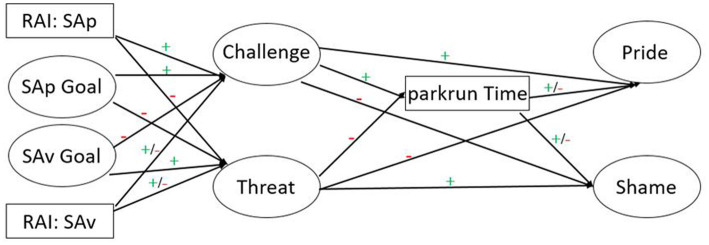
Introduction: A temporal sequence of hypothesized relationships was tested between self-based goals and their underlying reasons → stress appraisals → performance and emotions, among UK parkrunners. A conditional process model was also examined to ascertain the potential moderating role of self-determined reasons in explaining the indirect relationship of self-based goals predicting performance and emotions via stress appraisals.
Methods: Utilizing a prospective design, 324 parkrunners (Mage = 45.27; SD = 10.73 years) completed online measures of self-based goals, their underlying reasons at 7 days (T1), and stress appraisals at 24 h (T2), prior to their next UK parkrun. Performance data and discrete emotions (pride and shame) were reported 24 h post-parkrun (T3).
Results: Structural Equation Modeling revealed partial support for the hypothesized model. More specifically, findings suggested that: (1) T1 self-determined reasons underpinning a self-approach goal positively predicted T2 challenge appraisals and T3 pride, (2) T1 self-determined reasons for pursuing a self-avoidance goal corresponded to reduced T3 performance and shame, (3) T2 challenge and threat appraisals were found to positively relate to T3 pride, and (4) the slower parkrunners ran, the more shame they felt post-event. T2 challenge and threat appraisals were found to mediate the relationship between T1 self-determined reasons underlying a self-approach goal and T3 pride. Further analysis failed to support a conditional process model.
Discussion: Our findings suggest the intensity of pursuing a self-based goal does not matter at all, but underlying self-determined reasons are a key driver influencing stress appraisals, performance and subsequent emotions among parkrunners.
Keywords: discrete emotions; performance; self-based goals; self-determination; stress.
Copyright © 2023 Mulvenna, Adie and Tramontano.
Conflict of interest statement
The authors declare that the research was conducted in the absence of any commercial or financial relationships that could be construed as a potential conflict of interest.
Figures

References
-
- Adie J. W., Bartholomew K. J. (2013). “The well- and ill-being of participants in competitive sports settings: a review of motivational determinants” in Advances in the psychology of sport and exercise. ed. Mohiyedinni C. (Hauppauge, NY: Nova Science Publishers; ), 109–140.
-
- Anderson J. C., Gerbing D. W. (1988). Structural equation modeling in practice: a review and recommended two-step approach. Psychol. Bull. 103, 411–423. doi: 10.1037/0033-2909.103.3.411 - DOI
LinkOut - more resources
Full Text Sources
Miscellaneous
