


Predictive value of pre-procedural N-terminal pro-B-type natriuretic peptide level for atrial fibrillation recurrence after radiofrequency catheter ablation
- PMID: 37465622
- PMCID: PMC10351070
- DOI: 10.5114/aic.2023.125317
Predictive value of pre-procedural N-terminal pro-B-type natriuretic peptide level for atrial fibrillation recurrence after radiofrequency catheter ablation
Abstract
Introduction: N-terminal pro-B-type natriuretic peptide (NT-proBNP) has been demonstrated as a valuable risk marker for mortality and morbidity of cardiovascular disease. Recurrence after atrial fibrillation (AF) radiofrequency catheter ablation remains common.
Aim: We investigated the predictive value of the pre-procedural level of NT-proBNP to differentiate high-risk patients for post-ablation AF recurrence.
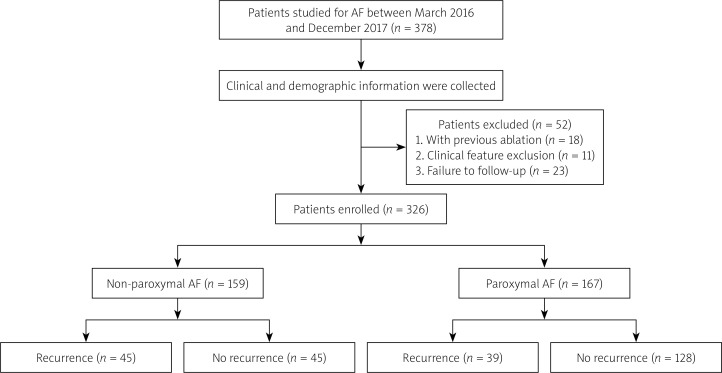
Material and methods: 326 individuals with nonvalvular AF and preserved systolic function after enduring an initial radiofrequency catheter ablation (RFCA) between March 2018 and December 2019 were categorized into a recurrent group and a non-AF recurrent group. The serum NT-proBNP levels were examined before the ablation procedure. The researchers used multivariate logistic regression to find the determinants of AF recurrence.
Results: During a 14-month (interquartile range (IQR): 12-16) median follow-up, AF recurred in 84 (25.8%) patients. Patients in the recurrence group had considerably greater pre-ablation NT-proBNP levels (389.4 vs. 141.7 pg/ml, p < 0.001 in non-paroxysmal AF and 348.0 vs. 99.4 pg/ml, p < 0.001 in paroxysmal AF) as well as a greater left atrium (40 vs. 36 mm, p = 0.01 in non-paroxysmal AF and 38 vs. 36 mm, p = 0.01 in paroxysmal AF) than the non-AF recurrence group. A cut-off value of NT-proBNP ≥ 168.05 pg/ml identified AF recurrence with a sensitivity of 78.6% and specificity of 53.7% (area under ROC curve 0.68, 95% confidence interval (CI) 0.62-0.74, p < 0.001). Kaplan-Meier examination revealed that the elevated NT-proBNP (≥ 168.05 pg/ml) group presented a considerably shorter period without an occurrence compared to the low-NT-proBNP group (18.4 vs. 22.2 months, log-rank p = 0.001). Multivariate cox regression investigation showed that a level of NT-proBNP ≥ 168.05 pg/ml (hazard ratio (HR): 2.89, 95% CI: 1.71-4.903, p < 0.001) was a reliable predictor of AF recurrence after RFCA.
Conclusions: A high pre-ablation NT-proBNP level was associated with AF recurrence, and it was also discovered to be a prognostic factor of recurrence of AF following RFCA.
Keywords: N-terminal pro-B-type natriuretic peptide; atrial fibrillation; radiofrequency catheter ablation; recurrence.
Copyright: © 2023 Termedia Sp. z o. o.
Conflict of interest statement
The authors declare no conflict of interest.
Figures


References
-
- Pallisgaard JL, Gislason GH, Hansen J, et al. . Temporal trends in atrial fibrillation recurrence rates after ablation between 2005 and 2014: a nationwide Danish cohort study. Eur Heart J 2018; 39: 442-9. - PubMed
-
- Kizilirmak F, Gokdeniz T, Gunes HM, et al. . Myocardial injury biomarkers after radiofrequency catheter and cryoballoon ablation for atrial fibrillation and their impact on recurrence. Kardiol Pol 2017; 75: 126-34. - PubMed
-
- Wu N, Xu B, Xiang Y, et al. . Association of inflammatory factors with occurrence and recurrence of atrial fibrillation: a meta-analysis. Int J Cardiol 2013; 169: 62-72. - PubMed
LinkOut - more resources
Full Text Sources
Research Materials
