Review
. 2023 Jun;120(6):e20220245.
doi: 10.36660/abc.20220245.

Carcinoid Heart Disease: A Case Report and Literature Review

[Article in English, Portuguese]
Affiliations
Review

Carcinoid Heart Disease: A Case Report and Literature Review

[Article in English, Portuguese]
Isabela Bispo Santos da Silva Costa et al. Arq Bras Cardiol. 2023 Jun.
No abstract available


Conflict of interest statement

Potencial conflito de interesse

Não há conflito com o presente artigo

Figures
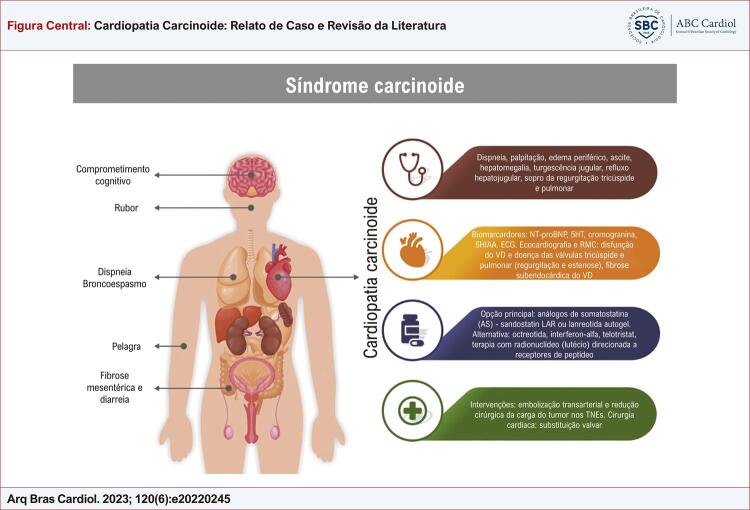
Figura Central
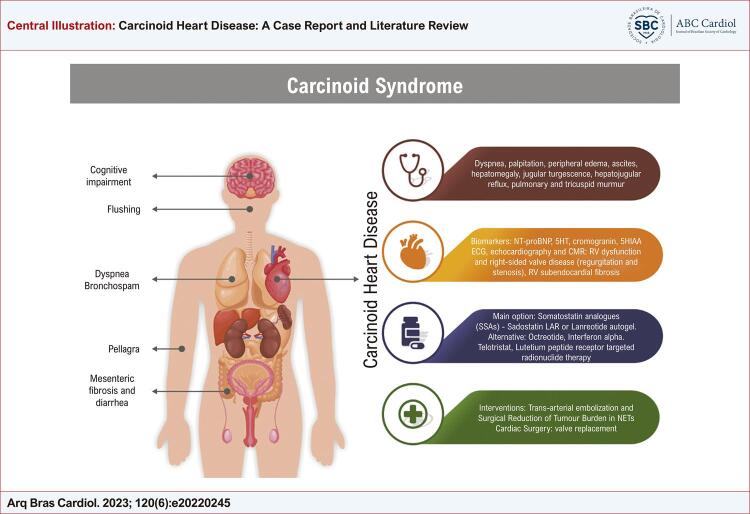
Figura Central. : Cardiopatia Carcinoide: Relato de Caso e Revisão da Literatura
Figura 1
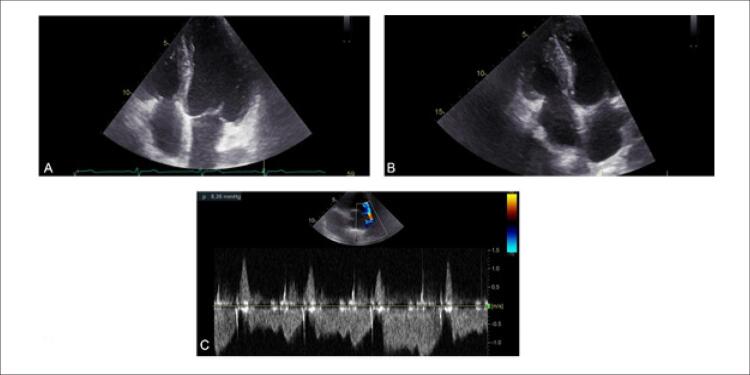
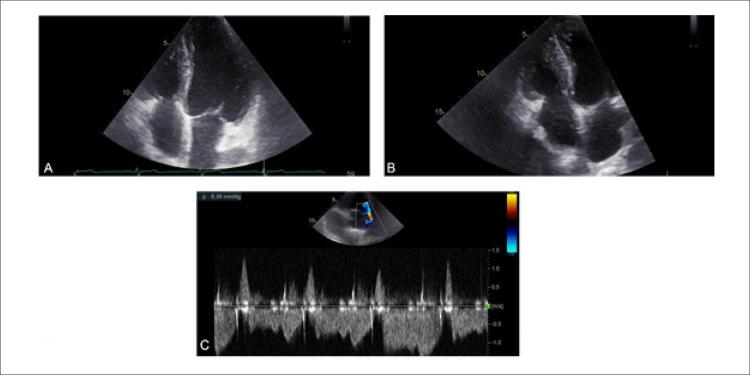
Figura 1. – Ecocardiografia transesofágica e transtorácica bidimensional. A) corte apical de quatro câmaras na sístole mostrando a válvula tricúspide aberta e retraída e a válvula mitral fechada; B) corte apical de quatro câmaras na sístole (foco no ventrículo direito) mostrando a válvula tricúspide aberta e retraída e a válvula mitral fechada; C) curva do fluxo tricúspide no Doppler contínuo, mostrando uma equalização da pressão entre o átrio direito e o ventrículo direito.
Figura 2
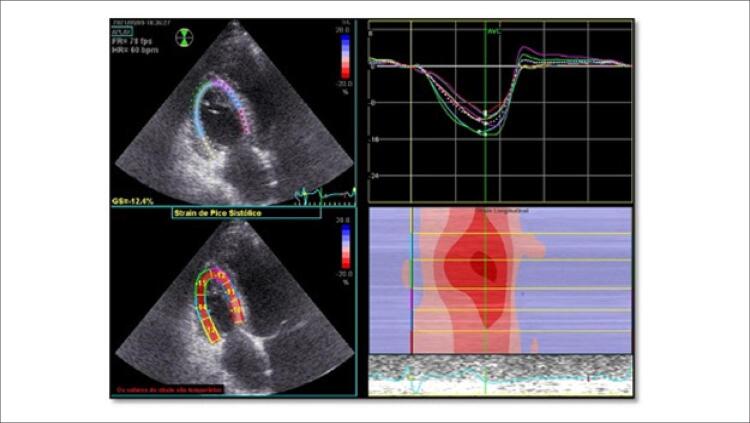
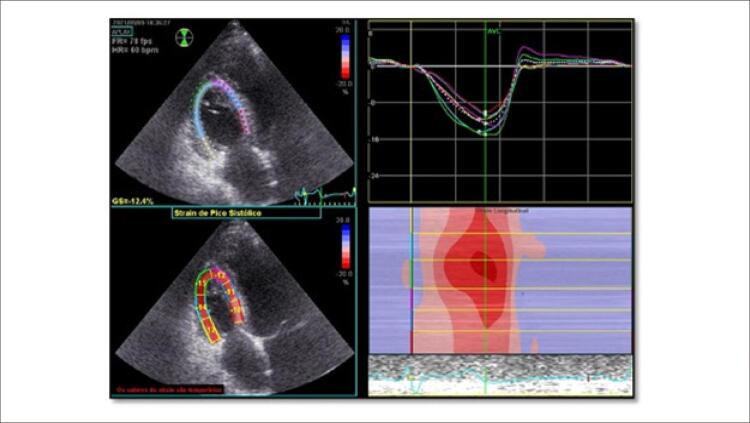
Figura 2. – Corte apical de quatro câmaras (foco no ventrículo direito); quantificação do strain ventricular direito por ecocardiografia speckle-tracking mostrando valores anormais do strain global e do strain da parede livre (12,4% e 13,6%, respectivamente).
Figura 3
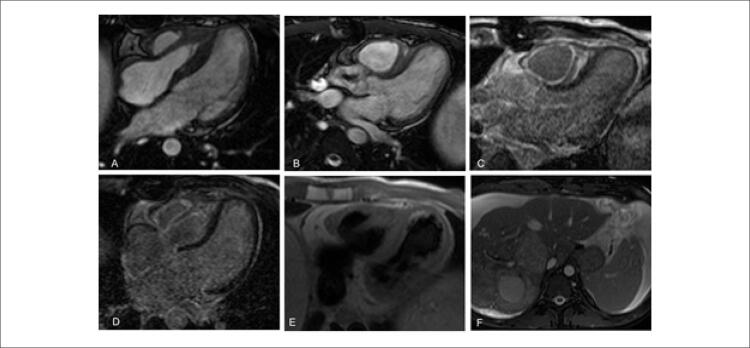
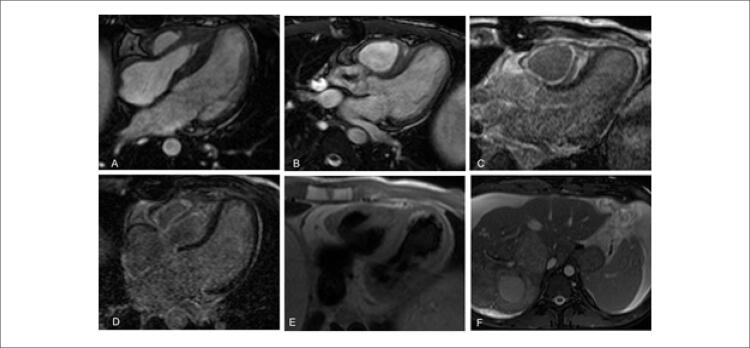
Figura 3. – Avaliação por ressonância magnética cardíaca; A e B) cine-ressonância magnética de quatro câmaras e três câmaras, respectivamente; há um aumento na espessura da parede livre do ventrículo direito e do músculo papilar e retração da válvula tricúspide. O átrio direito e o ventrículo direito aparecem como uma câmara única. O septo interventricular encontra-se deslocado para o ventrículo esquerdo, sugerindo um aumento do volume ventricular direito. C e D) mostram presença de realce tardio com gadolínio (RTG) na região subendocárdica da parede livre, músculo papilar e septo interventricular. Não se observou RTG no ventrículo esquerdo. E) técnica do sangue escuro (dark blood) mostrando aumento da espessura do miocárdio do ventrículo esquerdo e ausência de edema; F) imagens da transição toracoabdominal mostrando hepatomegalia, múltiplos nódulos hepáticos e ascite, característico de tumores neuroendócrinos.
Figura 4
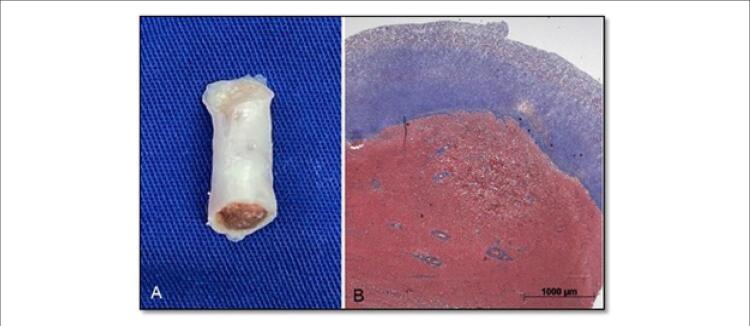
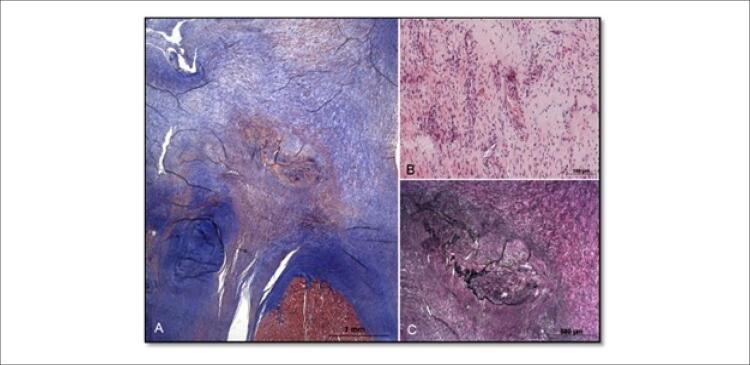
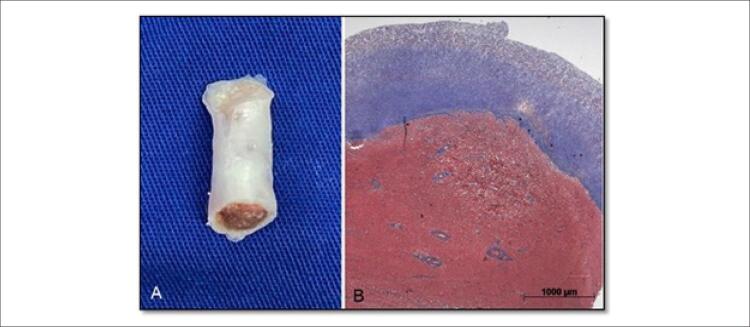
Figura 4. – Espécimes patológicos constituídos de um segmento cilíndrico do músculo papilar medindo 18mm, com presença de tecido esbranquiçado espesso em uma das extremidades (A). Seções histológicas transversais do músculo papilar revelaram um endocárdio fibroso espessado (B; corante tricromo de Masson).
Figura 5
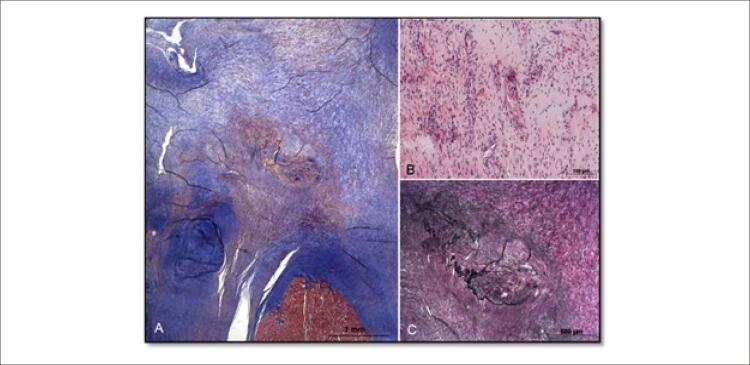
Figura 5. – Seções histológicas longitudinais do tecido esbranquiçado na ponta do músculo papilar mostra um tecido fibroso denso (A) corante tricromo de Masson), com um foco central de neovascularização, infiltração inflamatória crônica leve (B- coloração de hematoxilina-eosina) e algumas fibras elásticas irregulares (C- coloração de Verhoeff).
Central Illustration
Central Illustration. : Carcinoid Heart Disease: A Case Report and Literature Review
Figure 1
Figure 1. – Two-dimensional transthoracic and transesophageal echocardiographic evaluation; A) apical four-chamber view in systole displaying an opened and retracted tricuspid valve, while the mitral valve is closed; B) apical four-chamber view in systole (focused on the right ventricle) displaying an opened and retracted tricuspid valve, while the mitral valve is closed; C) triscupid flow curve, by continuous Doppler, showing a pressure equalization between the right atrium and ventricle.
Figure 2
Figure 2. – Apical four-chamber view (focused on the right ventricle); quantification of right ventricular strain by speckle-tracking echocardiography showing abnormal global and free wall strain values (12.4% and 13.6%, respectively).
Figure 3
Figure 3. – Cardiac magnetic resonance imaging evaluation. A and B) cine resonance magnetic imaging in 4-chamber and 3-chamber, respectively; there is an increase in the thickness of the free wall of the right ventricle and papillary muscle and a retracted tricuspid valve. The right atrium and the right ventricle appear as a single chamber. The interventricular septum is displaced to the left ventricle, suggesting an increased volume of the right ventricle. C and D) show the presence of late gadolinium enhancement (LGE) in the subendocardial region of the free wall, papillary muscle and interventricular septum. There was no LGE in the left ventricle. E) dark blood sequence with increased thickness of the right ventricular myocardium and absence of edema. F) images of the thoracoabdominal transition showing hepatomegaly, multiple hepatic nodules and ascites, characteristic of neuroendocrine tumors.
Figure 4
Figure 4. – The pathological specimen was constituted by a cylindrical segment of the papillary muscle measuring 18 mm, presenting a thickened, whitish tissue at one end (A). Transversal histological sections of the papillary muscle revealed a thickened, fibrous endocardium (B; Masson trichrome stain).
Figure 5
Figure 5. – Longitudinal histological sections of the whitish tissue at the tip of the papillary muscle show a dense fibrous tissue (A- Masson trichrome stain), with a central focus of neovascularization, mild chronic inflammatory infiltration (B- hematoxylin-eosin stain) and few irregular elastic fibers (C- Verhoeff stain).

References

    1. 1. Mota JM, Sousa LG, Riechelmann RP. Complications from Carcinoid Syndrome: Review of the Current Evidence. Ecancermedicalscience. 2016;10:662. doi: 10.3332/ecancer.2016.662. - PMC - PubMed
    2. Mota JM, Sousa LG, Riechelmann RP. Complications from Carcinoid Syndrome: Review of the Current Evidence. 662Ecancermedicalscience. 2016;10 doi: 10.3332/ecancer.2016.662. - DOI - PMC - PubMed
    1. 2. Halperin DM, Shen C, Dasari A, Xu Y, Chu Y, Zhou S, et al. Frequency of Carcinoid Syndrome at Neuroendocrine Tumour Diagnosis: A Population-Based Study. Lancet Oncol. 2017;18(4):525-34. doi: 10.1016/S1470-2045(17)30110-9. - PMC - PubMed
    2. Halperin DM, Shen C, Dasari A, Xu Y, Chu Y, Zhou S, et al. Frequency of Carcinoid Syndrome at Neuroendocrine Tumour Diagnosis: A Population-Based Study. Lancet Oncol. 2017;18(4):525–534. doi: 10.1016/S1470-2045(17)30110-9. - DOI - PMC - PubMed
    1. 3. Ferrari ACRC, Glasberg J, Riechelmann RP. Carcinoid Syndrome: Update on the Pathophysiology and Treatment. Clinics. 2018;73(suppl 1):e490s. doi: 10.6061/clinics/2018/e490s. - PMC - PubMed
    2. Ferrari ACRC, Glasberg J, Riechelmann RP. Carcinoid Syndrome: Update on the Pathophysiology and Treatment. Clinics. 2018;73(suppl 1):e490s. doi: 10.6061/clinics/2018/e490s. - DOI - PMC - PubMed
    1. 4. Steeds R, Sagar V, Shetty S, Oelofse T, Singh H, Ahmad R, et al. Multidisciplinary Team Management of Carcinoid Heart Disease. Endocr Connect. 2019;8(12):R184-R199. doi: 10.1530/EC-19-0413. - PMC - PubMed
    2. Steeds R, Sagar V, Shetty S, Oelofse T, Singh H, Ahmad R, et al. Multidisciplinary Team Management of Carcinoid Heart Disease. Endocr Connect. 2019;8(12):R184–R199. doi: 10.1530/EC-19-0413. - DOI - PMC - PubMed
    1. 5. Pellikka PA, Tajik AJ, Khandheria BK, Seward JB, Callahan JA, Pitot HC, et al. Carcinoid Heart Disease. Clinical and Echocardiographic Spectrum in 74 Patients. Circulation. 1993;87(4):1188-96. doi: 10.1161/01.cir.87.4.1188. - PubMed
    2. Pellikka PA, Tajik AJ, Khandheria BK, Seward JB, Callahan JA, Pitot HC, et al. Carcinoid Heart Disease. Clinical and Echocardiographic Spectrum in 74 Patients. Circulation. 1993;87(4):1188–1196. doi: 10.1161/01.cir.87.4.1188. - DOI - PubMed

MeSH terms