Improved outcomes of UM171-expanded cord blood transplantation compared with other graft sources: real-world evidence
- PMID: 37467030
- PMCID: PMC10539875
- DOI: 10.1182/bloodadvances.2023010599
Improved outcomes of UM171-expanded cord blood transplantation compared with other graft sources: real-world evidence
Abstract
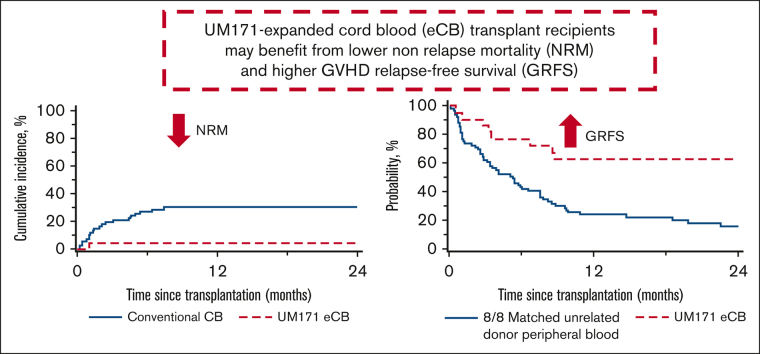
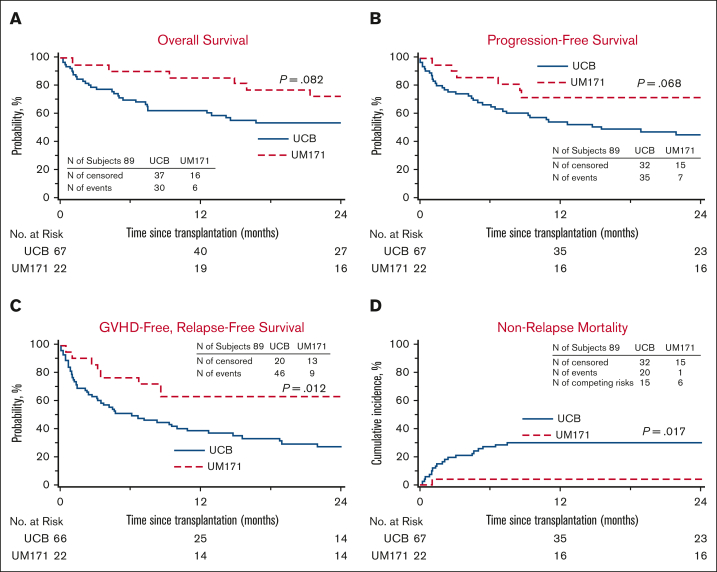
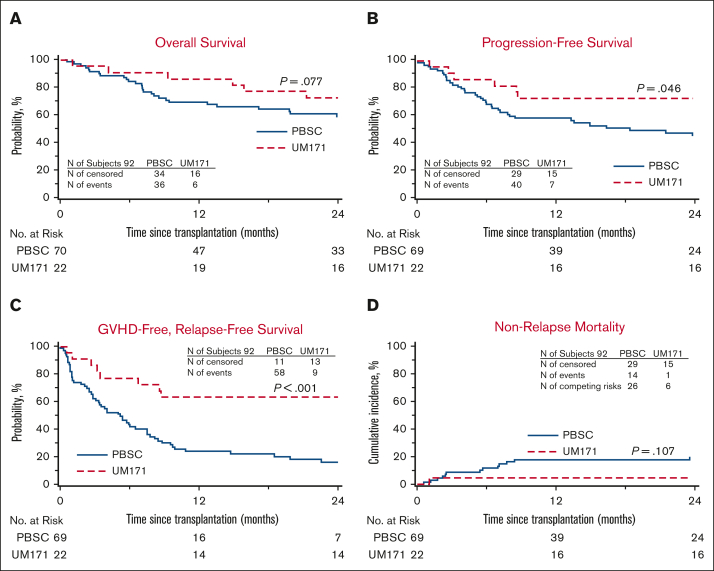
Cord blood (CB) transplantation is hampered by low cell dose and high nonrelapse mortality (NRM). A phase 1-2 trial of UM171-expanded CB transplants demonstrated safety and favorable preliminary efficacy. The aim of the current analysis was to retrospectively compare results of the phase 1-2 trial with those after unmanipulated CB and matched-unrelated donor (MUD) transplants. Data from recipients of CB and MUD transplants were obtained from the Center for International Blood and Marrow Transplant Research (CIBMTR) database. Patients were directly matched for the number of previous allogeneic hematopoietic stem cell transplants (alloHCT), disease and refined Disease Risk Index. Patients were further matched by propensity score for age, comorbidity index, and performance status. Primary end points included NRM, progression-free survival (PFS), overall survival (OS), and graft-versus-host disease (GVHD)-free relapse-free survival (GRFS) at 1 and 2 years after alloHCT. Overall, 137 patients from CIBMTR (67 CB, 70 MUD) and 22 with UM171-expanded CB were included. NRM at 1 and 2 years was lower, PFS and GRFS at 2 years and OS at 1 year were improved for UM171-expanded CBs compared with CB controls. Compared with MUD controls, UM171 recipients had lower 1- and 2-year NRM, higher 2-year PFS, and higher 1- and 2-year GRFS. Furthermore, UM171-expanded CB recipients experienced less grades 3-4 acute GVHD and chronic GVHD compared with MUD graft recipients. Compared with real-world evidence with CB and MUD alloHCT, this study suggests that UM171-expanded CB recipients may benefit from lower NRM and higher GRFS. This trial was registered at www.clinicaltrials.gov as #NCT02668315.
© 2023 by The American Society of Hematology. Licensed under Creative Commons Attribution-NonCommercial-NoDerivatives 4.0 International (CC BY-NC-ND 4.0), permitting only noncommercial, nonderivative use with attribution. All other rights reserved.
Conflict of interest statement
Conflict-of-interest disclosures: S.C. has received consulting fees from ExCellThera. S.C., J.R., S.L., and G.S. are eligible to receive royalties if UM171 is commercialized. G.S. is a major stockholder and chief executive/scientific officer of ExCellThera. S.C. and J.R. have received funding for clinical trials from ExCellThera. ExCellThera holds the license for UM171. L.J.B., M.-J.Z., and X.T. have collaborated on research with Gamida Cell, Inc. L. Burns has also collaborated on research with Astellas, bluebird bio, Gamida Cell, Kyowa Kirin, Mesoblast, Sanofi, and Vertex. The remaining authors declare no competing financial interests.
Figures


References
-
- Pallua S, Giesinger J, Oberguggenberger A, et al. Impact of GvHD on quality of life in long-term survivors of haematopoietic transplantation. Bone Marrow Transplant. 2010;45(10):1534–1539. - PubMed
Publication types
MeSH terms
Associated data
LinkOut - more resources
Full Text Sources
Medical