


Mixing of moiré-surface and bulk states in graphite
- PMID: 37468634
- PMCID: PMC10447246
- DOI: 10.1038/s41586-023-06264-5
Mixing of moiré-surface and bulk states in graphite
Abstract
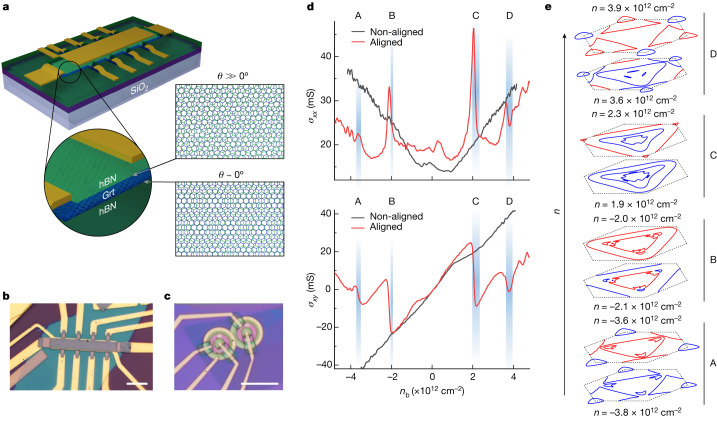
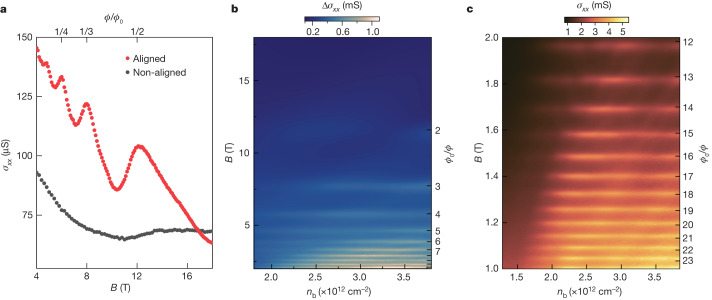
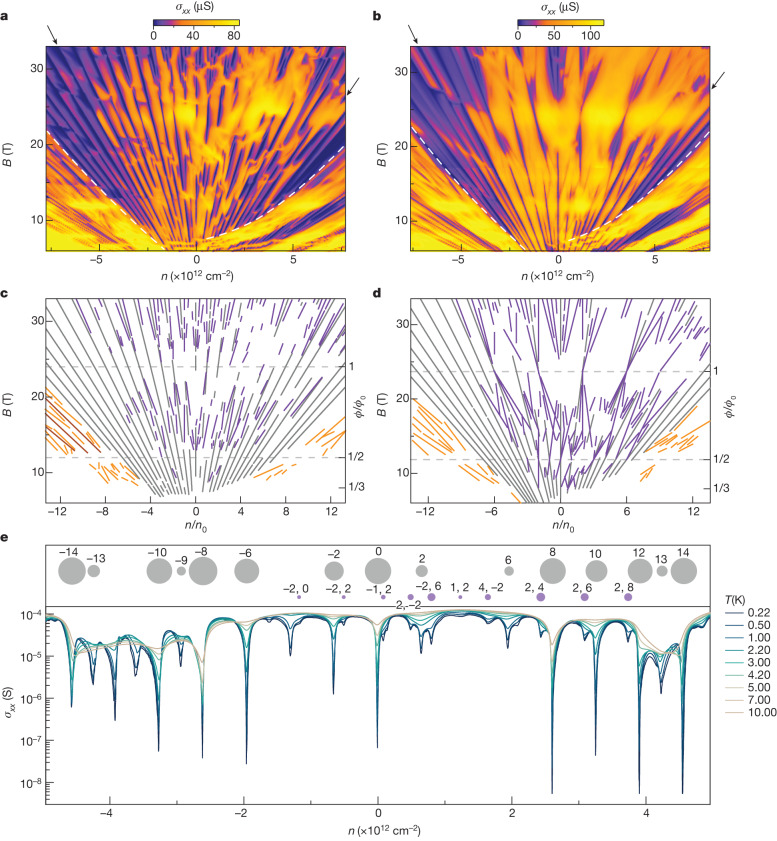
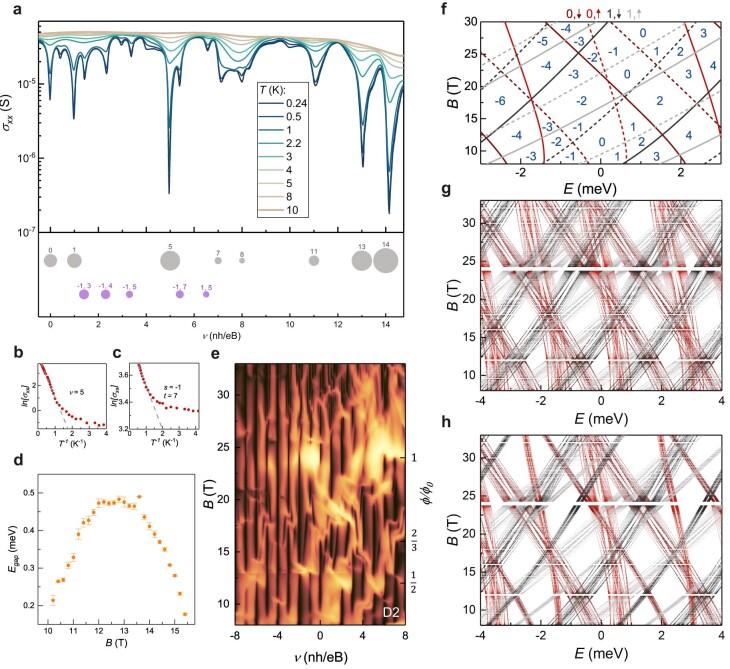
Van der Waals assembly enables the design of electronic states in two-dimensional (2D) materials, often by superimposing a long-wavelength periodic potential on a crystal lattice using moiré superlattices1-9. This twistronics approach has resulted in numerous previously undescribed physics, including strong correlations and superconductivity in twisted bilayer graphene10-12, resonant excitons, charge ordering and Wigner crystallization in transition-metal chalcogenide moiré structures13-18 and Hofstadter's butterfly spectra and Brown-Zak quantum oscillations in graphene superlattices19-22. Moreover, twistronics has been used to modify near-surface states at the interface between van der Waals crystals23,24. Here we show that electronic states in three-dimensional (3D) crystals such as graphite can be tuned by a superlattice potential occurring at the interface with another crystal-namely, crystallographically aligned hexagonal boron nitride. This alignment results in several Lifshitz transitions and Brown-Zak oscillations arising from near-surface states, whereas, in high magnetic fields, fractal states of Hofstadter's butterfly draw deep into the bulk of graphite. Our work shows a way in which 3D spectra can be controlled using the approach of 2D twistronics.
© 2023. The Author(s).
Conflict of interest statement
The authors declare no competing interests.
Figures






References
-
- Ciarrocchi A, Tagarelli F, Avsar A, Kis A. Excitonic devices with van der Waals heterostructures: valleytronics meets twistronics. Nat. Rev. Mater. 2022;7:449–464. doi: 10.1038/s41578-021-00408-7. - DOI
-
- Kennes DM, et al. Moiré heterostructures as a condensed-matter quantum simulator. Nat. Phys. 2021;17:155–163. doi: 10.1038/s41567-020-01154-3. - DOI
LinkOut - more resources
Full Text Sources
