


X-Chromosome Association Study in Latin American Cohorts Identifies New Loci in Parkinson's Disease
- PMID: 37469269
- PMCID: PMC10524402
- DOI: 10.1002/mds.29508
X-Chromosome Association Study in Latin American Cohorts Identifies New Loci in Parkinson's Disease
Abstract
Background: Sex differences in Parkinson's disease (PD) risk are well-known. However, the role of sex chromosomes in the development and progression of PD is still unclear.
Objective: The objective of this study was to perform the first X-chromosome-wide association study for PD risk in a Latin American cohort.
Methods: We used data from three admixed cohorts: (1) Latin American Research consortium on the Genetics of Parkinson's Disease (n = 1504) as discover cohort, and (2) Latino cohort from International Parkinson Disease Genomics Consortium (n = 155) and (3) Bambui Aging cohort (n = 1442) as replication cohorts. We also developed an X-chromosome framework specifically designed for admixed populations.
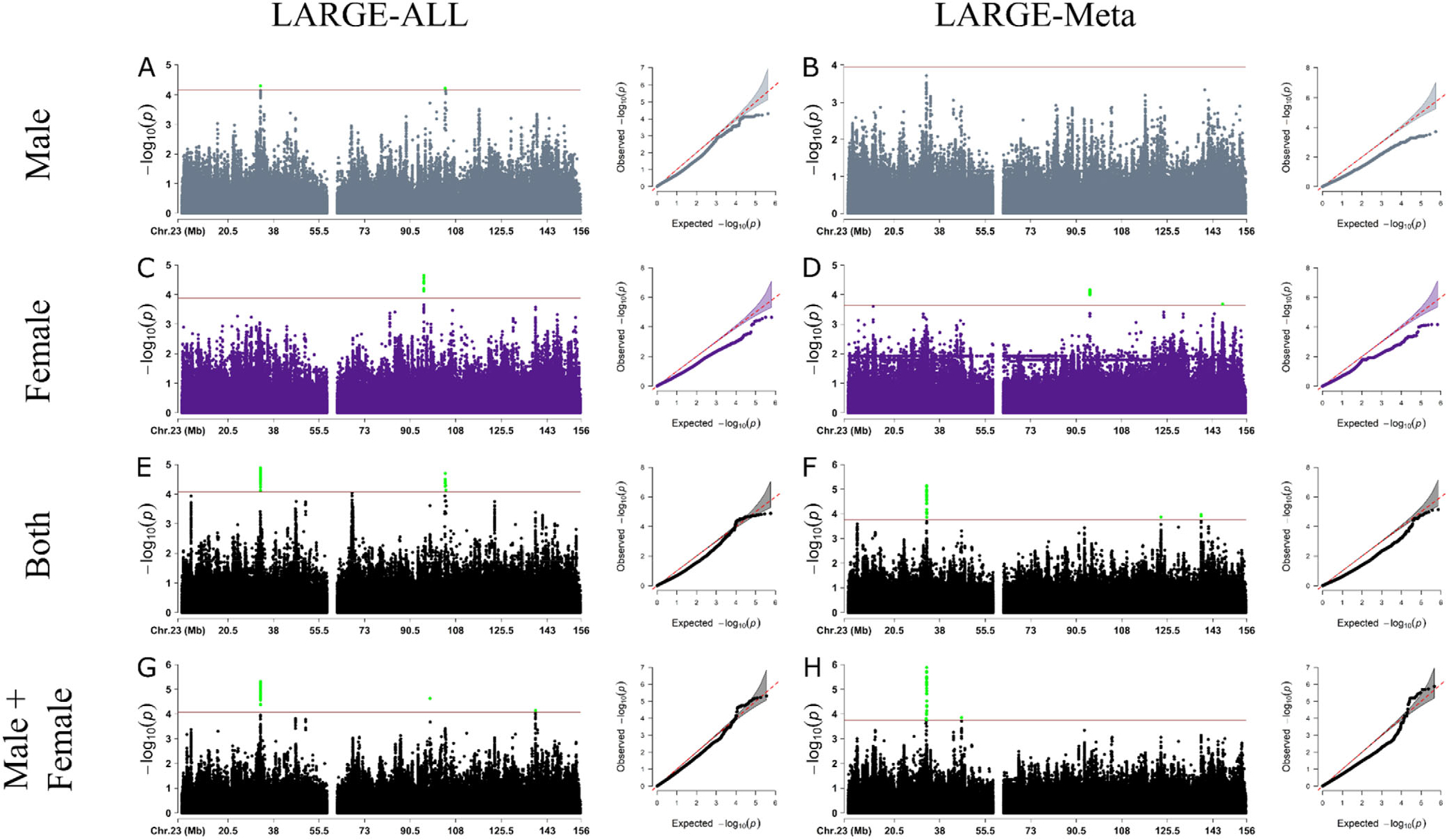
Results: We identified eight linkage disequilibrium regions associated with PD. We replicated one of these regions (top variant rs525496; discovery odds ratio [95% confidence interval]: 0.60 [0.478-0.77], P = 3.13 × 10⁻⁵ replication odds ratio: 0.60 [0.37-0.98], P = 0.04). rs5525496 is associated with multiple expression quantitative trait loci in brain and non-brain tissues, including RAB9B, H2BFM, TSMB15B, and GLRA4, but colocalization analysis suggests that rs5525496 may not mediate risk by expression of these genes. We also replicated a previous X-chromosome-wide association study finding (rs28602900), showing that this variant is associated with PD in non-European populations.
Conclusions: Our results reinforce the importance of including X-chromosome and diverse populations in genetic studies. © 2023 The Authors. Movement Disorders published by Wiley Periodicals LLC on behalf of International Parkinson and Movement Disorder Society.
Keywords: Parkinson's disease; admixed populations; hipanic/latino; underrepresented populations; x-chromosome wide association study.
© 2023 The Authors. Movement Disorders published by Wiley Periodicals LLC on behalf of International Parkinson and Movement Disorder Society.
Conflict of interest statement
Figures
Update of
-
X-Chromosome Association Study in Latin American Cohorts Identifies New Loci in Parkinson Disease.medRxiv [Preprint]. 2023 Feb 2:2023.01.31.23285199. doi: 10.1101/2023.01.31.23285199. medRxiv. 2023. Update in: Mov Disord. 2023 Sep;38(9):1625-1635. doi: 10.1002/mds.29508. PMID: 36778409 Free PMC article. Updated. Preprint.
Comment in
-
X-chromosome variants and PD in Latin America.Nat Rev Neurol. 2023 Sep;19(9):508. doi: 10.1038/s41582-023-00861-8. Nat Rev Neurol. 2023. PMID: 37553389 No abstract available.
References
Publication types
MeSH terms
Grants and funding
LinkOut - more resources
Full Text Sources
Medical
