. 2023 Aug 18;133(5):430-443.
doi: 10.1161/CIRCRESAHA.123.322629. Epub 2023 Jul 20.

Danicamtiv Increases Myosin Recruitment and Alters Cross-Bridge Cycling in Cardiac Muscle

Affiliations

Danicamtiv Increases Myosin Recruitment and Alters Cross-Bridge Cycling in Cardiac Muscle

Kristina B Kooiker et al. Circ Res. .

Abstract

Background: Modulating myosin function is a novel therapeutic approach in patients with cardiomyopathy. Danicamtiv is a novel myosin activator with promising preclinical data that is currently in clinical trials. While it is known that danicamtiv increases force and cardiomyocyte contractility without affecting calcium levels, detailed mechanistic studies regarding its mode of action are lacking.

Methods: Permeabilized porcine cardiac tissue and myofibrils were used for X-ray diffraction and mechanical measurements. A mouse model of genetic dilated cardiomyopathy was used to evaluate the ability of danicamtiv to correct the contractile deficit.

Results: Danicamtiv increased force and calcium sensitivity via increasing the number of myosins in the ON state and slowing cross-bridge turnover. Our detailed analysis showed that inhibition of ADP release results in decreased cross-bridge turnover with cross bridges staying attached longer and prolonging myofibril relaxation. Danicamtiv corrected decreased calcium sensitivity in demembranated tissue, abnormal twitch magnitude and kinetics in intact cardiac tissue, and reduced ejection fraction in the whole organ.

Conclusions: As demonstrated by the detailed studies of Danicamtiv, increasing myosin recruitment and altering cross-bridge cycling are 2 mechanisms to increase force and calcium sensitivity in cardiac muscle. Myosin activators such as Danicamtiv can treat the causative hypocontractile phenotype in genetic dilated cardiomyopathy.

Keywords: calcium; cardiomyopathies; myofibrils; myosin; sarcomeres.


Conflict of interest statement

Disclosures None.

Figures

Figure 1.
Figure 1.
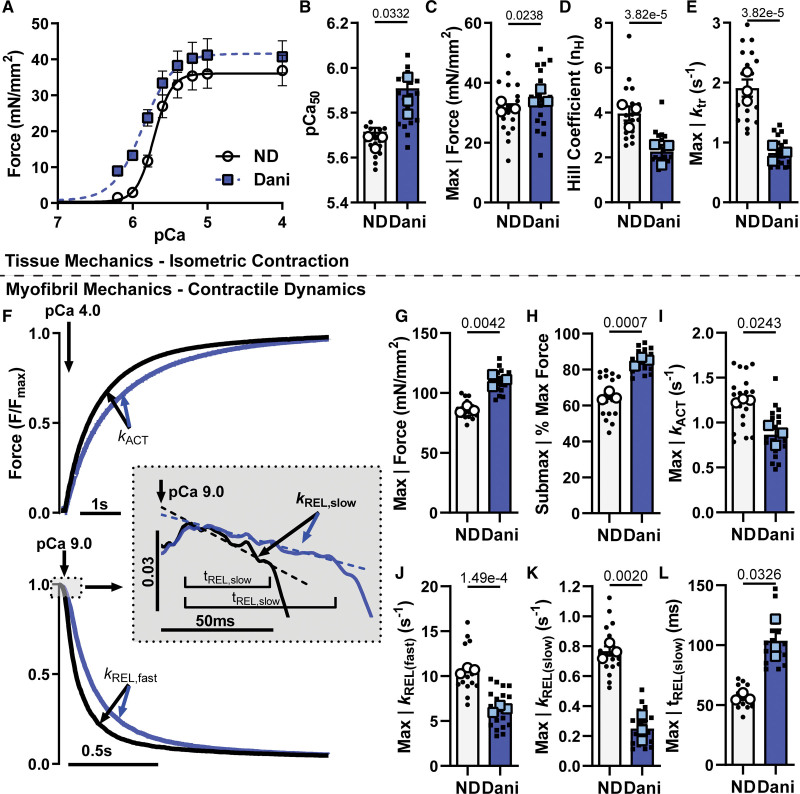
Mechanics in permeabilized porcine cardiac tissue and myofibrils treated with 1 μM Danicamtiv (Dani). A, Force-pCa curves from isolated uniaxially aligned porcine ventricle tissue strips before and after incubation in 1 μM Dani. Summary data for (B) pCa50, (C) max force generation, (D) Hill coefficient, and (E) max kTR. F, Example myofibril mechanics traces at maximum calcium (pCa=4.0) showing activation (top) and relaxation (bottom). Summary myofibril data for (G) max force, (H) sub-max force, rate constants for (I) activation, (J) fast phase of relaxation, and (K) slow phase of relaxation, along with (L) duration of the slow phase of relaxation. Data are from 19 paired demembranated tissue preparations (small symbols) and 18 DMSO or 21 Dani-treated myofibrils (small symbols) from 3 biological replicates (large symbols). P values vs no drug (ND).
Figure 2.
Figure 2.
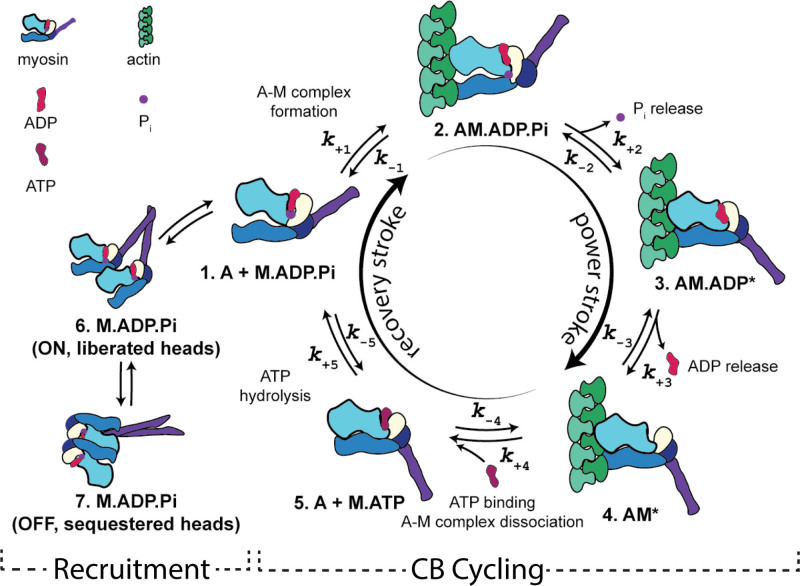
Scheme illustrating a 5-step cross-bridge model of contraction. Figure art by Matthew Childers, University of Washington, 2023, licensed under a Creative Commons Attribution-Non-Commercial 4.0 International License.
Figure 3.
Figure 3.
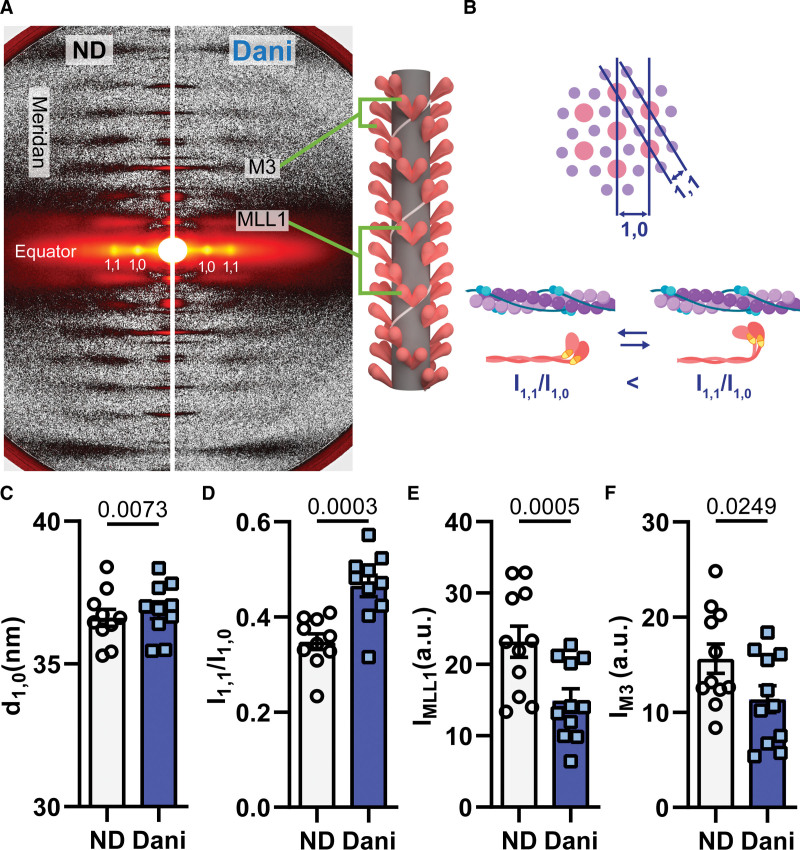
Fifty micromolar Danicamtiv (Dani) partially activated the thick filament in resting cardiac muscle (pCa=8.0). A, Sample X-ray diffraction patterns of demembranated porcine cardiac tissue exposed to X-ray beams while bathed in low calcium solution (pCa=8.0) containing DMSO (left) or Dani (right). B, Schematics defining how actin and myosin relationships relate to equatorial measurements. C, Summary data for lattice spacing (d1,0), (D) intensity ratio of the primary equatorial reflections (I1,1/I1,0), intensity of (E) the first-order myosin-based layer line (IMLL1), and (F) the third-order myosin-based meridional reflection (IM3). Data are from 10 paired tissue preparations. The illustrations were created with BioRender.com. a.u. indicates arbitrary units.
Figure 4.
Figure 4.
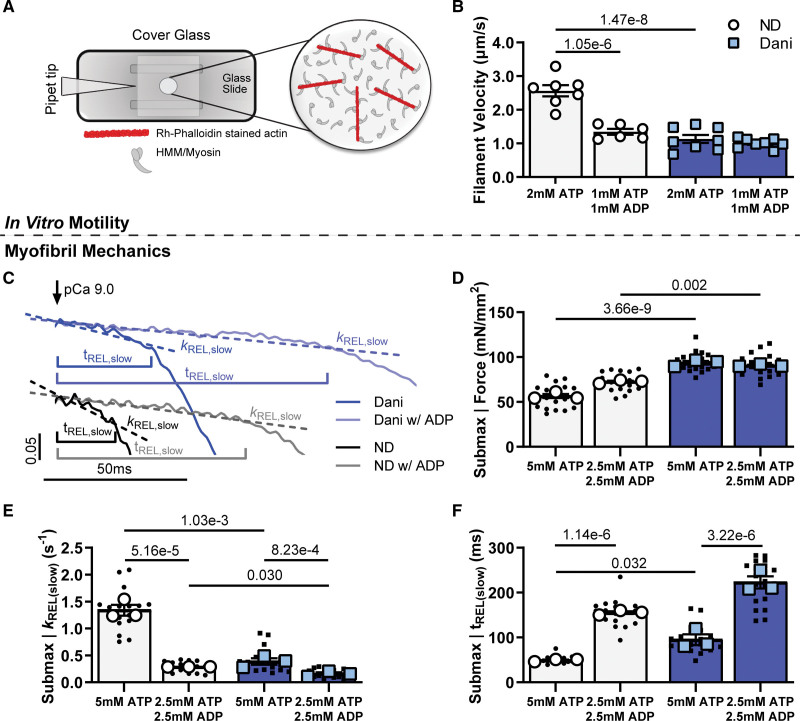
Effect of Danicamtiv (Dani) and ADP on cross-bridge cycling. A, The in vitro motility assay was used to look at cross-bridge cycling in isolated myosin and actin. B, Filament sliding velocity with 0.5 μM Dani-treated ATP-bound myosin (left columns), and with (50:50 ADP:ATP)-bound myosin (right columns). C, Example tracings of the slow phase of myofibril relaxation with and without 1 μM Dani and with ATP or 50:50 ADP:ATP mixture at pCa=5.8. Example tracings are offset for visual clarity. Summary data of the effect of Dani and ADP on (D) submaximal force, and the (E) rate constant and (F) duration for the slow phase of relaxation. Data are from 7 to 8 slides per condition for in vitro motility and 18 DMSO or 21 Dani-treated myofibrils (small symbols) from 3 biological replicates (large symbols).
Figure 5.
Figure 5.
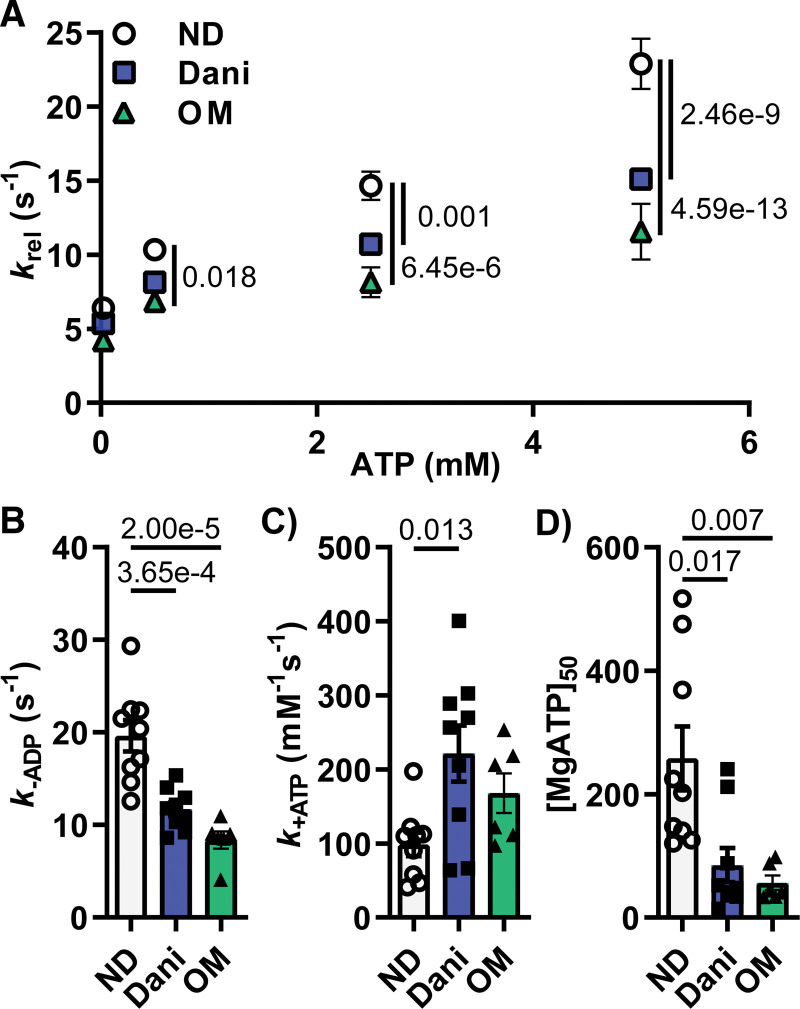
One-micromolar Danicamtiv (Dani) and Omecamtiv Mecarbil (OM) increased ATP binding and decreased ADP release in activated porcine cardiac muscle. A, The cross-bridge detachment rates (krel) increased with increasing [MgATP] for the untreated, Dani-treated and OM-treated myocardial strips. Treatment with both Dani and OM decreased krel at [MgATP] >0.5 mmol/L (B). Dani and OM decreased ADP release rate (B, k-ADP) while increasing ATP binding (C, k+ATP). MgATP concentration at half-maximal detachment rate ([MgATP]50) was lower for both Dani-treated and OM-treated strips (D). Data are from 9 tissue preparations per condition.
Figure 6.
Figure 6.
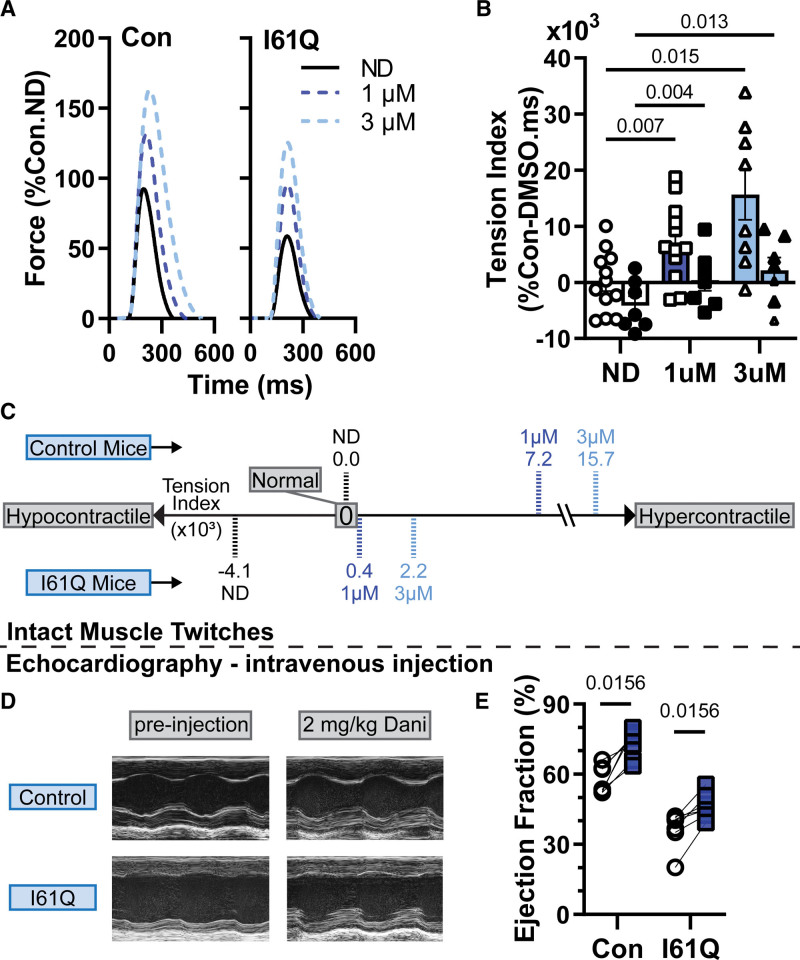
Danicamtiv (Dani) mitigated the contractile abnormalities in a rodent dilated cardiomyopathy model. A, Average twitch force-time traces (in % control-ND Tp) of intact papillary muscle trabeculae from control (left) and I61Q cTnC (cardiac troponin C; right) mice stimulated at 1 Hz. Dani increased Tp (A) and tension index (B and C) in control and I61Q cTnC twitches in a dose-dependent manner. C, Intravenous injection of 2 mg/kg Dani resulted in significant increase in ejection in both control and I61Q cTnC hearts 10-minute post-injection. Data are from 15 control mice and 11 I61Q mice for intact twitches and 7 mice for in each echo group.

Update of

Comment in

References

    1. Tsao CW, Aday AW, Almarzooq ZI, Anderson CAM, Arora P, Avery CL, Baker-Smith CM, Beaton AZ, Boehme AK, Buxton AE, et al. Heart Disease and Stroke Statistics-2023 Update: A Report From the American Heart Association. Circulation. 2023;147:e93–e621. doi: 10.1161/CIR.0000000000001123 - PMC - PubMed
    1. Shah KS, Xu H, Matsouaka RA, Bhatt DL, Heidenreich PA, Hernandez AF, Devore AD, Yancy CW, Fonarow GC. Heart failure with preserved, borderline, and reduced ejection fraction: 5-year outcomes. J Am Coll Cardiol. 2017;70:2476–2486. doi: 10.1016/j.jacc.2017.08.074 - PubMed
    1. Maack C, Eschenhagen T, Hamdani N, Heinzel FR, Lyon AR, Manstein DJ, Metzger J, Papp Z, Tocchetti CG, Yilmaz MB, et al. Treatments targeting inotropy. Eur Heart J. 2019;40:3626–3644. doi: 10.1093/eurheartj/ehy600 - PMC - PubMed
    1. Teerlink JR, Metra M, Zaca V, Sabbah HN, Cotter G, Gheorghiade M, Cas LD. Agents with inotropic properties for the management of acute heart failure syndromes. Traditional agents and beyond. Heart Fail Rev. 2009;14:243–253. doi: 10.1007/s10741-009-9153-y - PMC - PubMed
    1. Malik FI, Hartman JJ, Elias KA, Morgan BP, Rodriguez H, Brejc K, Anderson RL, Sueoka SH, Lee KH, Finer JT, et al. Cardiac myosin activation: a potential therapeutic approach for systolic heart failure. Science. 2011;331:1439–1443. doi: 10.1126/science.1200113 - PMC - PubMed

Publication types