


Comparison of Left Ventricular Global Longitudinal Strain with Ejection Fraction as a Predictor for Peri-operative IABP Insertion in Patients Undergoing Off-Pump Coronary Artery Bypass Grafting: A Pilot Study
- PMID: 37470528
- PMCID: PMC10451142
- DOI: 10.4103/aca.aca_144_22
Comparison of Left Ventricular Global Longitudinal Strain with Ejection Fraction as a Predictor for Peri-operative IABP Insertion in Patients Undergoing Off-Pump Coronary Artery Bypass Grafting: A Pilot Study
Abstract
Background: Prophylactic use of intra-aortic balloon pump (IABP) mainly depends on left ventricular (LV) systolic function. Global longitudinal strain (GLS) is a robust prognostic parameter for LV strain. It has proved to be more sensitive than LV ejection fraction (EF) as a measure of LV systolic function and is a strong predictor of outcome.
Aim: To determine whether GLS can be used as a reliable marker and its cut-off value for IABP insertion in patients undergoing elective off-pump coronary artery bypass grafting (OPCABG).
Settings and design: A prospective observational clinical study which included 100 adult patients scheduled for elective OPCABG.
Materials and methods: Two-dimensional (2D) speckle tracking echocardiography (STE)-estimated GLS was computed and compared with LV EF measured by three dimensional (3D) echocardiography for the insertion of IABP. The intensive care unit (ICU) parameters were correlated with echocardiographic parameters to predict early post-operative outcome.
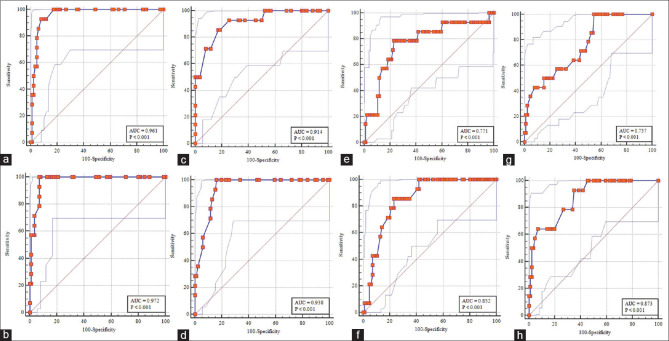
Results: IABP insertion correlates better with GLS (post-revascularization > pre-revascularization) than with 3D LV EF. Receiver operating characteristic (ROC) curve analysis revealed the highest area under the curve (AUC, 0.972) with a cut-off value of > -9.8% for GLS compared to 3D LV EF (AUC, 0.938) with a cut-off value of ≤ 44%. ICU parameters show better correlation with E/e'> GLS > WMSI than 3D LV EF.
Conclusion: GLS is a better predictor of IABP insertion compared to 3D LV EF in patients undergoing OPCABG.
Keywords: Ejection fraction; global longitudinal strain; intra-aortic balloon pump; low cardiac output state; off-pump coronary artery bypass grafting; trans-esophageal echocardiography.
Conflict of interest statement
There are no conflicts of interest.
Figures

References
-
- Kantrowitz A, Tjønneland S, Freed PS, Phillips SJ, Butner AN, Sherman JL., Jr Initial clinical experience with intraaortic balloon pumping in cardiogenic shock. JAMA. 1968;203:113–8. - PubMed
-
- Kolh P, Windecker S, Alfonso F, Collet J, Cremer J, Falk V, et al. 2014 ESC/EACTS guidelines on myocardial revascularization: the task force on myocardial revascularization of the European Society of Cardiology (ESC) and the European Association for Cardio-Thoracic Surgery (EACTS) developed with the special contribution of the European Association of Percutaneous Cardiovascular Interventions (EAPCI) Eur Heart J. 2014;46:517–92. - PubMed
-
- Ding W, Ji Q, Wei Q, Shi Y, Ma R, Wang C. Prophylactic application of an intra-aortic balloon pump in high-risk patients undergoing off-pump coronary artery bypass grafting. Cardiology. 2015;131:109–15. - PubMed
-
- Hanlon-Pena PM, Quaal SJ. Intra-aortic balloon pump timing: Review of evidence supporting current practice. Am J Crit Care. 2011;20:323–33. - PubMed
-
- De Silva K, Lumley M, Kailey B, Alastruey J, Guilcher A, Asrress KN, et al. Coronary and microvascular physiology during intra-aortic balloon counterpulsation. JACC Cardiovasc Interv. 2014;7:631–40. - PubMed
Publication types
MeSH terms
LinkOut - more resources
Full Text Sources
Research Materials
Miscellaneous
