. 2023 Nov-Dec;34(8):2246-2251.
doi: 10.1097/SCS.0000000000009542. Epub 2023 Jul 20.

Clinical Outcomes After Cranioplasty With Titanium Mesh, Polyetheretherketone, or Composite Bone Cement: A Retrospective Study

Affiliations

Clinical Outcomes After Cranioplasty With Titanium Mesh, Polyetheretherketone, or Composite Bone Cement: A Retrospective Study

Kui Chen et al. J Craniofac Surg. 2023 Nov-Dec.

Abstract

Cranioplasty is a common neurosurgical procedure; however, the optimal material choice remains controversial. At the time of this writing, autologous bone, the preferred choice for primary cranioplasty, has a high incidence of complications such as infection and resorption, thus requiring frequent use of synthetic materials. Therefore, this study aimed to compare the clinical benefits of titanium mesh (Ti), polyetheretherketone (PEEK), and composite bone cement (CBC) in cranioplasty to provide a clear selection basis for clinicians and patients. This study retrospectively collected data from 207 patients who underwent cranioplasty with Ti (n=129), PEEK (n=54), and CBC (n=24) between January 2018 and December 2020 at Henan Provincial People's Hospital. Postoperative follow-up information after 6 months was used to compare the long-term effects of the 3 materials on the patients. There were no significant differences in the overall complication rate after cranioplasty among the 3 materials. However, subcutaneous effusion was more frequent with PEEK (24.07%) and CBC (20.83%) than with Ti (2.33%). Second, there were no significant differences in the increase in Glasgow Outcome Scale and Karnofsky Performance Status scores after cranioplasty among the 3 materials. Finally, we found that PEEK had the highest patient satisfaction and hospitalization cost, whereas the opposite was true for Ti. Although the surgical outcomes of the 3 implant materials were similar, an examination of clinical outcomes such as patient satisfaction showed significant differences, deepening people's perceptions of the 3 materials.


Conflict of interest statement

The authors report no conflicts of interest.

Figures

FIGURE 1
FIGURE 1
(A) Ti was covered over the area of the defect. (B and C) PEEK and CBC are embedded in the area of the defect. CBC indicates composite bone cement; PEEK, polyetheretherketone.
FIGURE 2
FIGURE 2
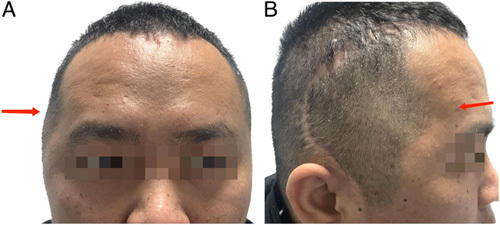
(A and B) The patient developed atrophy of the temporal muscles within 6 months of cranioplasty. A and B are the frontal and lateral aspects of temporal muscle atrophy, respectively. This patient had mild temporal muscle atrophy with a satisfaction score of 4.
FIGURE 3
FIGURE 3
(A–C) Implant exposure due to foreign body rejection and poor scalp healing.
FIGURE 4
FIGURE 4
(A) The postoperative GOS and KPS scores of Ti were significantly higher than those of preoperative. (B) The postoperative GOS and KPS scores of PEEK were significantly higher than those of preoperative. (C) The postoperative GOS and KPS scores of CBC were significantly higher than those of preoperative. (D and E) GOS and KPS score of postoperative Increase. There was no significant difference in the increased GOS and KPS scores after surgery between the 3 materials. Notes: “*” indicates P<0.05. “**” indicates P<0.01. “****” indicates P<0.001. “ns” indicates no significant difference. GOS indicates Glasgow Outcome Scale; KPS, Karnofsky Performance Status; PEEK, polyetheretherketone.
FIGURE 5
FIGURE 5
(A) Comparison of postoperative satisfaction scores of 3 groups of patients. Postoperative satisfaction scores were significantly higher for PEEK than Ti and CBC, and there was no significant difference between Ti and CBC. (B) Comparison of hospitalization expenses of 3 groups of patients. PEEK had the greatest hospitalization cost, intermediate CBC, and the least Ti. Notes: “*” indicates P<0.05. “**” indicates P<0.01. “****” indicates P<0.001.CBC indicates composite bone cement; ns, no significant difference; PEEK, polyetheretherketone.

References

    1. Andrabi SM, Sarmast AH, Kirmani AR, et al. Cranioplasty: indications, procedures, and outcome—an institutional experience. Surg Neurol Int 2017;8:91 - PMC - PubMed
    1. Cho YJ, Kang SH. Review of cranioplasty after decompressive craniectomy. Korean J Neurotrauma 2017;13:9–14 - PMC - PubMed
    1. Safi S, Ali A, Abdelhafez I, et al. Predictors of clinical outcomes in autologous cranioplasty. World Neurosurg 2022;167:e561–e566 - PubMed
    1. Sveikata L, Vasung L, El RA, et al. Syndrome of the trephined: clinical spectrum, risk factors, and impact of cranioplasty on neurologic recovery in a prospective cohort. Neurosurg Rev 2022;45:1431–1443 - PMC - PubMed
    1. Corallo F, Lo BV, Calabro RS, et al. Can cranioplasty be considered a tool to improve cognitive recovery following traumatic brain injury? A 5-years retrospective study. J Clin Med 2021;10:5437 - PMC - PubMed