


Structural and microstructural thalamocortical network disruption in sporadic behavioural variant frontotemporal dementia
- PMID: 37473493
- PMCID: PMC10371821
- DOI: 10.1016/j.nicl.2023.103471
Structural and microstructural thalamocortical network disruption in sporadic behavioural variant frontotemporal dementia
Abstract
Background: Using multi-block methods we combined multimodal neuroimaging metrics of thalamic morphology, thalamic white matter tract diffusion metrics, and cortical thickness to examine changes in behavioural variant frontotemporal dementia. (bvFTD).
Method: Twenty-three patients with sporadic bvFTD and 24 healthy controls underwent structural and diffusion MRI scans. Clinical severity was assessed using the Clinical Dementia Rating scale and behavioural severity using the Frontal Behaviour Inventory by patient caregivers. Thalamic volumes were manually segmented. Anterior and posterior thalamic radiation fractional anisotropy and mean diffusivity were extracted using Tract-Based Spatial Statistics. Finally, cortical thickness was assessed using Freesurfer. We used shape analyses, diffusion measures, and cortical thickness as features in sparse multi-block partial least squares (PLS) discriminatory analyses to classify participants within bvFTD or healthy control groups. Sparsity was tuned with five-fold cross-validation repeated 10 times. Final model fit was assessed using permutation testing. Additionally, sparse multi-block PLS was used to examine associations between imaging features and measures of dementia severity.
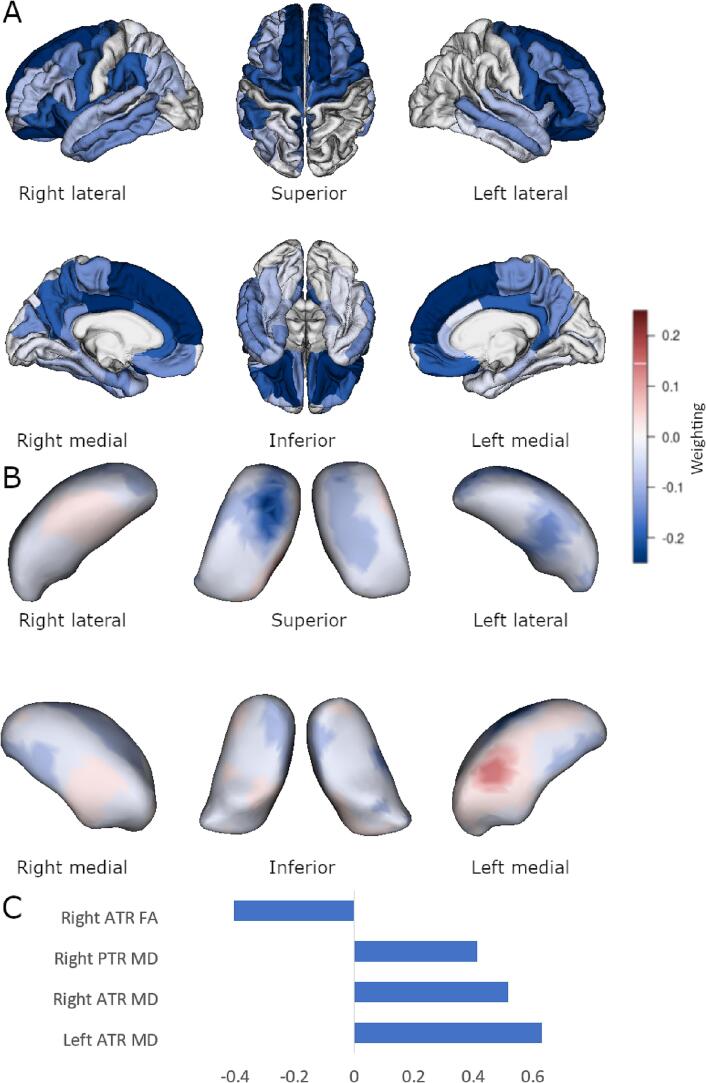
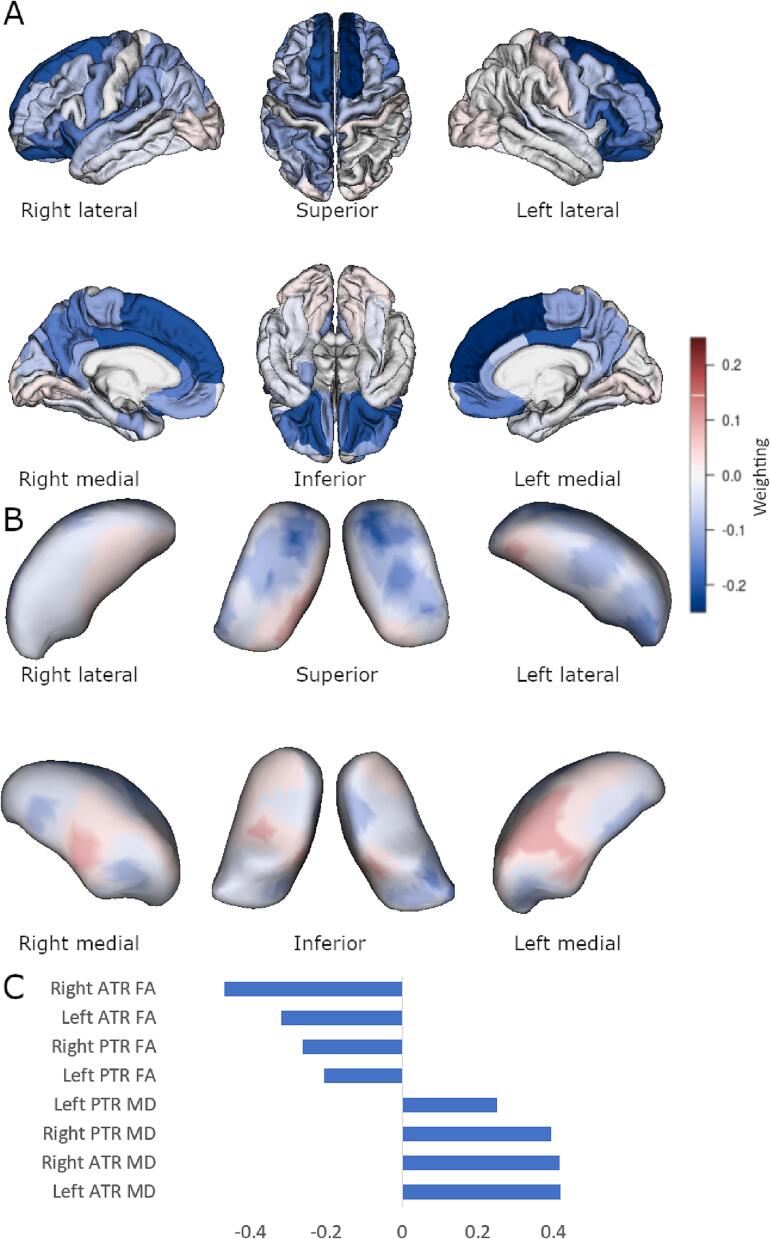
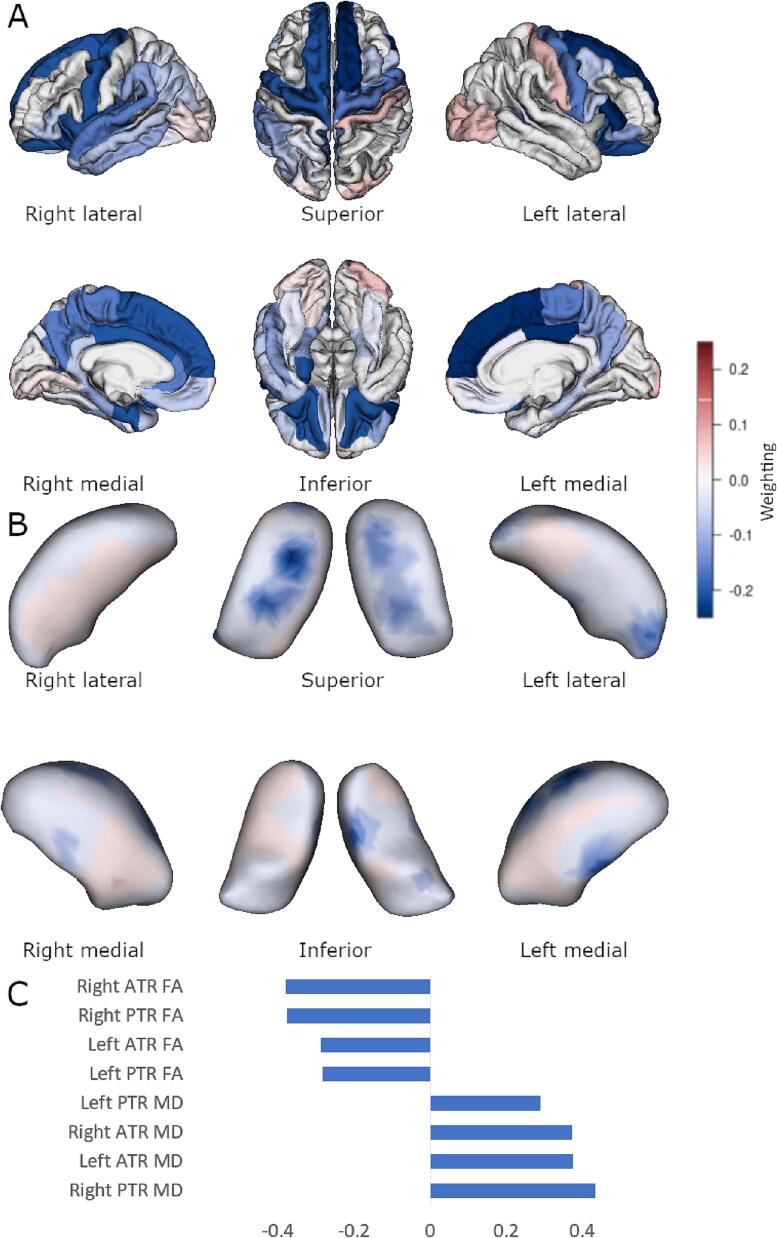
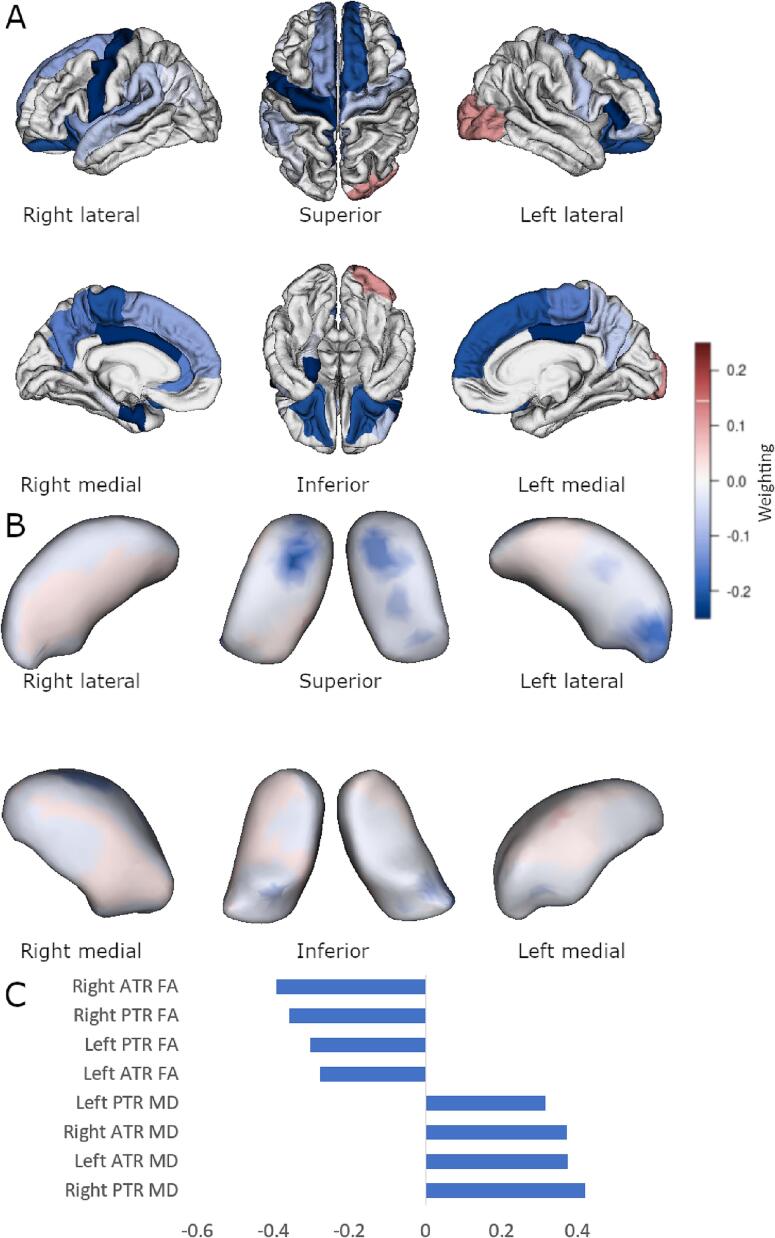
Results: Bilateral anterior-dorsal thalamic atrophy, reduction in mean diffusivity of thalamic projections, and frontotemporal cortical thinning, were the main features predicting bvFTD group membership. The model had a sensitivity of 96%, specificity of 68%, and was statistically significant using permutation testing (p = 0.012). For measures of dementia severity, we found similar involvement of regional thalamic and cortical areas as in discrimination analyses, although more extensive thalamo-cortical white matter metric changes.
Conclusions: Using multimodal neuroimaging, we demonstrate combined structural network dysfunction of anterior cortical regions, cortical-thalamic projections, and anterior thalamic regions in sporadic bvFTD.
Keywords: Behavioural variant frontotemporal dementia; Diffusion; MRI; Partial least squares; Shape analysis.
Copyright © 2023. Published by Elsevier Inc.
Conflict of interest statement
Declaration of Competing Interest The authors declare that they have no known competing financial interests or personal relationships that could have appeared to influence the work reported in this paper.
Figures
References
-
- Avants B.B., Libon D.J., Rascovsky K., Boller A., McMillan C.T., Massimo L., Coslett H.B., Chatterjee A., Gross R.G., Grossman M. Sparse canonical correlation analysis relates network-level atrophy to multivariate cognitive measures in a neurodegenerative population. Neuroimage. 2014;84:698–711. doi: 10.1016/j.neuroimage.2013.09.048. - DOI - PMC - PubMed
-
- Bede P., Omer T., Finegan E., Chipika R.H., Iyer P.M., Doherty M.A., Vajda A., Pender N., McLaughlin R.L., Hutchinson S., Hardiman O. Connectivity-based characterisation of subcortical grey matter pathology in frontotemporal dementia and ALS: A multimodal neuroimaging study. Brain Imaging Behav. 2018;12(6):1696–1707. doi: 10.1007/s11682-018-9837-9. - DOI - PubMed
-
- Behrens T.E.J., Johansen-Berg H., Woolrich M.W., Smith S.M., Wheeler-Kingshott C.A.M., Boulby P.A., Barker G.J., Sillery E.L., Sheehan K., Ciccarelli O., Thompson A.J., Brady J.M., Matthews P.M. Non-invasive mapping of connections between human thalamus and cortex using diffusion imaging. Nat. Neurosci. 2003;6(7):750–757. - PubMed
Publication types
MeSH terms
LinkOut - more resources
Full Text Sources
