


Manchester Intermittent and Daily diet Type 1 Diabetes App Study (MIDDAS-Type 1): protocol for a randomised feasibility trial of an intermittent and continuous low-energy diet in patients with type 1 diabetes and overweight and obesity
- PMID: 37474169
- PMCID: PMC10360425
- DOI: 10.1136/bmjopen-2022-071395
Manchester Intermittent and Daily diet Type 1 Diabetes App Study (MIDDAS-Type 1): protocol for a randomised feasibility trial of an intermittent and continuous low-energy diet in patients with type 1 diabetes and overweight and obesity
Abstract
Introduction: Rising levels of overweight and obesity among people with type 1 diabetes (T1D) contribute to insulin resistance, dyslipidaemia, retinopathy, cardiometabolic complications and psychological morbidity. Continuous low-energy diets (CLED) providing approximately 800 kcal (3347 kJ)/day can produce significant weight loss in type 2 diabetes, and intermittent low-energy diets (ILED) may be an alternative. The Manchester Intermittent and Daily diet Type 1 Diabetes App Study (MIDDAS-Type 1) aims to assess the safety, acceptability and feasibility of remotely delivered ILED and CLED programmes for people with T1D and overweight and obesity.
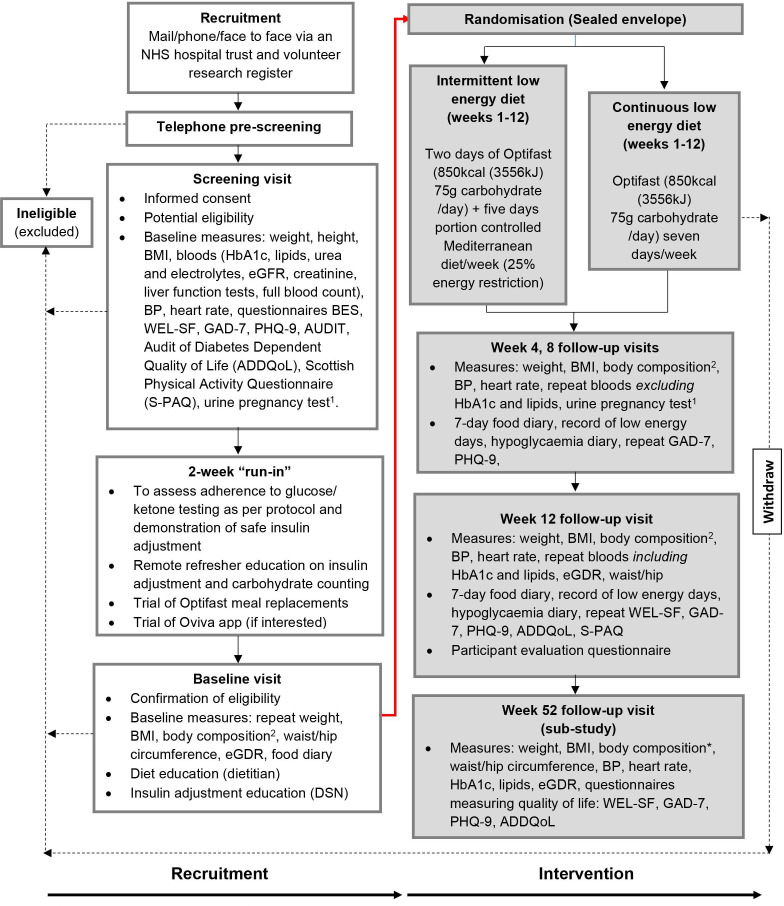
Methods and analysis: Twelve participants with T1D and body mass index ≥27.5 kg/m2 (≥25 kg/m2 in high-risk ethnic minorities) recruited from an National Health Service (NHS) trust and research register in England will be randomised to a remotely delivered CLED (n=6) or ILED (n=6) for 12 weeks. The CLED includes a daily Optifast 850 kcal (3556 kJ) 75 g carbohydrate formula diet. The ILED includes 2 days/week of Optifast and 5 days of a portion-controlled Mediterranean diet (170-250 g carbohydrate/day). Both groups will receive matched high-frequency remote support from a dietitian, nurse and psychologist via telephone and/or the Oviva app. The primary outcome will assess safety (occurrence of severe hypoglycaemia, ketonaemia, ketoacidosis and time above and below target blood glucose). Secondary outcomes include study uptake, retention, dietary adherence, acceptability, intervention delivery fidelity and potential efficacy in relation to change in weight, insulin requirements, glycated haemoglobin, lipids, insulin resistance (estimated glucose disposal rate) and quality of life. Participants will be invited for optional repeat measurements at 52 weeks.
Ethics and dissemination: The trial protocol (V4.0/08.06.2022) was granted ethical approval by Cambridge East Research Ethics Committee (Ref: 21/EE/0014). The study will inform progression to a full-scale randomised controlled trial to test the efficacy of these programmes for patients with T1D and overweight and obesity.
Trial registration number: NCT04674384; Pre-results.
Keywords: clinical trials; diabetes & endocrinology; nutrition & dietetics.
© Author(s) (or their employer(s)) 2023. Re-use permitted under CC BY-NC. No commercial re-use. See rights and permissions. Published by BMJ.
Conflict of interest statement
Competing interests: None declared.
Figures
References
-
- JDRF. n.d. Available: https://jdrf.org.uk/information-support/about-type-1-diabetes/facts-and-...
-
- Nathan DM, Zinman B, Cleary PA, et al. . Diabetes control and complications trial, epidemiology of diabetes interventions and complications (DCCT/EDIC) research group. modern-day clinical course of type 1 diabetes mellitus after 30 years’ duration: the diabetes control and complications trial/epidemiology of diabetes interventions and complications and Pittsburgh epidemiology of diabetes complications experience (1983-2005). Arch Intern Med 2009;169:1307. 10.1001/archinternmed.2009.193 - DOI - PMC - PubMed
Publication types
MeSH terms
Substances
Associated data
Grants and funding
LinkOut - more resources
Full Text Sources
Medical
